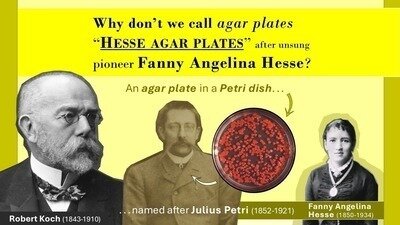

Call them “Hesse agar plates” after the discoverer, Fanny Angelina Hesse!
The Issue
As we call “Petri dishes” after Julius Petri… shouldn’t we call agar plates after Fanny Angelina Hesse? Let’s call them “Hesse Agar Plates”!
Did you know that tens of thousands of researchers, students, and clinicians grow microorganisms daily using “agar plates”, perhaps unaware of the pioneer who introduced this crucial substance to the laboratory? That person was Fanny Angelina Hesse (1850-1934).
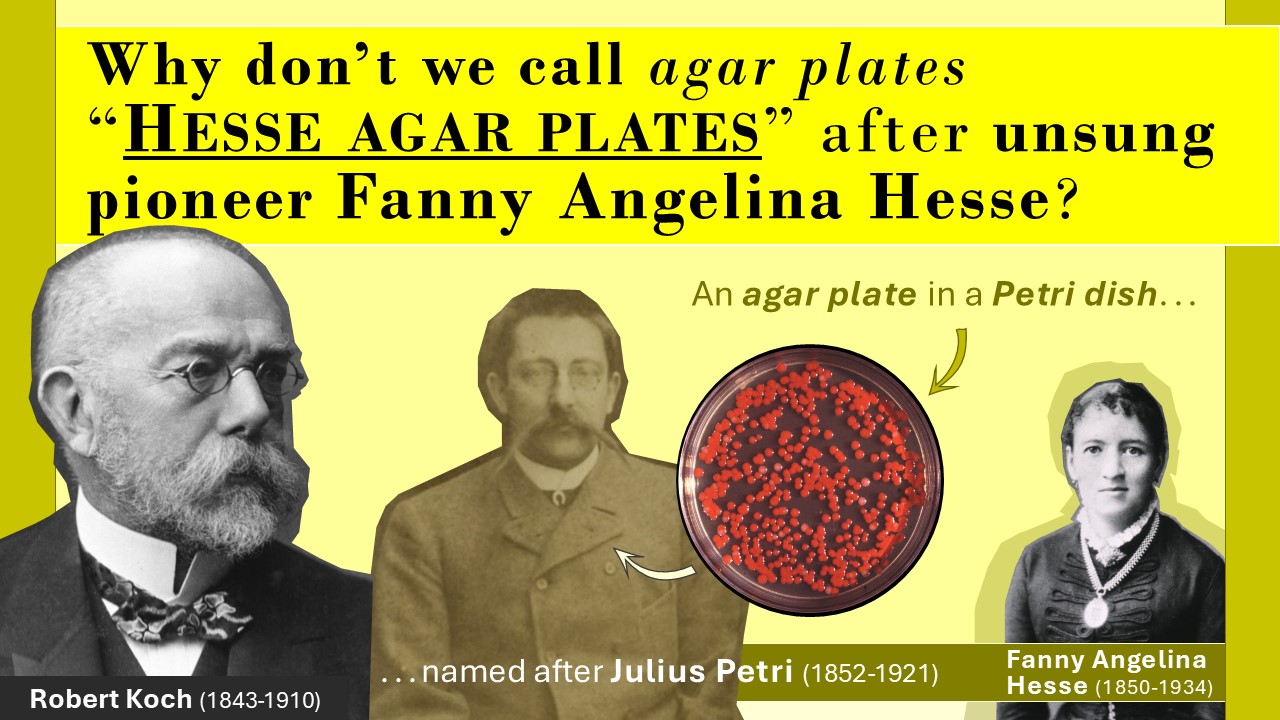
“Agar plates” are prepared by pouring agar dissolved in a hot nutrient broth into “Petri dishes” named after Julius Richard Petri (1852-1921). Together, agar plates and Petri dishes are essential in the technique known as “Koch’s plating technique” (a.k.a. “culture-plate method”) after physician Robert Koch (1843-1910).
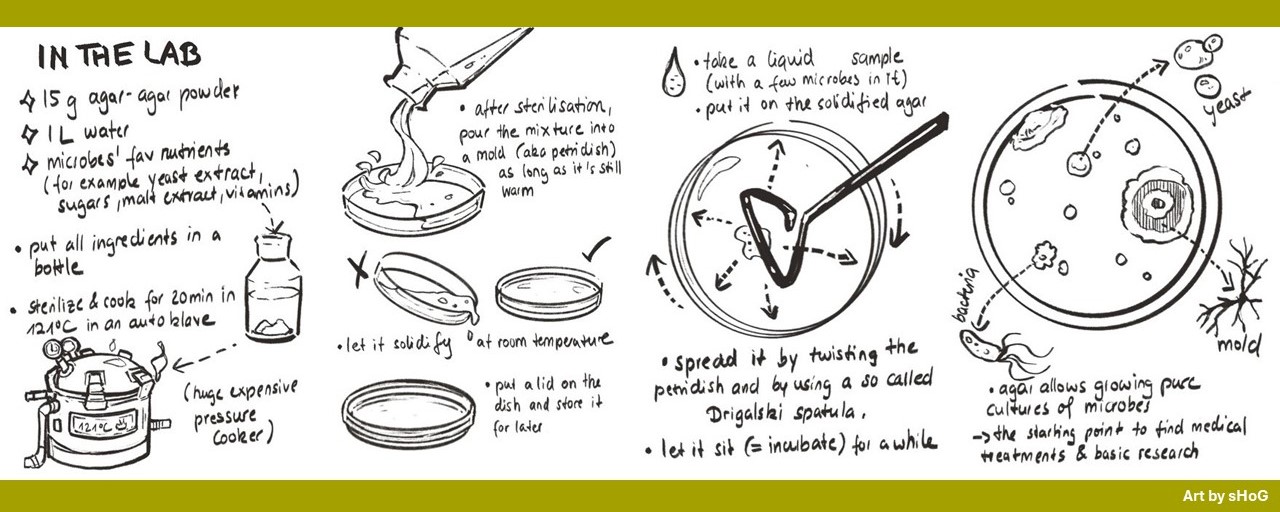
☝🏽 How to prepare and use agar plates in the lab (art by sHoG a.k.a. Dr. Stephanie Herzog).
And so, while Koch’s and Petri’s names are immortalized in eponymous inventions, not many people can name Fanny Angelina Hesse, even though agar is today a substance of paramount importance in medicine and research.
Fanny Angelina Hesse revolutionized microbiology but is largely forgotten (read also in Smithsonian Magazine*). Even reputable sources often misattribute the discovery of agar to Robert Koch, including The Lancet and the website of the Nobel Prize(**).
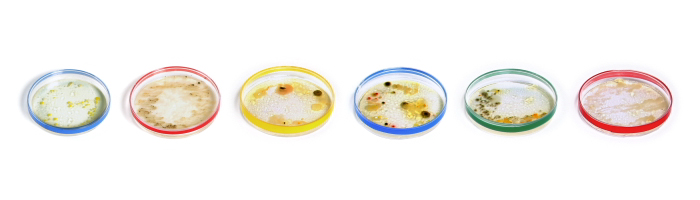
☝🏽 Even though not many people might know Julius Petri, his name is remembered with the eponymous “Petri dishes” as for example in this Google Doodle celebrating his 161st birthday on 31 May 2013.
The suggestion is simple: “agar plates” could be called “Hesse agar plates” to pay tribute to Fanny Angelina Hesse, akin to “Petri dishes” called after Julius Richard Petri.
Sadly, many textbooks still do not mention Fanny Angelina Hesse (watch also the short video recorded at the annual meeting of the American Society for Microbiology***) and hence perpetuate the trend of downplaying the role of women in the history of science.
Everyone resontating with the initative is encouraged to sign this petition. Many signatories can show educators, publishers, key opinion leaders, science communicators, influencers, life science organizations, scientific editors and authors that there is a strong, grassroot support for this initiative, with the hope that they will act as amplifiers.
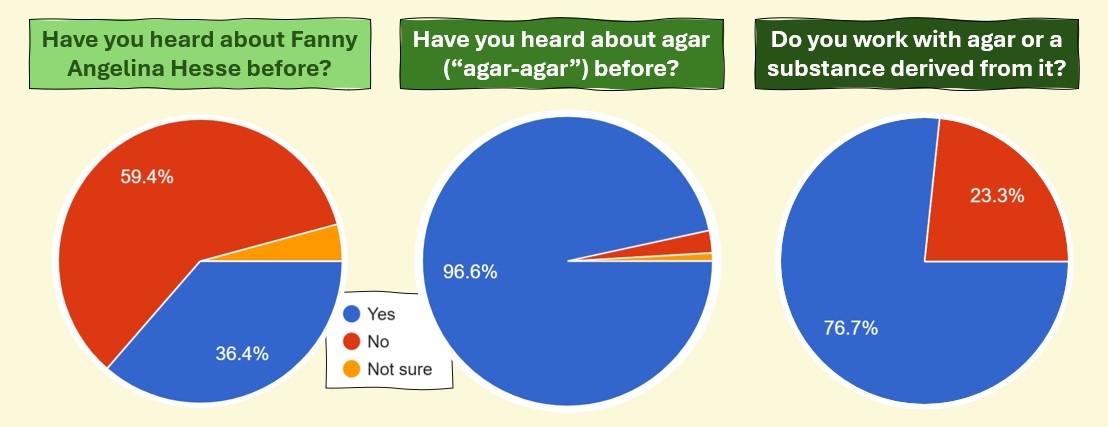
☝🏽 A short survey filled by ~500 respondents, many of which work or have worked with agar, shows that a large percentage of them never heard of Fanny Angelina Hesse (survey link available below****).
This initiative could be declared a success if textbooks will start mentioning “Hesse agar plates”. The goal is ambitious and can only achieve with the help of many signatories. Please support our initiative by sharing and signing this petition!
Acting together, we can pay tribute to Fanny Angelina Hesse’s unsung contribution to science and medicine!
Hashtags: #HesseAgarPlates #JustLikePetri
PS If you are an author of scientific articles, you can have an impact by formally designating “agar plates” as “Hesse agar plates” in the Materials & Methods section of your publication!
PPS If you are not familiar with agar (or the derivate substance, agarose), or why it is such an important substance for science and medicine, you can read more in the article below.(*****)
Further readings:
(*)“Meet the Forgotten Woman Who Revolutionized Microbiology With a Simple Kitchen Staple”, Smithsonian Magazine, June 2024: https://www.smithsonianmag.com/history/meet-the-forgotten-woman-who-revolutionized-microbiology-with-a-simple-kitchen-staple-180984572/
(**)Even reputable sources fail to attribute the introduction of agar to Fanny Angelina Hesse: see for example this article from 2014 in The Lancet Respiratory Medicine 2:264-265 (doi: 10.1016/S2213-2600(14)70018-9) or the biographical sketch of Robert Koch on the website of the Nobel Prize (https://www.nobelprize.org/prizes/medicine/1905/koch/biographical/
(***)“Fanny Angelina Hesse and the Discovery of Agar”, a short presentation by David Westenberg at ASM Microbe 2025 in Los Angeles, California, on 22 June 2025: https://www.youtube.com/watch?v=qyTjqIKTQLo
(****)You can access and fill in the survey “Do you know who dsicvoered agar?” at this link (Google Form): https://docs.google.com/forms/d/1N3duKJe33cxBD0BjNM-d5M-zs8uKSAT_O03VEUb7c_M
(*****)“The Origins of Agar”, Asimov Press, February 2026: https://www.asimov.press/p/agar
FAQ:
Q: Does it mean we shouldn't call “Petri dishes” as such?
A: Absolutely not. This initiative arises from the feeling that Fanny Angelina Hesse deserves equal recognition!
Q: Does it mean that everyone has to call them “Hesse agar plates”?
A: Certainly not! This iniative is to spark change, not to discipline nor preach.
Q: When can this iniative be considered a success?
Broadly speaking, this initiative can be considered a success when Fanny Angelina Hesse is universally recognized as the person who introduced agar to the laboratory; this goals cannot measured! In practice, if authors of textbooks and scientific articles will start to mention "Hesse agar plates" this initiative could be considered a success...
Q: Why shouldn't they be called just “Hesse plates”?
A: To avoid confusion, it's best to add the prefix “Hesse” without loosing the term “agar”! The name change is relatively minor, with the only addition of the gender-neutral prefix “Hesse” to help sparking curiosity without adding confusion.
Q: How is “Hesse” pronounced?
A: In English-speaking areas, it is often pronounced hɛs (“HESS”) or hɛsə (“HESS-uh”).

11
The Issue
As we call “Petri dishes” after Julius Petri… shouldn’t we call agar plates after Fanny Angelina Hesse? Let’s call them “Hesse Agar Plates”!
Did you know that tens of thousands of researchers, students, and clinicians grow microorganisms daily using “agar plates”, perhaps unaware of the pioneer who introduced this crucial substance to the laboratory? That person was Fanny Angelina Hesse (1850-1934).
“Agar plates” are prepared by pouring agar dissolved in a hot nutrient broth into “Petri dishes” named after Julius Richard Petri (1852-1921). Together, agar plates and Petri dishes are essential in the technique known as “Koch’s plating technique” (a.k.a. “culture-plate method”) after physician Robert Koch (1843-1910).
☝🏽 How to prepare and use agar plates in the lab (art by sHoG a.k.a. Dr. Stephanie Herzog).
And so, while Koch’s and Petri’s names are immortalized in eponymous inventions, not many people can name Fanny Angelina Hesse, even though agar is today a substance of paramount importance in medicine and research.
Fanny Angelina Hesse revolutionized microbiology but is largely forgotten (read also in Smithsonian Magazine*). Even reputable sources often misattribute the discovery of agar to Robert Koch, including The Lancet and the website of the Nobel Prize(**).
☝🏽 Even though not many people might know Julius Petri, his name is remembered with the eponymous “Petri dishes” as for example in this Google Doodle celebrating his 161st birthday on 31 May 2013.
The suggestion is simple: “agar plates” could be called “Hesse agar plates” to pay tribute to Fanny Angelina Hesse, akin to “Petri dishes” called after Julius Richard Petri.
Sadly, many textbooks still do not mention Fanny Angelina Hesse (watch also the short video recorded at the annual meeting of the American Society for Microbiology***) and hence perpetuate the trend of downplaying the role of women in the history of science.
Everyone resontating with the initative is encouraged to sign this petition. Many signatories can show educators, publishers, key opinion leaders, science communicators, influencers, life science organizations, scientific editors and authors that there is a strong, grassroot support for this initiative, with the hope that they will act as amplifiers.
☝🏽 A short survey filled by ~500 respondents, many of which work or have worked with agar, shows that a large percentage of them never heard of Fanny Angelina Hesse (survey link available below****).
This initiative could be declared a success if textbooks will start mentioning “Hesse agar plates”. The goal is ambitious and can only achieve with the help of many signatories. Please support our initiative by sharing and signing this petition!
Acting together, we can pay tribute to Fanny Angelina Hesse’s unsung contribution to science and medicine!
Hashtags: #HesseAgarPlates #JustLikePetri
PS If you are an author of scientific articles, you can have an impact by formally designating “agar plates” as “Hesse agar plates” in the Materials & Methods section of your publication!
PPS If you are not familiar with agar (or the derivate substance, agarose), or why it is such an important substance for science and medicine, you can read more in the article below.(*****)
Further readings:
(*)“Meet the Forgotten Woman Who Revolutionized Microbiology With a Simple Kitchen Staple”, Smithsonian Magazine, June 2024: https://www.smithsonianmag.com/history/meet-the-forgotten-woman-who-revolutionized-microbiology-with-a-simple-kitchen-staple-180984572/
(**)Even reputable sources fail to attribute the introduction of agar to Fanny Angelina Hesse: see for example this article from 2014 in The Lancet Respiratory Medicine 2:264-265 (doi: 10.1016/S2213-2600(14)70018-9) or the biographical sketch of Robert Koch on the website of the Nobel Prize (https://www.nobelprize.org/prizes/medicine/1905/koch/biographical/
(***)“Fanny Angelina Hesse and the Discovery of Agar”, a short presentation by David Westenberg at ASM Microbe 2025 in Los Angeles, California, on 22 June 2025: https://www.youtube.com/watch?v=qyTjqIKTQLo
(****)You can access and fill in the survey “Do you know who dsicvoered agar?” at this link (Google Form): https://docs.google.com/forms/d/1N3duKJe33cxBD0BjNM-d5M-zs8uKSAT_O03VEUb7c_M
(*****)“The Origins of Agar”, Asimov Press, February 2026: https://www.asimov.press/p/agar
FAQ:
Q: Does it mean we shouldn't call “Petri dishes” as such?
A: Absolutely not. This initiative arises from the feeling that Fanny Angelina Hesse deserves equal recognition!
Q: Does it mean that everyone has to call them “Hesse agar plates”?
A: Certainly not! This iniative is to spark change, not to discipline nor preach.
Q: When can this iniative be considered a success?
Broadly speaking, this initiative can be considered a success when Fanny Angelina Hesse is universally recognized as the person who introduced agar to the laboratory; this goals cannot measured! In practice, if authors of textbooks and scientific articles will start to mention "Hesse agar plates" this initiative could be considered a success...
Q: Why shouldn't they be called just “Hesse plates”?
A: To avoid confusion, it's best to add the prefix “Hesse” without loosing the term “agar”! The name change is relatively minor, with the only addition of the gender-neutral prefix “Hesse” to help sparking curiosity without adding confusion.
Q: How is “Hesse” pronounced?
A: In English-speaking areas, it is often pronounced hɛs (“HESS”) or hɛsə (“HESS-uh”).

Petition Updates
Share this petition
Petition created on September 13, 2026