Brandon Fugal: Replace Live Cows at Skinwalker Ranch With Robotic Monitoring Technology
The Issue
If We Cannot Explain the Risks, Why Are We Still Putting Animals in Them?
Dear Brandon Fugal,
Skinwalker Ranch has attracted worldwide attention for decades because of reports of unusual and unexplained phenomena. Among the most disturbing stories associated with the property are reports of unusual cattle deaths and alleged animal mutilations.
I believe it's time to ask an important question.
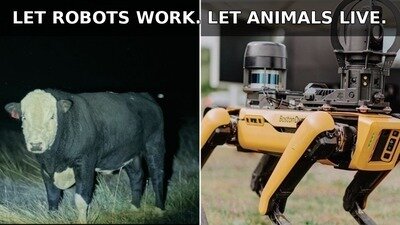
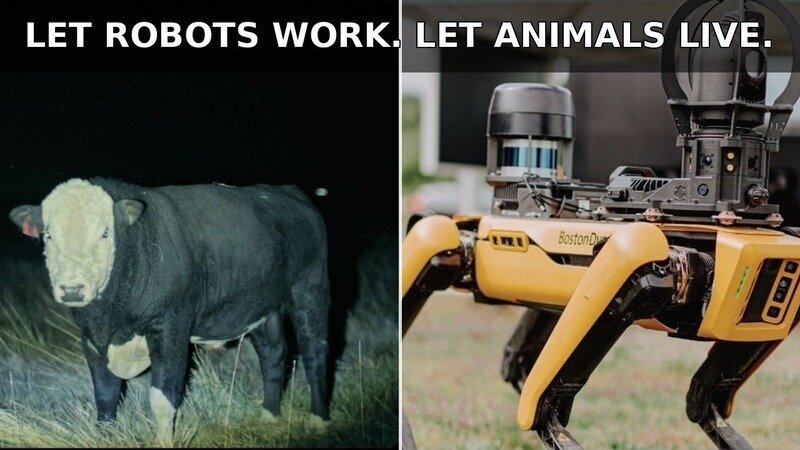
If we are investigating phenomena we do not fully understand, why are we continuing to keep live cows on the property when modern technology could offer an alternative?
I'm asking you to take a meaningful step toward protecting animals by removing live cows from Skinwalker Ranch and replacing their investigative role with robotic monitoring technology.
I'm also asking you to consider replacing live dogs used in investigative activities with a fleet of sensor-equipped robotic dogs capable of monitoring the property around the clock.
This isn't a request to end your investigations. It's a request to pursue them without unnecessarily putting living animals at risk.
ANIMALS CANNOT CONSENT TO THE RISKS.
Humans can choose to participate in an investigation, understand its potential risks, and decide whether those risks are acceptable.
Animals cannot make that choice.
They cannot understand the purpose of an experiment, evaluate the dangers of an unfamiliar environment, or consent to being exposed to circumstances that might threaten their safety.
They depend on us to make those decisions for them.
I am not claiming that every reported incident at Skinwalker Ranch has been verified or that every unusual animal death has an unexplained cause. However, the reports associated with the property raise a reasonable question about whether keeping live animals there is necessary.
When we have the ability to use technology instead, shouldn't we seriously consider that option?
An animal should not have to bear a risk that a machine could take instead.
IT'S 2026. WE HAVE OTHER OPTIONS.
Robotics, artificial intelligence, thermal imaging, remote sensing, and autonomous monitoring systems have advanced tremendously.
We already have robotic platforms capable of navigating challenging environments, carrying scientific instruments, recording video, and transmitting information to remote operators.
Rather than relying on live cows and dogs for investigative purposes, Skinwalker Ranch could explore a robotic monitoring system designed specifically for its research environment.
Imagine a fleet of robotic dogs equipped with:
High-resolution cameras to record activity across the property, day and night.
Thermal imaging to identify temperature differences and observe activity in low-light conditions.
Environmental sensors to measure conditions such as temperature, humidity, and atmospheric pressure.
Acoustic monitoring equipment to record unusual sounds and help investigators identify their sources.
Electromagnetic-field instruments to measure selected electromagnetic conditions where scientifically appropriate.
Continuous data recording to help investigators compare observations, identify patterns, and investigate unusual events.
The equipment could be adapted to the particular research questions being investigated.
These robots would not necessarily detect every possible phenomenon, but they could provide valuable information without requiring live animals to serve as investigative subjects.
A ROBOTIC DOG ARMY, WORKING IN SHIFTS.
Here's where the idea becomes especially interesting.
Rather than deploying just one or two robots, Skinwalker Ranch could evaluate a fleet of robotic dogs operating through a coordinated patrol system.
Imagine multiple robots monitoring different sections of the property while others recharge at designated docking stations.
When one robot's battery runs low, another takes over its assigned patrol. The first returns to its charging station and rejoins the fleet when it's ready.
With appropriate fleet-management software, the system could coordinate patrol routes, battery levels, sensor readings, and overlapping coverage.
Some robots could concentrate on perimeter monitoring. Others could inspect designated research areas, record environmental conditions, or investigate alerts from fixed monitoring equipment.
The goal would be to maintain consistent monitoring while minimizing interruptions caused by charging, equipment maintenance, or unexpected failures.
A properly designed system would also include backup coverage, human oversight, and plans for difficult terrain or equipment malfunctions.
This is not merely an imaginary concept. Autonomous charging and robotic inspection are already used in industrial applications.
Skinwalker Ranch could explore how these technologies might be adapted to its own investigative needs.
And rather than keeping live cows on the property for investigative purposes, researchers could use robotic monitoring systems to observe the same locations without placing a living animal in that role.
WHY NOT LET TECHNOLOGY TAKE THE RISK?
The point of scientific investigation is to learn something we don't already know.
But the pursuit of knowledge should also encourage us to reconsider outdated methods when better alternatives become available.
If a robotic platform can collect useful data from a location, why expose a living animal to uncertain conditions to obtain that data?
If a network of cameras and sensors can observe an area continuously, why rely on an animal to be physically present?
And if multiple robots can rotate through patrols, why not use them to maintain monitoring coverage without placing animals in the same investigative role?
Robotic systems cannot replace every biological response, and they cannot guarantee that every unusual event will be detected. Scientific limitations must be acknowledged.
However, when an investigation does not require a living animal, I believe the humane choice is to use an alternative.
We should not confuse the ability to use an animal with the necessity of using one.
MY REQUEST TO BRANDON FUGAL
I respectfully ask Brandon Fugal and the Skinwalker Ranch investigative team to take the following steps:
1. Remove live cows from Skinwalker Ranch.
I am calling for live cows to be removed from the property, with their investigative role replaced by robotic monitoring technology rather than other live animals.
2. Replace live dogs used in investigative activities with robotic alternatives.
Where dogs are used for monitoring or investigative purposes, I ask the team to consider sensor-equipped robotic platforms that can perform those tasks without exposing living dogs to the same potential risks.
3. Evaluate a coordinated robotic patrol fleet.
I ask the team to investigate deploying multiple robotic dogs equipped with appropriate scientific instruments, autonomous charging capabilities, and rotating patrol assignments to maintain monitoring coverage.
4. Use scientific instruments to investigate unexplained phenomena.
I encourage the team to expand its use of remote cameras, thermal imaging, environmental sensors, acoustic monitoring, and other appropriate instruments to collect evidence without relying on live animals.
5. Publish a clear animal-welfare policy.
I ask Skinwalker Ranch to explain how animals are protected, how potential risks are assessed, and what measures are taken to avoid exposing animals to unnecessary danger during investigations.
6. Make animal protection part of future research planning.
Before using a live animal in an investigative activity, I ask the team to consider whether the same objective could be achieved through robotics, remote observation, or other non-animal alternatives.
These requests are intended to encourage a more humane approach to research, not to prevent scientific exploration.
SCIENCE AND COMPASSION CAN MOVE FORWARD TOGETHER.
Brandon Fugal, you have an opportunity to demonstrate that scientific curiosity and animal welfare do not have to compete with one another.
Skinwalker Ranch is associated with some of the most intriguing and controversial unexplained phenomena in the public imagination.
That makes it an opportunity to consider a different approach to investigating the unknown.
Imagine a property monitored by robotic dogs equipped with cameras and scientific instruments, rotating through patrols while charging stations keep the fleet operating. Imagine researchers reviewing recorded evidence instead of relying on the presence of live animals in potentially concerning environments.
It would be a practical demonstration of how emerging technology could help reduce unnecessary animal exposure while supporting scientific investigation.
Most importantly, it would reflect a simple principle: when we have a reasonable alternative to placing an animal at risk, we should take that alternative seriously.
We do not need to know the explanation for every reported incident to recognize the importance of prevention.
We do not need to abandon scientific discovery to improve how we conduct it.
And we do not need to wait for another disturbing story before asking whether a different approach is possible.
Brandon Fugal, please remove live cows from Skinwalker Ranch and embrace robotic monitoring technology as an alternative to using live animals in potentially hazardous investigative activities.
Let's pursue the unknown with better instruments, better monitoring, and greater consideration for the animals who cannot choose for themselves.
Protect animals. Advance science. Let technology take the risk.
If you believe scientific investigation should move forward without exposing animals to unnecessary danger, please sign and share this petition.
Thank you.

7
The Issue
If We Cannot Explain the Risks, Why Are We Still Putting Animals in Them?
Dear Brandon Fugal,
Skinwalker Ranch has attracted worldwide attention for decades because of reports of unusual and unexplained phenomena. Among the most disturbing stories associated with the property are reports of unusual cattle deaths and alleged animal mutilations.
I believe it's time to ask an important question.
If we are investigating phenomena we do not fully understand, why are we continuing to keep live cows on the property when modern technology could offer an alternative?
I'm asking you to take a meaningful step toward protecting animals by removing live cows from Skinwalker Ranch and replacing their investigative role with robotic monitoring technology.
I'm also asking you to consider replacing live dogs used in investigative activities with a fleet of sensor-equipped robotic dogs capable of monitoring the property around the clock.
This isn't a request to end your investigations. It's a request to pursue them without unnecessarily putting living animals at risk.
ANIMALS CANNOT CONSENT TO THE RISKS.
Humans can choose to participate in an investigation, understand its potential risks, and decide whether those risks are acceptable.
Animals cannot make that choice.
They cannot understand the purpose of an experiment, evaluate the dangers of an unfamiliar environment, or consent to being exposed to circumstances that might threaten their safety.
They depend on us to make those decisions for them.
I am not claiming that every reported incident at Skinwalker Ranch has been verified or that every unusual animal death has an unexplained cause. However, the reports associated with the property raise a reasonable question about whether keeping live animals there is necessary.
When we have the ability to use technology instead, shouldn't we seriously consider that option?
An animal should not have to bear a risk that a machine could take instead.
IT'S 2026. WE HAVE OTHER OPTIONS.
Robotics, artificial intelligence, thermal imaging, remote sensing, and autonomous monitoring systems have advanced tremendously.
We already have robotic platforms capable of navigating challenging environments, carrying scientific instruments, recording video, and transmitting information to remote operators.
Rather than relying on live cows and dogs for investigative purposes, Skinwalker Ranch could explore a robotic monitoring system designed specifically for its research environment.
Imagine a fleet of robotic dogs equipped with:
High-resolution cameras to record activity across the property, day and night.
Thermal imaging to identify temperature differences and observe activity in low-light conditions.
Environmental sensors to measure conditions such as temperature, humidity, and atmospheric pressure.
Acoustic monitoring equipment to record unusual sounds and help investigators identify their sources.
Electromagnetic-field instruments to measure selected electromagnetic conditions where scientifically appropriate.
Continuous data recording to help investigators compare observations, identify patterns, and investigate unusual events.
The equipment could be adapted to the particular research questions being investigated.
These robots would not necessarily detect every possible phenomenon, but they could provide valuable information without requiring live animals to serve as investigative subjects.
A ROBOTIC DOG ARMY, WORKING IN SHIFTS.
Here's where the idea becomes especially interesting.
Rather than deploying just one or two robots, Skinwalker Ranch could evaluate a fleet of robotic dogs operating through a coordinated patrol system.
Imagine multiple robots monitoring different sections of the property while others recharge at designated docking stations.
When one robot's battery runs low, another takes over its assigned patrol. The first returns to its charging station and rejoins the fleet when it's ready.
With appropriate fleet-management software, the system could coordinate patrol routes, battery levels, sensor readings, and overlapping coverage.
Some robots could concentrate on perimeter monitoring. Others could inspect designated research areas, record environmental conditions, or investigate alerts from fixed monitoring equipment.
The goal would be to maintain consistent monitoring while minimizing interruptions caused by charging, equipment maintenance, or unexpected failures.
A properly designed system would also include backup coverage, human oversight, and plans for difficult terrain or equipment malfunctions.
This is not merely an imaginary concept. Autonomous charging and robotic inspection are already used in industrial applications.
Skinwalker Ranch could explore how these technologies might be adapted to its own investigative needs.
And rather than keeping live cows on the property for investigative purposes, researchers could use robotic monitoring systems to observe the same locations without placing a living animal in that role.
WHY NOT LET TECHNOLOGY TAKE THE RISK?
The point of scientific investigation is to learn something we don't already know.
But the pursuit of knowledge should also encourage us to reconsider outdated methods when better alternatives become available.
If a robotic platform can collect useful data from a location, why expose a living animal to uncertain conditions to obtain that data?
If a network of cameras and sensors can observe an area continuously, why rely on an animal to be physically present?
And if multiple robots can rotate through patrols, why not use them to maintain monitoring coverage without placing animals in the same investigative role?
Robotic systems cannot replace every biological response, and they cannot guarantee that every unusual event will be detected. Scientific limitations must be acknowledged.
However, when an investigation does not require a living animal, I believe the humane choice is to use an alternative.
We should not confuse the ability to use an animal with the necessity of using one.
MY REQUEST TO BRANDON FUGAL
I respectfully ask Brandon Fugal and the Skinwalker Ranch investigative team to take the following steps:
1. Remove live cows from Skinwalker Ranch.
I am calling for live cows to be removed from the property, with their investigative role replaced by robotic monitoring technology rather than other live animals.
2. Replace live dogs used in investigative activities with robotic alternatives.
Where dogs are used for monitoring or investigative purposes, I ask the team to consider sensor-equipped robotic platforms that can perform those tasks without exposing living dogs to the same potential risks.
3. Evaluate a coordinated robotic patrol fleet.
I ask the team to investigate deploying multiple robotic dogs equipped with appropriate scientific instruments, autonomous charging capabilities, and rotating patrol assignments to maintain monitoring coverage.
4. Use scientific instruments to investigate unexplained phenomena.
I encourage the team to expand its use of remote cameras, thermal imaging, environmental sensors, acoustic monitoring, and other appropriate instruments to collect evidence without relying on live animals.
5. Publish a clear animal-welfare policy.
I ask Skinwalker Ranch to explain how animals are protected, how potential risks are assessed, and what measures are taken to avoid exposing animals to unnecessary danger during investigations.
6. Make animal protection part of future research planning.
Before using a live animal in an investigative activity, I ask the team to consider whether the same objective could be achieved through robotics, remote observation, or other non-animal alternatives.
These requests are intended to encourage a more humane approach to research, not to prevent scientific exploration.
SCIENCE AND COMPASSION CAN MOVE FORWARD TOGETHER.
Brandon Fugal, you have an opportunity to demonstrate that scientific curiosity and animal welfare do not have to compete with one another.
Skinwalker Ranch is associated with some of the most intriguing and controversial unexplained phenomena in the public imagination.
That makes it an opportunity to consider a different approach to investigating the unknown.
Imagine a property monitored by robotic dogs equipped with cameras and scientific instruments, rotating through patrols while charging stations keep the fleet operating. Imagine researchers reviewing recorded evidence instead of relying on the presence of live animals in potentially concerning environments.
It would be a practical demonstration of how emerging technology could help reduce unnecessary animal exposure while supporting scientific investigation.
Most importantly, it would reflect a simple principle: when we have a reasonable alternative to placing an animal at risk, we should take that alternative seriously.
We do not need to know the explanation for every reported incident to recognize the importance of prevention.
We do not need to abandon scientific discovery to improve how we conduct it.
And we do not need to wait for another disturbing story before asking whether a different approach is possible.
Brandon Fugal, please remove live cows from Skinwalker Ranch and embrace robotic monitoring technology as an alternative to using live animals in potentially hazardous investigative activities.
Let's pursue the unknown with better instruments, better monitoring, and greater consideration for the animals who cannot choose for themselves.
Protect animals. Advance science. Let technology take the risk.
If you believe scientific investigation should move forward without exposing animals to unnecessary danger, please sign and share this petition.
Thank you.
Petition Updates
Share this petition
Petition created on October 28, 2026