

Boycott & Stop Unicode's Rolling Out of New Neopronoun Characters Such as "X也"、"男也", etc.
The issue
On September 9 2025, Unicode will be planning to the release the version 17.0 standard. Among the release of the new CJKV ideographs, are the fringe neopronoun "X也", and abandoned historical neopronoun"男也", along with superficial neopronouns like "您 and 怹 replaced with a 女 in-lieu of the 人 radical (女尔心 and 女也心)."
It can be strongly argued that this new release is a counterproductive and regressive implement, especially in this day and age when different languages are shifting away from gendered pronouns and the hegemony of anglicization is being challenged.
The reception and reactions from Chinese internet users regarding the roll out of these new characters are filled with complaints of redundancy, at best, and cultural appropriation, at worst. This lies true among some Chinese LGBTQ+ communities, and there is criticism that the proposed character is perplexing, inaccurate, and offensive; some even voiced opinions of feeling uncomfortable and dehumanized, especially when these new neopronoun characters are being juxtaposed with other extant third person pronoun characters - this will be elaborated later.
Furthermore, the introduction of the new "X也" pronoun parallels with the prevalence of cultural imperialism and colonial mentality that occurred in China around a century ago, especially during the period of the May Fourth movement. The repurposing of the character "她" was initiated by Chinese poet 刘半农 (Liu Bannong), circa 1920, which was originally an alternative orthography of "姐" originally meaning "elder sister". A group of Chinese women writers protested in newspapers in response to the introduction of "她" the same year, going as far when an anonymous writer by the pseudonym of 寒冰 (Han Bing) published in the newspaper《新人》an article titled《这是刘半农的错》— this is all Liu Bannong's fault, and again in 1934 in an edition of《妇女共鸣》with the editors proclaiming: "本刊同仁,以人字旁代男子、女字旁代女子,牛字旁代物件,含有侮辱女子非人之意,所以拒絕用『她』字。" (This magazine believes that using the "人 (human/person) radical" to represent men, the "女(woman) radical" to represent women, while using the “牛(cow)” radical to represent objects, insinuates women are not to be classified as humans, thus we condemn the usage of the character “她”. — translation mine), the year of his death.
The same sentiment is repeated today by some members of the LGBTQ community as shown below:

A user records feedback on the neopronoun from his transgender friends and the lack of support and overall condemnation.
However, Andrew West (1960-2025), a professor of sinology at Yale University who proposed the neopronoun implementation, became defensive:

Professor Andrew West ignored the reply, and tried to "whitesplain" the necessity of the neopronoun without elaborating further evidence (including anecdotal) whether the perceived beneficiaries (i.e., Chinese LGBTQ communities) are in agreement with the new implementations.
The common complaints against the proposed "X也" are about how the "X" insinuates the non-human nature of genderqueer individuals when juxtaposed with "他" which has a human radical (人), and the "X" appearing to similar to the radical "乂" which carries a violent connotation: "to weed" or "to kill" as expressed in the character "刈"; this is problematic as it causes confusion amongst Chinese-speaking internet users, and can help further stigmatizing an already marginalized community.
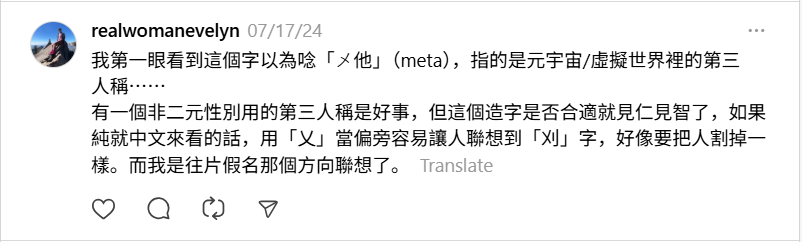
"My first impression was that this was a sci-fi third person pronoun for aliens. There is nothing inherently wrong with a gender neutral third person pronoun, but this seems to be the case of offering a one-size-fits-all solution to the problem. Honestly, from a purely analytical Chinese perspective the "乂" reminds me of the "刈" character, as if its implying somebody's getting chopped up. I prefer using the katakana (i.e., bopomofo) spelling instead." — translation mine.
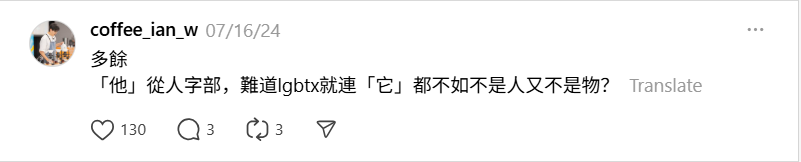
How redundant. "他" contains a human radical. Does this mean that the LGBTQ is lesser than a "它" (neuter third person pronoun introduced c. 1920), thus aren't persons or inanimate objects? — translation mine.
In contrary, unsurprisingly, the biggest endorsers and beneficiaries of these new characters are Western academics who see this as an opportunity to capitalize the "linguistic reforms" for personal profit and prestige, and push an ethnocentric and historical revisionist agenda.
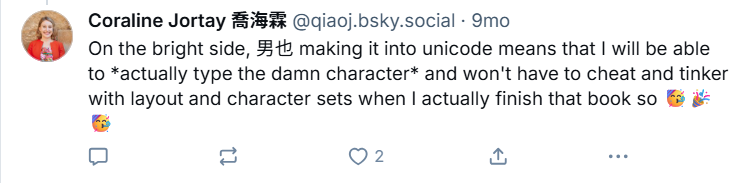
This demonstrates that the actual beneficiaries are not actually the Sinophone world but rather White Westerners in positions of power. (https://bsky.app/profile/qiaoj.bsky.social/post/3latjlccvck2f)
#BoycottUnicode #BoycottBabelStone #NoNeoColonialism #NoNeoPronouns #StopVersion17

1
The issue
On September 9 2025, Unicode will be planning to the release the version 17.0 standard. Among the release of the new CJKV ideographs, are the fringe neopronoun "X也", and abandoned historical neopronoun"男也", along with superficial neopronouns like "您 and 怹 replaced with a 女 in-lieu of the 人 radical (女尔心 and 女也心)."
It can be strongly argued that this new release is a counterproductive and regressive implement, especially in this day and age when different languages are shifting away from gendered pronouns and the hegemony of anglicization is being challenged.
The reception and reactions from Chinese internet users regarding the roll out of these new characters are filled with complaints of redundancy, at best, and cultural appropriation, at worst. This lies true among some Chinese LGBTQ+ communities, and there is criticism that the proposed character is perplexing, inaccurate, and offensive; some even voiced opinions of feeling uncomfortable and dehumanized, especially when these new neopronoun characters are being juxtaposed with other extant third person pronoun characters - this will be elaborated later.
Furthermore, the introduction of the new "X也" pronoun parallels with the prevalence of cultural imperialism and colonial mentality that occurred in China around a century ago, especially during the period of the May Fourth movement. The repurposing of the character "她" was initiated by Chinese poet 刘半农 (Liu Bannong), circa 1920, which was originally an alternative orthography of "姐" originally meaning "elder sister". A group of Chinese women writers protested in newspapers in response to the introduction of "她" the same year, going as far when an anonymous writer by the pseudonym of 寒冰 (Han Bing) published in the newspaper《新人》an article titled《这是刘半农的错》— this is all Liu Bannong's fault, and again in 1934 in an edition of《妇女共鸣》with the editors proclaiming: "本刊同仁,以人字旁代男子、女字旁代女子,牛字旁代物件,含有侮辱女子非人之意,所以拒絕用『她』字。" (This magazine believes that using the "人 (human/person) radical" to represent men, the "女(woman) radical" to represent women, while using the “牛(cow)” radical to represent objects, insinuates women are not to be classified as humans, thus we condemn the usage of the character “她”. — translation mine), the year of his death.
The same sentiment is repeated today by some members of the LGBTQ community as shown below:
A user records feedback on the neopronoun from his transgender friends and the lack of support and overall condemnation.
However, Andrew West (1960-2025), a professor of sinology at Yale University who proposed the neopronoun implementation, became defensive:
Professor Andrew West ignored the reply, and tried to "whitesplain" the necessity of the neopronoun without elaborating further evidence (including anecdotal) whether the perceived beneficiaries (i.e., Chinese LGBTQ communities) are in agreement with the new implementations.
The common complaints against the proposed "X也" are about how the "X" insinuates the non-human nature of genderqueer individuals when juxtaposed with "他" which has a human radical (人), and the "X" appearing to similar to the radical "乂" which carries a violent connotation: "to weed" or "to kill" as expressed in the character "刈"; this is problematic as it causes confusion amongst Chinese-speaking internet users, and can help further stigmatizing an already marginalized community.
"My first impression was that this was a sci-fi third person pronoun for aliens. There is nothing inherently wrong with a gender neutral third person pronoun, but this seems to be the case of offering a one-size-fits-all solution to the problem. Honestly, from a purely analytical Chinese perspective the "乂" reminds me of the "刈" character, as if its implying somebody's getting chopped up. I prefer using the katakana (i.e., bopomofo) spelling instead." — translation mine.
How redundant. "他" contains a human radical. Does this mean that the LGBTQ is lesser than a "它" (neuter third person pronoun introduced c. 1920), thus aren't persons or inanimate objects? — translation mine.
In contrary, unsurprisingly, the biggest endorsers and beneficiaries of these new characters are Western academics who see this as an opportunity to capitalize the "linguistic reforms" for personal profit and prestige, and push an ethnocentric and historical revisionist agenda.
This demonstrates that the actual beneficiaries are not actually the Sinophone world but rather White Westerners in positions of power. (https://bsky.app/profile/qiaoj.bsky.social/post/3latjlccvck2f)
#BoycottUnicode #BoycottBabelStone #NoNeoColonialism #NoNeoPronouns #StopVersion17
Petition Updates
Share this petition
Petition created on 21 August 2025