Veterinary Council to consider issue of vet involvement in cruel hare coursing

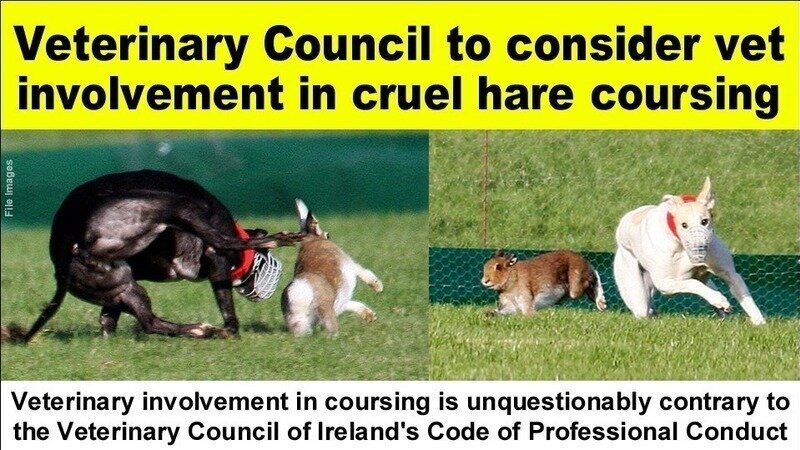
The Veterinary Council of Ireland has said that it will consider the issue of veterinary involvement in cruel hare coursing.
Responding to an appeal from the Irish Council Against Bloodsports to stop vets from certifying thousands of hares "fit to course", a VCI spokesperson stated: "your correspondence will be considered at the next meeting of the Legislation, Ethics and Monitoring Committee" and the matter will be "given due consideration".
In our appeal, we pointed out that vets are facilitating hare coursing by certifying hares "fit to course". This is undoubtedly contrary to the Veterinary Council of Ireland's Code of Professional Conduct which makes it clear that vets “must act with compassion”, "must always regard animals as sentient beings and treat them in a manner that safeguards their health and welfare" and "must be advocates for the good welfare of animals".
Certifying these timid and delicate animals as being "fit" to be used as live lures for dogs in a cruel bloodsport is a deplorable betrayal of the animals, whose welfare vets are compelled to protect and enhance. It is an affront to everything the veterinary profession stands for. Without this certification by vets, the coursing meeting and its inherent cruelty, would not be permitted to proceed.
As if this was not bad enough, vets may also certify greyhounds fit for coursing. The Irish Coursing Club's "Coursing Rules" document outlines that "where the Veterinary Surgeon certifies the dog fit to course, he shall take his place in the next round." https://irishcoursingclub.ie/wp-content/uploads/2018/10/Rules-Pt-6.pdf It is truly appalling that a vet would not only give the go-ahead for hares to be subjected to this abuse but also give approval for the dogs to be used to terrorise the hares.
In a "Vets out of coursing" submission, we noted that licensed coursing meetings can only take place if vets agree to be in attendance. By being present, vets are enabling this cruel activity.
Coursing is a form of "animal abuse/cruelty/mistreatment" which the VCI's code defines as "any act or omission that causes unnecessary suffering to or endangers the health or welfare of an animal."
By acting as coursing club vets and playing a role at coursing meetings, vets are not being "advocates for the good welfare of animals" and are acting in a way that facilitates unnecessary suffering to animals and endangers the health and welfare of animals. They are therefore breaching the code of conduct.
The code defines animal welfare as how an animal "is coping with the conditions in which they live", noting that "an animal is in a good state of welfare if (as indicated by scientific evidence) they are healthy, comfortable, well nourished, safe, able to express innate behaviour and are not suffering from unpleasant states such as pain, fear, and distress."
Hares used in coursing suffer pain, fear and distress as they are subjected to a series of cruelties. Their ordeal starts when they are captured from the wild - nets are placed in fields and the hares are frightened out of their habitats by groups of men/women/children who make loud noises. The hares try to get away from this threat and, in doing so, run into the nets and become entangled. Their cries of desperation have been likened to those of a crying child. Hares can suffer injuries such as cut toes as they desperately try to free themselves from the nets.
To be admitted to the Register of Veterinary Practitioners of Ireland, vets must make the following declaration: “I solemnly and sincerely declare that I will, to the best of my ability, uphold the honour, dignity and integrity of the veterinary professions, that I will promote the welfare of animals entrusted to my care and that I will abide by the rulings of the Veterinary Council.” Vets must also "enhance animal health and welfare".
By working with coursing clubs, vets are acting contrary to this pledge.
At coursing meetings, the vets who examine hares mauled into the ground (hares who suffer hits are not examined) determine if the animals are injured. They either treat the injured hares or "euthanise" them. Another role played by vets at coursing meetings is to examine hares found dead in enclosures (e.g. from injuries or stress) and decide whether or not to send them to a lab for examination to establish the cause of death. Vets agreeing to work in a situation in which animals are inevitably going to be harmed contravenes the section of the VCI code headed "Preventing and Addressing Adverse Events". This tells vets that they "must take reasonable steps to prevent harm to both the animals under their care".
The VCI code outlines that "euthanasia is the act of purposely inducing the death of an animal using humane methods that eliminate or minimise pain and distress - its primary purpose is to relieve suffering" and that it may be considered by vets "if an animal’s condition cannot be adequately treated and is likely to cause unavoidable pain, distress or suffering to the animal". The euthanisation of hares at coursing meetings leaves no doubt, therefore, about the level of hare suffering which vets are dealing with.
The VCI code also reminds vets about handling animals "as gently, quietly and safely as circumstances allow" and states that they should "use their best endeavours to eliminate any unnecessary sources of stress during examination and treatment" and "in the case of wild animals and other animals that are fearful of being handled, veterinary practitioners should only handle or restrain them when it is absolutely necessary".
Hares are fearful of being handled and they experience stress as a result. The hares in captivity at the coursing meetings where vets are present have been subjected to this fear and stress in the capturing process. In full view of the vets, they continue to be subjected to it during the coursing meeting.
Vets attending coursing meetings where the welfare of hares is negatively impacted and where they are subjected to unnecessary pain, distress and suffering is entirely incompatible with the "Suspected Cases of Animal Cruelty and Compromised Animal Welfare" section of the VCI's code. This states that "a veterinary practitioner who becomes aware of (a) an animal that is being or was subjected to unreasonable or unnecessary pain, distress or suffering, or (b) an animal that is not kept in a manner that safeguards their health and welfare, should take action to ensure that the matter is effectively dealt with."
In the code, vets are told that they "should attend to wildlife" for reasons including animal welfare and that they have "a responsibility to provide first aid and pain relief to any species of animal to relieve suffering". It is clear that vets have an obligation to act in a respectful way towards wildlife and to alleviate the suffering of wild animals, not enable it.
The code goes on to state that "any conduct by a veterinary practitioner that is contrary to this code may constitute professional misconduct and may lead to the imposition of a sanction by the VCI in the event of allegations being proven".
"It is inarguable that the role vets play at hare coursing meetings is unquestionably contrary to the code," we emphasised in our appeal. "Therefore we urge the Veterinary Council of Ireland to convey to vets that they must abide by the code and stop working for coursing clubs."
Among the hares certified fit to course by vets in the 2025-26 season were:
• A hare found in agony with a detached and protruding leg bone after a coursing meeting in Limerick
• A pregnant hare who died at a coursing meeting in Gorey. She suffered abdominal bruising and haemorrhage
• A hare “found dead” at a coursing meeting in Tipperary who suffered an injured eye and a wound on the hind quarters
• Hares who "died of injuries"
• Injured hares euthanised by vets
• An injured hare who was “given injection for shock”
• Hares administered painkillers and anti-inflammatory drugs
• A hare who suffered bruising after being pinned to the ground by a dog
• A hare mauled with such force that an ear tag came off
• A mauled hare with a graze on the back
• A hare seen with "ear bleeding from tag removal”
• A hare who got tangled in a wire fence during coursing
• A hare who “died during release”
ACTION ALERT
Contact the Veterinary Council of Ireland and call for an end to veterinary involvement in cruel hare coursing.
Leo Kearns
Interim CEO & Registrar
Veterinary Council of Ireland
Email: info@vci.ie
Tel: 01 668 4402
Watch our campaign videos
The suffering of hares during 2025-26 coursing season
https://www.youtube.com/watch?v=1jN3OMM7_UY
Bill to ban hare coursing shamefully rejected - 24 in favour, 125 against
https://www.youtube.com/watch?v=eMSh_T5l6i0