Seattle Times Editorial Board and South Seattle Emerald Weigh in on Seattle's Appeal Ban

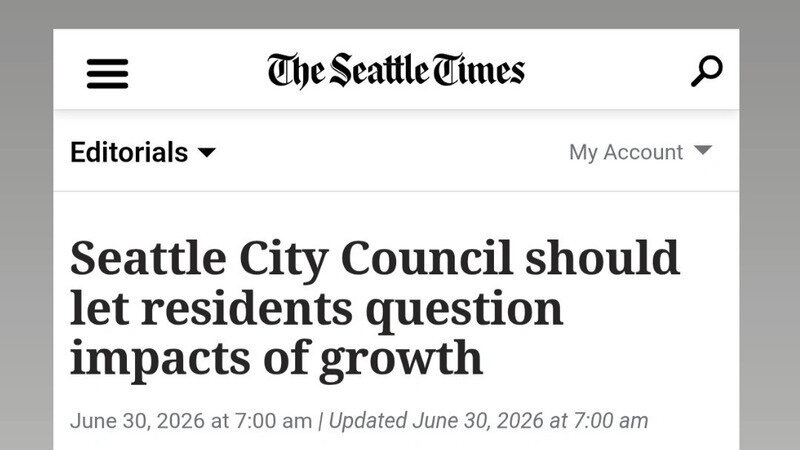
Much gratitude to The Seattle Times Editorial Board and South Seattle Emerald for these great pieces.
July 1st 9:30am City Council - Comment in Person or Remotely
The City has used dismissals and delays to avoid discussing the real point of an Environmental Impact Statement - the environment. For 10 months prior to filing the Orca Appeal, the appellant asked the city to correct several factual inaccuracies, like "the only" endangered species known to use habitat in Seattle are fish, excluding the beloved Southern Resident Killer Whales.
The city's response? It's too late to help them because of damage done by colonization (FEIS 20-6b). In the 2025 Orca Appeal pre-hearing conference, Hearing Examiner Ryan Vancil clearly stated the environmental arguments would be heard - just a few days later the cases were rapidly dismissed. Corruption? In the state Court of Appeals, Judge David Mann asked how will the City Council have the best information in front of them.
NOAA recovery plans show that recovery of protected species is possible. The state Middle Housing Bill (HB 1110) intended to promote shared walls and stacked flats (not 4-6 luxury single family homes paving entire lots) - which also saves green space and trees that reduce polluted runoff into citywide storm drains for free. Concentrating these free water managers in a handful of parks does nothing for storm drains citywide. Storm drains are a man made watershed. Trees also cool runoff - salmon require cool temperatures to thrive. Most water in Seattle is on the 303D impaired list (above). The Nature Conservancy study by Lambert et al shows that there's no loss of density with protecting green space. It’s “yes and.”
The City has avoided the environmental case by dismissals and delays - until now. Their response? Ban future public oversight of the largest environmental assessments. CB 121215 would eliminate the public right to appeal the adequacy of Seattle's largest citywide Environmental Impact Statement (EIS) to the Hearing Examiner before major land use projects are approved. When the current US president didn't like climate science reports, they gutted NOAA. Banning appeals erases accountability.
Environmental review is like a doctor’s exam before surgery. A Comprehensive Plan is like surgery on the ecosystem we share. Would you agree to a procedure without a physician consult about health impacts? If the doctor did a bad job on the consultation, would you want the ability to get a second opinion? It would be potentially impossible to undo the damage after the fact. The EIS is an important contract with City residents, the ecosystem, endangered species, and consequently the health of over 700,000 people. Where's the problem? It's in the wallets and minds of a small handful unwilling to embrace science.
How to Save Time and Resources:
- Do a quality EIS the first time.
- Continue to provide council information (but remove bias in Director's Reports).
- Allow equitable access to the City appeal that the state allows every municipality.
The City attorney caused many delays in what could have been a simple case that could have been resolved via City's response to public comments before getting to the hearing examiner - but the city refused during the 10 months prior to the appeal.
Streamline the Appeals before Eliminating Accountability:
Seattle's Hearing Examiner process is an outlier regarding length compared to other Western Washington cities; Seattle can take over twice as long.
Shorten that timeline without eliminating all appeals to “provide more efficient and predictable timeframes for City decision-making to occur.” Reform the hearing process first before cutting the public out of environmental review.
The Lin ordinance misses the mark - it’s not appellants that cause problems and potential delays; it’s the failure of city staff to do its job of properly informing the council on the potential impacts of its decisions. Had city staff accurately assessed environmental harms, there would be no appeal.
Council Needs Good Information - "Retain the current requirement that all Council originated bills have a Director's Report.
CB 121215 would eliminate this requirement for Council land use legislation while continuing it for Mayor’s Office originated land use bills. Directors' reports for Comprehensive Plans, Comp Plan amendments and land use legislation need to continue to be mandatory for both the Council and Mayor’s Office. There should be no difference between who introduces the legislation. City Councilmembers, the Mayor’s Office, and the public all benefit from Director's Reports, to ensure that Departments that have to comply with the proposed legislation have reviewed it and added their input." - TreePAC
Patrick Condon reported on the largest North American upzone increased housing cost exponentially.
Send an email to council@seattle.gov and mayor.wilson@seattle.gov or use this pre-written email template.
See also Trees and People Coalition and Tree Action Seattle for alternate perspectives.