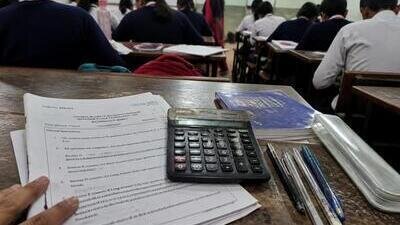

Allow calculators in CBSE board exams for Grade 12
The Issue
By Speed Post & Email
WITHOUT PREJUDICE
….08.2026
To,
1. The Chairperson,
Central Board of Secondary Education (CBSE),
Shiksha Kendra, 2, Community Centre,
Preet Vihar, Delhi – 110092
info.cbse@gov.in
2. The Secretary,
Department of School Education & Literacy,
Ministry of Education, Government of India,
Shastri Bhawan, New Delhi – 110001
secy.sel@nic.in
3. The Director,
National Council of Educational Research and Training (NCERT),
Sri Aurobindo Marg, New Delhi – 110016
nindia@ncert.nic.in
4. The Chairperson,
PARAKH (National Assessment Centre),
Ministry of Education, New Delhi
nationalassessmentcenter.parakh@gmail.com
Subject: Representation seeking permission for use of basic, non-programmable calculators for students appearing in CBSE Class XII Board Examinations, including restoration of the facility for physically challenged and specially-abled students & request for time-bound action
Respected Sir/Madam,
We, the undersigned, are parents of children studying in Class XII in various CBSE-affiliated schools in Delhi/NCR i.e. ………., ………………., …………..& …………. and this representation is being sent by Mrs. …………… for and on behalf of herself and the other parents named in Annexure-Ato this letter, each of whom has authorised her to act on their behalf in this matter. We are writing about the continuing ban on the use of even a basic calculator by students appearing in CBSE Class XII Board Examinations. We are raising this issue not on behalf of any single school or batch of students but as a matter that affects all CBSE students appearing for Class XII Board Examinations across the country. Below, we have set out clear facts, documents and dates, and we are asking for a clear, time-bound response, because this issue affects lakhs of students every year.
1. CBSE's own Curriculum Committee has already looked into this and we are simply asking CBSE to finish what it started
News reports by the Press Trust of India, dated 24th-25th March 2025 (and carried the same way by several national news outlets), said that CBSE's Curriculum Committee had proposed and was seriously considering, a plan to allow basic, non-programmable calculators which are limited to simple functions like addition, subtraction, multiplication, division and percentage for the Class XII Accountancy exam. The reports said a panel would be set up to decide which calculator models would be allowed, so that advanced or programmable devices could not be misused and that the Committee had taken this decision in principle around November 2024. The same reports also said that final approval was still needed from CBSE's top governing body. We have not found any information since then confirming that this final approval has been given or that the facility has actually been made available to any student. It has now been more than a year since this was first reported covering at least one full examination cycle (2025-26) and it still has not been notified or implemented. So we are not asking CBSE to think about something new. We are simply asking CBSE to complete a process its own Curriculum Committee already started, and to tell us where that panel and its approval currently stand.
2. Other examining bodies in India have, at least at some point, allowed calculators to their students
We understand that CBSE's own officials mentioned this while discussing the 2025 Accountancy proposal that the Council for the Indian School Certificate Examinations (CISCE) issued a notice allowing a specific calculator model for its Class XII (ISC) students in its November 2021 exam. We would request CBSE and the Ministry to check, with CISCE if needed, whether and how this facility has continued in CISCE's later exams, so that an accurate, up-to-date comparison can guide your decision. We are not saying CBSE is behind every other Indian board on this in every respect. We simply want to show that a controlled, basic calculator facility is not something new or untried, even within India's own examination system.
3. Every major international examination board allows calculators in a controlled and regulated way
(i).The International Baccalaureate (IB) Diploma Programme requires students to have a calculator for one or more subjects, with a detailed, subject-wise Calculator Policy set by the IB (see IB's "Use of Calculators in Examinations" document and the IB's Exam Calculator Policy page, ibo.org).
(ii).Cambridge International's IGCSE Mathematics syllabus (Syllabus 0580/0980, 2025–2027, published by Cambridge Assessment International Education) allows a scientific calculator for Papers 3 and 4, while Papers 1 and 2 stay calculator-free which is a balanced approach that tests both basic number skills and applied, calculator-based problem-solving.
(iii) In the United Kingdom, GCSE Mathematics (under the rules of JCQ i.e. Joint Council for Qualifications -"Instructions for Conducting Examinations," as explained on OCR's official website) allows scientific and graphical calculators, subject to clear conditions (no stored data, no automatic algebra-solving, no communication features).
(iv) In the United States, the College Board's Digital SAT allows calculator use through the whole Mathematics section, including a built-in Desmos calculator given to every student to keep things fair regardless of what they can personally afford; the ACT similarly allows calculators through its whole Mathematics test.
We mention all this to show that the safety measures CBSE would need before allowing only basic, non-programmable calculators, with clear rules on what functions are permitted are already designed, tested, and working well in some of the world's most respected examination systems. CBSE would not be starting from scratch.
4. This fits with the Government of India's own education policy
(i).The National Education Policy (NEP), 2020, approved by the Union Cabinet on 29th July 2020 (Ministry of Education), calls for school exams to move away from rote memorisation and towards testing real understanding and application of concepts and for reducing reliance on high-pressure, high-stakes exams of the old kind.
(ii) The National Curriculum Framework for School Education (NCF-SE), 2023, brought out by NCERT in August 2023 to carry forward NEP 2020, specifically asks for Mathematics teaching and testing to move away from rote learning and towards activity-based, discovery-based and application-based learning and for exams to test competency and understanding rather than memorisation and mechanical calculation.
A complete ban on calculators in calculation-heavy subjects like Mathematics & Accountancy does not sit well with this policy direction, which CBSE as the country's largest school board working under the Ministry of Education, is expected to follow.
5.Independent research supports the fear that calculators "weaken" students is not backed by evidence
There is a good amount of independent, peer-reviewed research on this exact question, going back several decades:
(i). A review of 54 research studies on calculator use by school students (Ellington, L., 2003, "A Meta-Analysis of the Effects of Calculators on Students' Achievement and Attitude Levels in Precollege Mathematics Classes," Journal for Research in Mathematics Education) found that students' calculation and problem-solving skills got better when calculators were made part of testing, that calculator use did not weaken maths skills in any of the studies looked at, and that students who used calculators felt more positive about maths.
(ii) An earlier review of 79 research reports (Hembree, R. & Dessart, D.J., 1986, "Effects of Hand-Held Calculators in Precollege Mathematics Education: A Meta-Analysis," Journal for Research in Mathematics Education, Vol. 17, published by the National Council of Teachers of Mathematics) found that calculator use, along with regular classroom teaching, improved students' basic calculation skills at almost every grade level, and improved their confidence and attitude towards the subject.
(iii) The Visible Learning global research database (visiblelearningmetax.com), which brings together 6 separate research reviews covering 238 studies and over 1,100 results, lists calculator use as something "likely to have a positive impact" on student performance.
We would be happy to share the summaries of this research with you and to help you get the full papers, if that would be useful for your review.
6. Physically challenged and specially-abled students need urgent attention
We want to specifically flag the situation of physically challenged and specially-abled CBSE students, which we feel needs urgent fixing on its own, separate from the larger issue above:
(i) In 2020, CBSE itself allowed basic, non-programmable calculators for Children With Special Needs (CWSN) candidates in Class XII Board Exams, something confirmed at the time by CBSE's own Controller of Examinations in a message to schools, recognising that such students should not be put at a disadvantage because of difficulty in doing calculations by hand.
(ii) Based on the latest information available to us, which several sources consistently report, this facility is not available in the current examination cycle and CBSE's present relaxation is limited to a smaller group of students certified with a Specific Learning Disability (Dyscalculia), for whom the exam centre itself provides a calculator.
(iii) We request that CBSE confirm, in writing, its current official policy on calculator use for children with disabilities and special needs, and that if what we understand above is correct,the wider 2020 CWSN facility be restored right away, without waiting for the outcome of the larger review asked for in this letter, and be extended to all categories of children with disabilities and special needs who may need it, including but not limited to those with visual impairment, locomotor disability, and specific learning disabilities affecting calculation.
7.We are not asking for any lowering of standards
To be clear, we are not asking for any change in the syllabus, any reduction in difficulty or any lowering of academic standards. We are only asking for a basic, non-programmable calculator, exactly the kind CBSE's own Curriculum Committee has already proposed and the kind allowed by CISCE, IB, Cambridge, UK boards and the US College Board so that a student's exam result shows how well they understand the subject not how fast they can do sums by hand under time pressure.
8. This is a matter courts have taken seriously in the past, on similar facts
We would like to respectfully point out that CBSE's Examination Bye-Laws have in the past, been examined by the Supreme Court of India, which made clear that individual rules within such Bye-Laws can still be challenged and are not automatically safe from scrutiny just because CBSE frames them using its own regulatory powers. In Jigya Yadav (Minor) v. CBSE, (2021) 7 SCC 535, the Supreme Court struck down, as too restrictive and unconstitutional, one specific rule in CBSE's Bye-Laws that stopped a candidate from correcting their name after results were declared, even while accepting, in the same judgment that CBSE's Bye-Laws generally do carry the force of law. We mention this only to show that where a specific CBSE rule is found to be unfair or unreasonable, it can be and has been, corrected through the courts and we would much rather this particular issue be resolved by you directly, especially since your own Curriculum Committee has already moved in this direction.
Our specific requests
We respectfully request that the following steps be taken, and that we be told in writing what has been decided on each:
a. A written update on where the Class XII Accountancy calculator proposal recommended by CBSE's Curriculum Committee (as reported in March 2025) currently stands or notincluding whether the panel mentioned in that report has been set up and when final approval and implementation can be expected;
b. Setting up a time-bound expert committee, within six weeks of this letter, to look at extending a similarly basic, non-programmable calculator facility to Class XII Mathematics & Accountancy subjects taking into account the practice followed by IB, Cambridge International, UK GCSE boards and the US SAT/ACT mentioned above;
c. Written confirmation of CBSE's current official policy on calculator use for Children with Special Needs / Persons with Disabilities, and immediate restoration of the 2020 CWSN facility, extended to all categories of physically challenged and specially-abled students who may need it, while the review at point (b). above is being carried out.
d. A written, reasoned reply addressing each of the above points within four (4) weeks of receiving this representation.
We are placing this representation on record and would request that it be treated as urgent, since every academic session that goes by without a decision affects a fresh batch of students who cannot get that time back later. We would welcome the chance to meet any officer you may nominate, to discuss this further.
We look forward to a considered, time-bound response. If we do not receive one, we will regretfully have no choice but to pursue whatever legal remedies may be available to us, in the interest of the students affected by this policy.
Thanking you,
Yours sincerely,
For …………..

22
The Issue
By Speed Post & Email
WITHOUT PREJUDICE
….08.2026
To,
1. The Chairperson,
Central Board of Secondary Education (CBSE),
Shiksha Kendra, 2, Community Centre,
Preet Vihar, Delhi – 110092
info.cbse@gov.in
2. The Secretary,
Department of School Education & Literacy,
Ministry of Education, Government of India,
Shastri Bhawan, New Delhi – 110001
secy.sel@nic.in
3. The Director,
National Council of Educational Research and Training (NCERT),
Sri Aurobindo Marg, New Delhi – 110016
nindia@ncert.nic.in
4. The Chairperson,
PARAKH (National Assessment Centre),
Ministry of Education, New Delhi
nationalassessmentcenter.parakh@gmail.com
Subject: Representation seeking permission for use of basic, non-programmable calculators for students appearing in CBSE Class XII Board Examinations, including restoration of the facility for physically challenged and specially-abled students & request for time-bound action
Respected Sir/Madam,
We, the undersigned, are parents of children studying in Class XII in various CBSE-affiliated schools in Delhi/NCR i.e. ………., ………………., …………..& …………. and this representation is being sent by Mrs. …………… for and on behalf of herself and the other parents named in Annexure-Ato this letter, each of whom has authorised her to act on their behalf in this matter. We are writing about the continuing ban on the use of even a basic calculator by students appearing in CBSE Class XII Board Examinations. We are raising this issue not on behalf of any single school or batch of students but as a matter that affects all CBSE students appearing for Class XII Board Examinations across the country. Below, we have set out clear facts, documents and dates, and we are asking for a clear, time-bound response, because this issue affects lakhs of students every year.
1. CBSE's own Curriculum Committee has already looked into this and we are simply asking CBSE to finish what it started
News reports by the Press Trust of India, dated 24th-25th March 2025 (and carried the same way by several national news outlets), said that CBSE's Curriculum Committee had proposed and was seriously considering, a plan to allow basic, non-programmable calculators which are limited to simple functions like addition, subtraction, multiplication, division and percentage for the Class XII Accountancy exam. The reports said a panel would be set up to decide which calculator models would be allowed, so that advanced or programmable devices could not be misused and that the Committee had taken this decision in principle around November 2024. The same reports also said that final approval was still needed from CBSE's top governing body. We have not found any information since then confirming that this final approval has been given or that the facility has actually been made available to any student. It has now been more than a year since this was first reported covering at least one full examination cycle (2025-26) and it still has not been notified or implemented. So we are not asking CBSE to think about something new. We are simply asking CBSE to complete a process its own Curriculum Committee already started, and to tell us where that panel and its approval currently stand.
2. Other examining bodies in India have, at least at some point, allowed calculators to their students
We understand that CBSE's own officials mentioned this while discussing the 2025 Accountancy proposal that the Council for the Indian School Certificate Examinations (CISCE) issued a notice allowing a specific calculator model for its Class XII (ISC) students in its November 2021 exam. We would request CBSE and the Ministry to check, with CISCE if needed, whether and how this facility has continued in CISCE's later exams, so that an accurate, up-to-date comparison can guide your decision. We are not saying CBSE is behind every other Indian board on this in every respect. We simply want to show that a controlled, basic calculator facility is not something new or untried, even within India's own examination system.
3. Every major international examination board allows calculators in a controlled and regulated way
(i).The International Baccalaureate (IB) Diploma Programme requires students to have a calculator for one or more subjects, with a detailed, subject-wise Calculator Policy set by the IB (see IB's "Use of Calculators in Examinations" document and the IB's Exam Calculator Policy page, ibo.org).
(ii).Cambridge International's IGCSE Mathematics syllabus (Syllabus 0580/0980, 2025–2027, published by Cambridge Assessment International Education) allows a scientific calculator for Papers 3 and 4, while Papers 1 and 2 stay calculator-free which is a balanced approach that tests both basic number skills and applied, calculator-based problem-solving.
(iii) In the United Kingdom, GCSE Mathematics (under the rules of JCQ i.e. Joint Council for Qualifications -"Instructions for Conducting Examinations," as explained on OCR's official website) allows scientific and graphical calculators, subject to clear conditions (no stored data, no automatic algebra-solving, no communication features).
(iv) In the United States, the College Board's Digital SAT allows calculator use through the whole Mathematics section, including a built-in Desmos calculator given to every student to keep things fair regardless of what they can personally afford; the ACT similarly allows calculators through its whole Mathematics test.
We mention all this to show that the safety measures CBSE would need before allowing only basic, non-programmable calculators, with clear rules on what functions are permitted are already designed, tested, and working well in some of the world's most respected examination systems. CBSE would not be starting from scratch.
4. This fits with the Government of India's own education policy
(i).The National Education Policy (NEP), 2020, approved by the Union Cabinet on 29th July 2020 (Ministry of Education), calls for school exams to move away from rote memorisation and towards testing real understanding and application of concepts and for reducing reliance on high-pressure, high-stakes exams of the old kind.
(ii) The National Curriculum Framework for School Education (NCF-SE), 2023, brought out by NCERT in August 2023 to carry forward NEP 2020, specifically asks for Mathematics teaching and testing to move away from rote learning and towards activity-based, discovery-based and application-based learning and for exams to test competency and understanding rather than memorisation and mechanical calculation.
A complete ban on calculators in calculation-heavy subjects like Mathematics & Accountancy does not sit well with this policy direction, which CBSE as the country's largest school board working under the Ministry of Education, is expected to follow.
5.Independent research supports the fear that calculators "weaken" students is not backed by evidence
There is a good amount of independent, peer-reviewed research on this exact question, going back several decades:
(i). A review of 54 research studies on calculator use by school students (Ellington, L., 2003, "A Meta-Analysis of the Effects of Calculators on Students' Achievement and Attitude Levels in Precollege Mathematics Classes," Journal for Research in Mathematics Education) found that students' calculation and problem-solving skills got better when calculators were made part of testing, that calculator use did not weaken maths skills in any of the studies looked at, and that students who used calculators felt more positive about maths.
(ii) An earlier review of 79 research reports (Hembree, R. & Dessart, D.J., 1986, "Effects of Hand-Held Calculators in Precollege Mathematics Education: A Meta-Analysis," Journal for Research in Mathematics Education, Vol. 17, published by the National Council of Teachers of Mathematics) found that calculator use, along with regular classroom teaching, improved students' basic calculation skills at almost every grade level, and improved their confidence and attitude towards the subject.
(iii) The Visible Learning global research database (visiblelearningmetax.com), which brings together 6 separate research reviews covering 238 studies and over 1,100 results, lists calculator use as something "likely to have a positive impact" on student performance.
We would be happy to share the summaries of this research with you and to help you get the full papers, if that would be useful for your review.
6. Physically challenged and specially-abled students need urgent attention
We want to specifically flag the situation of physically challenged and specially-abled CBSE students, which we feel needs urgent fixing on its own, separate from the larger issue above:
(i) In 2020, CBSE itself allowed basic, non-programmable calculators for Children With Special Needs (CWSN) candidates in Class XII Board Exams, something confirmed at the time by CBSE's own Controller of Examinations in a message to schools, recognising that such students should not be put at a disadvantage because of difficulty in doing calculations by hand.
(ii) Based on the latest information available to us, which several sources consistently report, this facility is not available in the current examination cycle and CBSE's present relaxation is limited to a smaller group of students certified with a Specific Learning Disability (Dyscalculia), for whom the exam centre itself provides a calculator.
(iii) We request that CBSE confirm, in writing, its current official policy on calculator use for children with disabilities and special needs, and that if what we understand above is correct,the wider 2020 CWSN facility be restored right away, without waiting for the outcome of the larger review asked for in this letter, and be extended to all categories of children with disabilities and special needs who may need it, including but not limited to those with visual impairment, locomotor disability, and specific learning disabilities affecting calculation.
7.We are not asking for any lowering of standards
To be clear, we are not asking for any change in the syllabus, any reduction in difficulty or any lowering of academic standards. We are only asking for a basic, non-programmable calculator, exactly the kind CBSE's own Curriculum Committee has already proposed and the kind allowed by CISCE, IB, Cambridge, UK boards and the US College Board so that a student's exam result shows how well they understand the subject not how fast they can do sums by hand under time pressure.
8. This is a matter courts have taken seriously in the past, on similar facts
We would like to respectfully point out that CBSE's Examination Bye-Laws have in the past, been examined by the Supreme Court of India, which made clear that individual rules within such Bye-Laws can still be challenged and are not automatically safe from scrutiny just because CBSE frames them using its own regulatory powers. In Jigya Yadav (Minor) v. CBSE, (2021) 7 SCC 535, the Supreme Court struck down, as too restrictive and unconstitutional, one specific rule in CBSE's Bye-Laws that stopped a candidate from correcting their name after results were declared, even while accepting, in the same judgment that CBSE's Bye-Laws generally do carry the force of law. We mention this only to show that where a specific CBSE rule is found to be unfair or unreasonable, it can be and has been, corrected through the courts and we would much rather this particular issue be resolved by you directly, especially since your own Curriculum Committee has already moved in this direction.
Our specific requests
We respectfully request that the following steps be taken, and that we be told in writing what has been decided on each:
a. A written update on where the Class XII Accountancy calculator proposal recommended by CBSE's Curriculum Committee (as reported in March 2025) currently stands or notincluding whether the panel mentioned in that report has been set up and when final approval and implementation can be expected;
b. Setting up a time-bound expert committee, within six weeks of this letter, to look at extending a similarly basic, non-programmable calculator facility to Class XII Mathematics & Accountancy subjects taking into account the practice followed by IB, Cambridge International, UK GCSE boards and the US SAT/ACT mentioned above;
c. Written confirmation of CBSE's current official policy on calculator use for Children with Special Needs / Persons with Disabilities, and immediate restoration of the 2020 CWSN facility, extended to all categories of physically challenged and specially-abled students who may need it, while the review at point (b). above is being carried out.
d. A written, reasoned reply addressing each of the above points within four (4) weeks of receiving this representation.
We are placing this representation on record and would request that it be treated as urgent, since every academic session that goes by without a decision affects a fresh batch of students who cannot get that time back later. We would welcome the chance to meet any officer you may nominate, to discuss this further.
We look forward to a considered, time-bound response. If we do not receive one, we will regretfully have no choice but to pursue whatever legal remedies may be available to us, in the interest of the students affected by this policy.
Thanking you,
Yours sincerely,
For …………..
Petition Updates
Share this petition
Petition created on 9 August 2026