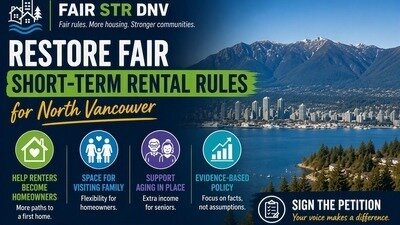

Align DNV Short-Term Rental Rules with Provincial Standards
The Issue
We, the residents of the District of North Vancouver, are calling on the District to align its Short-Term Rental (STR) bylaw with provincial regulations by allowing:
- One STR in a principal residence; and
- One STR in a legal secondary suite or accessory dwelling unit (ADU) on the same property;
provided the homeowner resides on the property.[1]
The current one-licence-per-property rule is more restrictive than provincial regulations, more restrictive than neighboring municipalities, and does not reflect how many families, seniors, and homeowners actually use their homes.
Why the Current Rule Should Be Reconsidered
1 - STRs are not a meaningful driver of housing scarcity
Evidence suggests that short-term rentals represent only a small share of the housing market and are unlikely to be a major cause of rental affordability challenges.
- STRs account for approximately 1.2% of DNV housing stock.[2]
- Statistics Canada found that units potentially convertible from STRs to long-term rentals represent less than 1% of Canada's housing stock.[3]
- CMHC identifies population growth, housing supply constraints, construction delays, and financing conditions as the primary drivers of housing shortages.[4]
- DNV's rental vacancy rate has risen from 2.9% to 3.4%.[7]
- The Province has indicated that municipalities with vacancy rates above 3% may be eligible for greater STR flexibility, recognizing that STRs are not a significant driver of rental shortages.[6]
- Market conditions also suggest that DNV's STR sector is increasingly demand-driven rather than supply-constrained. Based on AirDNA data reviewed by local hosts, there are approximately 400 active STR units in DNV and competition among hosts has increased as demand has leveled off. Even during major tourism and sporting events, accommodation availability remained relatively high, suggesting that additional STR restrictions are unlikely to meaningfully improve affordability while reducing flexibility for resident homeowners.
2.Homeownership is not the problem - it is part of the solution
Housing affordability does not improve when homeownership becomes harder to achieve.
- Many DNV residents rely on occasional STR income to help cover mortgages, property taxes, insurance, and maintenance costs. That flexibility can help families purchase a home, remain in it, and build long-term financial stability.
- Homeownership also benefits the broader housing market. Every renter who becomes a homeowner frees up a rental unit for someone else. By limiting homeowner flexibility, the current bylaw may make that transition harder while providing little measurable benefit to housing supply.
- First-time buyer flexibility: If you're buying your first home and want to keep your suite available for visiting family or future needs, you should still be able to rent your main home when you travel. Under the current one-licence rule, that option disappears.
3. Families need practical options
Many homeowners use their suite for relatives during part of the year and short-term guests during other periods. The current rule forces families to choose one use or the other, even though both are permitted under provincial regulations and can be managed responsibly.
4. Seniors need flexibility and independence
Many seniors rely on flexible housing arrangements to remain in their homes as they age.
- A suite may be used by family members, future caregivers, or visiting relatives. At other times, short-term rental income can help offset rising living expenses.
- Retiree affordability: A senior facing increasing property taxes, utility costs, insurance premiums, and healthcare expenses may need income from both a suite and a spare bedroom at different times of the year. The current bylaw unnecessarily limits those options.
5. Renovation realities should not create unintended consequences
Homeowners frequently need to renovate either their principal residence or their suite.
- Under the current one-licence rule, renovating one unit can eliminate all STR income, even when another part of the property remains available. This creates unnecessary financial pressure and can unintentionally contribute to future tenant displacement.
- Renovation realities: If you're renovating your suite, you should be able to temporarily rent a room in your main home to help offset costs. The current rule removes that flexibility and can contribute to avoidable renovictions later.
What We Are Asking For
We ask the District of North Vancouver to align its STR bylaw with provincial standards by allowing:
- One STR in a principal residence; and
- One STR in a legal secondary suite or ADU;
provided the homeowner resides on the property.
This change would:
- Support homeowners facing rising costs.
- Improve flexibility for families and seniors.
- Reduce the risk of avoidable renovictions.
- Reflect current housing and STR market realities.
- Align local regulations with provincial policy.
- Support pathways to homeownership.
- Maintain responsible, resident-hosted short-term rentals.
References
[1] BC Government - Short-Term Rental Accommodations Framework
https://www2.gov.bc.ca/gov/content/housing-tenancy/short-term-rentals
[2] District of North Vancouver STR Program Data
[3] Statistics Canada - Short-term rentals and housing in Canada
https://www150.statcan.gc.ca/n1/pub/46-28-0001/2023001/article/00003-eng.htm
[4] Canada Mortgage and Housing Corporation (CMHC) - Housing Supply Shortage Analysis
https://www.cmhc-schl.gc.ca/en/blog/2024/canada-housing-supply-shortage
[5] District of North Vancouver Community Statistics
https://www.dnv.org/community-statistics
[6] Government of British Columbia - Vacancy Rate Flexibility Announcement
https://news.gov.bc.ca/releases/2026HMA0045-000428
[7] District of North Vancouver Rental Market Data
https://www.dnv.org/community-environment/rental-market-data-in-the-district

88
The Issue
We, the residents of the District of North Vancouver, are calling on the District to align its Short-Term Rental (STR) bylaw with provincial regulations by allowing:
- One STR in a principal residence; and
- One STR in a legal secondary suite or accessory dwelling unit (ADU) on the same property;
provided the homeowner resides on the property.[1]
The current one-licence-per-property rule is more restrictive than provincial regulations, more restrictive than neighboring municipalities, and does not reflect how many families, seniors, and homeowners actually use their homes.
Why the Current Rule Should Be Reconsidered
1 - STRs are not a meaningful driver of housing scarcity
Evidence suggests that short-term rentals represent only a small share of the housing market and are unlikely to be a major cause of rental affordability challenges.
- STRs account for approximately 1.2% of DNV housing stock.[2]
- Statistics Canada found that units potentially convertible from STRs to long-term rentals represent less than 1% of Canada's housing stock.[3]
- CMHC identifies population growth, housing supply constraints, construction delays, and financing conditions as the primary drivers of housing shortages.[4]
- DNV's rental vacancy rate has risen from 2.9% to 3.4%.[7]
- The Province has indicated that municipalities with vacancy rates above 3% may be eligible for greater STR flexibility, recognizing that STRs are not a significant driver of rental shortages.[6]
- Market conditions also suggest that DNV's STR sector is increasingly demand-driven rather than supply-constrained. Based on AirDNA data reviewed by local hosts, there are approximately 400 active STR units in DNV and competition among hosts has increased as demand has leveled off. Even during major tourism and sporting events, accommodation availability remained relatively high, suggesting that additional STR restrictions are unlikely to meaningfully improve affordability while reducing flexibility for resident homeowners.
2.Homeownership is not the problem - it is part of the solution
Housing affordability does not improve when homeownership becomes harder to achieve.
- Many DNV residents rely on occasional STR income to help cover mortgages, property taxes, insurance, and maintenance costs. That flexibility can help families purchase a home, remain in it, and build long-term financial stability.
- Homeownership also benefits the broader housing market. Every renter who becomes a homeowner frees up a rental unit for someone else. By limiting homeowner flexibility, the current bylaw may make that transition harder while providing little measurable benefit to housing supply.
- First-time buyer flexibility: If you're buying your first home and want to keep your suite available for visiting family or future needs, you should still be able to rent your main home when you travel. Under the current one-licence rule, that option disappears.
3. Families need practical options
Many homeowners use their suite for relatives during part of the year and short-term guests during other periods. The current rule forces families to choose one use or the other, even though both are permitted under provincial regulations and can be managed responsibly.
4. Seniors need flexibility and independence
Many seniors rely on flexible housing arrangements to remain in their homes as they age.
- A suite may be used by family members, future caregivers, or visiting relatives. At other times, short-term rental income can help offset rising living expenses.
- Retiree affordability: A senior facing increasing property taxes, utility costs, insurance premiums, and healthcare expenses may need income from both a suite and a spare bedroom at different times of the year. The current bylaw unnecessarily limits those options.
5. Renovation realities should not create unintended consequences
Homeowners frequently need to renovate either their principal residence or their suite.
- Under the current one-licence rule, renovating one unit can eliminate all STR income, even when another part of the property remains available. This creates unnecessary financial pressure and can unintentionally contribute to future tenant displacement.
- Renovation realities: If you're renovating your suite, you should be able to temporarily rent a room in your main home to help offset costs. The current rule removes that flexibility and can contribute to avoidable renovictions later.
What We Are Asking For
We ask the District of North Vancouver to align its STR bylaw with provincial standards by allowing:
- One STR in a principal residence; and
- One STR in a legal secondary suite or ADU;
provided the homeowner resides on the property.
This change would:
- Support homeowners facing rising costs.
- Improve flexibility for families and seniors.
- Reduce the risk of avoidable renovictions.
- Reflect current housing and STR market realities.
- Align local regulations with provincial policy.
- Support pathways to homeownership.
- Maintain responsible, resident-hosted short-term rentals.
References
[1] BC Government - Short-Term Rental Accommodations Framework
https://www2.gov.bc.ca/gov/content/housing-tenancy/short-term-rentals
[2] District of North Vancouver STR Program Data
[3] Statistics Canada - Short-term rentals and housing in Canada
https://www150.statcan.gc.ca/n1/pub/46-28-0001/2023001/article/00003-eng.htm
[4] Canada Mortgage and Housing Corporation (CMHC) - Housing Supply Shortage Analysis
https://www.cmhc-schl.gc.ca/en/blog/2024/canada-housing-supply-shortage
[5] District of North Vancouver Community Statistics
https://www.dnv.org/community-statistics
[6] Government of British Columbia - Vacancy Rate Flexibility Announcement
https://news.gov.bc.ca/releases/2026HMA0045-000428
[7] District of North Vancouver Rental Market Data
https://www.dnv.org/community-environment/rental-market-data-in-the-district
The Decision Makers

Petition Updates
Share this petition
Petition created on August 17, 2026