Campaign Organiser Takes Part in British-Irish Airports Expo

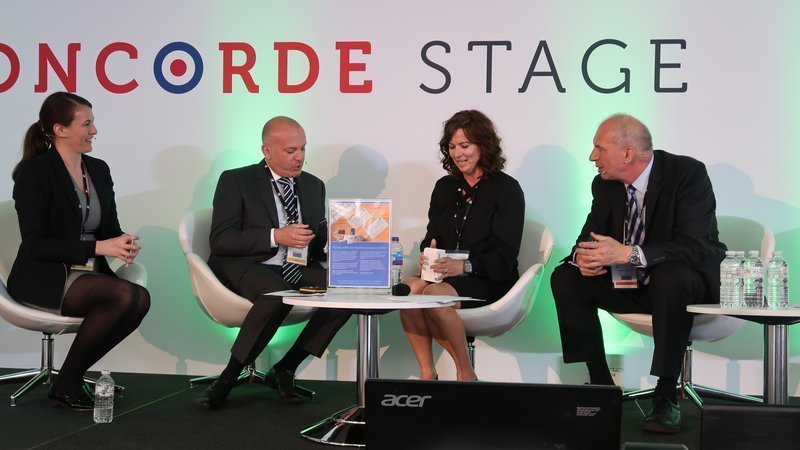
On Tuesday 11 June 2019, I gave a short speech regarding our campaign at the British-Irish Airports Expo at London Olympia, at the invitation of Peter Drissell, CAA Director of Aviation Security. It was a great opportunity to spread awareness of the Medical Device Awareness Card to key people in the aviation industry, many of whom I spoke with after the session. Here is a copy of the short speech.
“My son, George, who is now 17, was diagnosed with Type 1 Diabetes at the age of 9. He wears an insulin pump, which is a small battery operated device that delivers precise doses of insulin 24 hours a day.
The pump has a compartment that holds a reservoir filled with insulin which is then infused into the body through small tubing and a cannula inserted under the skin. The insulin pump must be constantly attached because disconnection would cause blood sugars to rise and ketoacidosis could then develop. This can then quickly become a life-threatening emergency which can develop faster in children. Hospital admission is essential to correct the life-threatening condition.
Hospitals and insulin pump manufacturers advise that x-ray screening and body scanners may interfere with the pump motor, resulting in a potential impact on insulin delivery. Therefore, pumps should not go through x-ray machines or full-body airport scanners.
In May 2016, I wrote an Open Letter to Dubai Airport after my family were held in an airport police room for over two hours and denied access to an aircraft because of George’s insulin pump. At the security gate an officer told George that his pump must be disconnected and put through the x-ray machine. I showed security our official documentation and explained the potential damage to the pump. The security team were adamant that the pump should go through.
We were escorted to the airport police room where we were held for two hours. It wasn’t until a doctor from the airport medical centre confirmed to the officer that what we had explained was correct, that we were told we could travel. By this time, George was visibly shaken, and his blood sugars had risen.
When I returned to the UK, I looked into the protocols in place for medical devices such as insulin pumps. I discovered that regulations do allow passengers to request a pat-down supported by ETD (explosive trace detection) in lieu of x-rays and body scanners and that the pump should not be removed from the passenger. So, I started a campaign to raise awareness, which quickly gained support.
I spoke directly with the major pump manufacturers, key NHS staff and security departments at most UK airports. I also reached out to the Chief Exec of the CAA and the Department of Transport who both lent their support, and the Airport Operators Association sent a reminder on the regulations to all UK airports.
We had articles published with JDRF, Diabetes UK and International Airport Review which highlighted the issues and helped spread awareness of the correct protocols.
I contacted the Head of Security at ACI World who in turn published an article called “Best practice for screening of insulin pumps” in their World Report, which was sent to their members operating over 1,800 airports in more than 170 countries.
The campaign made good progress, but it was not enough. I was receiving daily messages from pump users all over the world, who were having terrible experiences including accounts of pumps malfunctioning when forced to go through standard security. It became evident that this was an issue affecting thousands of travellers every year with many passengers avoiding certain airports or simply too anxious to travel via air again.
After pushing the campaign further, ACI World presented the issue at a global level to the ICAO and member states of the Aviation Security Panel. As a result, updated guidance material was included in the 10th edition of their Security Manual.
Despite all these protocols in place, Security Officers were often unaware and would argue that the pumps should go through standard security.
It was after a meeting with Peter Drissell and Michael Lee in December last year, that we started working on a new Medical Device Awareness Card, designed to remove any confusion at airport security. The card was offically launched in February this year, just in time for half-term! Sponsored by both the CAA and the AOA, the card has information on one side for Security Officers and for the passenger on the other and is backed by the UK government.
The card has received positive feedback and from a personal point of view, it means my son now has the freedom to travel without his lioness mother. The same goes for other young people, especially when on school trips etc. I arranged for information posters to be distributed to all NHS Diabetes clinics through the UK and continue to promote it on various social media platforms.
Last week I asked the European Commission to replicate the card for use at all EU airports. The Director-General for Mobility and Transport replied saying that the initiative seemed extremely effective and that it will be presented at the next meeting of the Aviation Security Regulatory Committee, where all EU Member States are present. Henrik Hololei added that the aim would be for the translation of the card into all the official EU languages and it would then be distributed via their official website. I am hoping to work with the TSA to adopt the same scheme.
I would like to add that running this campaign, which now has 13,000 signatures, is an interesting experience! I am working on both a grass roots level by hearing and talking to people who this affects directly, and also with the top management of various organisations, so I get to see all sides.
In closing, I would like to say how very grateful I am that the CAA worked so hard on this project and thank Peter Drissell, Michael Lee and Gloria Matlock for the time and effort that they have put into this critical project. My goal continues which is for all medical device users to have a stress free and safe experience at airport security around the world.”
RACHEL HUMPHREY