

A Mathematically Fairer Voting System: Adopt Rated Voting Now!
The Issue
Proposal for Adopting Rated Voting Systems: A Mathematically Fairer and More Representative Electoral Process
Overview
Democratic elections are meant to reflect the will of the people, yet traditional voting systems—especially Plurality Voting (First-Past-The-Post, FPTP)—are mathematically flawed and often fail to produce representative outcomes. This proposal presents Rated Voting Systems as a superior alternative, backed by mathematical proofs and real-world examples, demonstrating how they lead to fairer elections while addressing the inherent impossibility of true democracy under traditional methods.
This proposal will outline:
Why Traditional Democracies Are Mathematically Impossible
The Failings of Traditional Voting Systems
How Rated Voting Works
Mathematical Proof of Its Superiority
Key Advantages of Rated Voting
Call to Action for Implementation
1. Why Traditional Democracies Are Mathematically Impossible
The idea that elections perfectly capture "the will of the people" is fundamentally flawed due to mathematical paradoxes in voting theory.
A. Arrow’s Impossibility Theorem
In 1951, economist Kenneth Arrow proved that no rank-based voting system can perfectly satisfy all desirable criteria of fairness. Arrow's Theorem states that for any election system where voters rank candidates, the following three conditions cannot be simultaneously met:
Unrestricted Domain – Any set of voter preferences should be possible.
Non-Dictatorship – No single voter should unilaterally decide the outcome.
Pareto Efficiency – If all voters prefer Candidate A over Candidate B, then B should not win.
Arrow’s theorem mathematically proves that traditional democratic elections inevitably fail at least one of these fairness conditions, leading to distorted results.
B. The Condorcet Paradox (Majority Cycling)
A core flaw of democracy is the Condorcet Paradox, where majority rule can create circular, contradictory preferences. Consider the following election with three candidates:
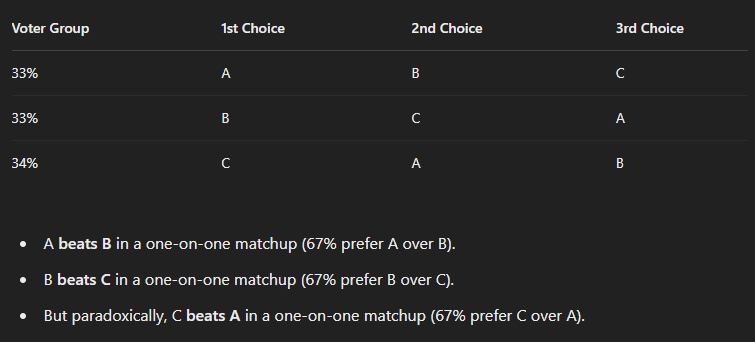
Thus, there is no clear "winner" that truly represents the majority. This exposes a fundamental flaw: democratic voting can create a cycle where no candidate is the absolute best choice, meaning elections may fail to select the most representative leader.
2. The Failings of Traditional Voting Systems
A. Plurality Voting (FPTP) Produces Unrepresentative Winners
Forces voters to pick only one candidate, even if they have nuanced preferences.
Majority rule is not guaranteed—a candidate can win with as little as 30-40% of votes, meaning most voters actually opposed them.
Vote splitting causes popular candidates to lose if similar candidates divide support.
🔴 Real-World Example: The 2000 U.S. Presidential Election
George W. Bush (Republican) won with 47.9% of the popular vote.
Al Gore (Democrat) received 48.4% but lost due to the Electoral College.
Ralph Nader (Green) got 2.7%, but most Nader voters would have preferred Gore.
Nader "spoiled" the election by pulling votes from Gore, handing the presidency to Bush—even though a majority of Americans preferred a non-Bush candidate.
B. The Two-Party Trap (Duverger’s Law)
Mathematically, Plurality Voting always trends toward two-party dominance, known as Duverger’s Law:

🔴 Real-World Example: The UK’s 2019 General Election
Boris Johnson’s Conservative Party won with 43.6% of the vote.
Over 56% of voters preferred other parties, but the opposition vote was split among Labor, Liberal Democrats, and others, handing the Conservatives full control.
3. How Rated Voting Works
Rated Voting fixes these flaws by allowing voters to score each candidate on a scale (e.g., 0-5, 0-10) instead of picking just one.
If a voter strongly supports a candidate, they give a high rating (e.g., 5).
If they dislike a candidate, they give a low rating (e.g., 0).
If they are indifferent, they may give an intermediate rating (e.g., 3).
The winner is the candidate with the highest total or average score, ensuring that broad support matters rather than just a simple plurality.
4. Mathematical Proof of Its Superiority
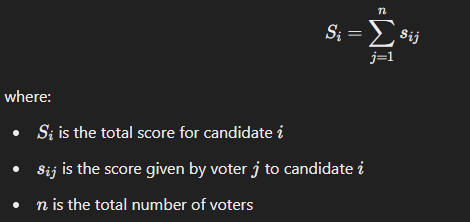
A. Capturing Voter Intensity
Plurality Voting ignores voter intensity. Rated Voting captures it through:
B. Eliminating the Spoiler Effect
In Rated Voting, if two similar candidates (e.g., Gore and Nader) receive high ratings from the same voters, both still accumulate points instead of splitting votes.
🔵 Proof: Suppose:
Gore and Nader share 60% of voters’ total approval.
Bush has 40% strong but isolated support.
In Plurality Voting, Bush wins with 40% because Gore and Nader split votes.
In Rated Voting, even if Nader receives high scores, Gore still accumulates enough to win.
Thus, spoilers are mathematically eliminated, leading to fairer results.
5. Key Advantages of Rated Voting
✅ 1. More Representative Elections
Captures both breadth and intensity of support.
✅ 2. Reducing Strategic Voting
Voters can honestly score all candidates instead of "lesser evil" voting.
✅ 3. Eliminating the "Spoiler Effect"
Similar candidates no longer split votes.
✅ 4. Encouraging Positive Campaigning
Candidates are incentivized to appeal to all voters, reducing polarization.
✅ 5. Smooth Implementation with Existing Infrastructure
Simple ballot changes allow easy adoption.
6. Call to Action
Mathematical and real-world evidence confirms Plurality Voting is fundamentally flawed. Rated Voting is the superior alternative.
We urge policymakers to:
Pilot Rated Voting in local elections
Study its real-world effects
Pass legislation for nation
al adoption
📢 Sign this petition to demand a fairer democracy!

2
The Issue
Proposal for Adopting Rated Voting Systems: A Mathematically Fairer and More Representative Electoral Process
Overview
Democratic elections are meant to reflect the will of the people, yet traditional voting systems—especially Plurality Voting (First-Past-The-Post, FPTP)—are mathematically flawed and often fail to produce representative outcomes. This proposal presents Rated Voting Systems as a superior alternative, backed by mathematical proofs and real-world examples, demonstrating how they lead to fairer elections while addressing the inherent impossibility of true democracy under traditional methods.
This proposal will outline:
Why Traditional Democracies Are Mathematically Impossible
The Failings of Traditional Voting Systems
How Rated Voting Works
Mathematical Proof of Its Superiority
Key Advantages of Rated Voting
Call to Action for Implementation
1. Why Traditional Democracies Are Mathematically Impossible
The idea that elections perfectly capture "the will of the people" is fundamentally flawed due to mathematical paradoxes in voting theory.
A. Arrow’s Impossibility Theorem
In 1951, economist Kenneth Arrow proved that no rank-based voting system can perfectly satisfy all desirable criteria of fairness. Arrow's Theorem states that for any election system where voters rank candidates, the following three conditions cannot be simultaneously met:
Unrestricted Domain – Any set of voter preferences should be possible.
Non-Dictatorship – No single voter should unilaterally decide the outcome.
Pareto Efficiency – If all voters prefer Candidate A over Candidate B, then B should not win.
Arrow’s theorem mathematically proves that traditional democratic elections inevitably fail at least one of these fairness conditions, leading to distorted results.
B. The Condorcet Paradox (Majority Cycling)
A core flaw of democracy is the Condorcet Paradox, where majority rule can create circular, contradictory preferences. Consider the following election with three candidates:
Thus, there is no clear "winner" that truly represents the majority. This exposes a fundamental flaw: democratic voting can create a cycle where no candidate is the absolute best choice, meaning elections may fail to select the most representative leader.
2. The Failings of Traditional Voting Systems
A. Plurality Voting (FPTP) Produces Unrepresentative Winners
Forces voters to pick only one candidate, even if they have nuanced preferences.
Majority rule is not guaranteed—a candidate can win with as little as 30-40% of votes, meaning most voters actually opposed them.
Vote splitting causes popular candidates to lose if similar candidates divide support.
🔴 Real-World Example: The 2000 U.S. Presidential Election
George W. Bush (Republican) won with 47.9% of the popular vote.
Al Gore (Democrat) received 48.4% but lost due to the Electoral College.
Ralph Nader (Green) got 2.7%, but most Nader voters would have preferred Gore.
Nader "spoiled" the election by pulling votes from Gore, handing the presidency to Bush—even though a majority of Americans preferred a non-Bush candidate.
B. The Two-Party Trap (Duverger’s Law)
Mathematically, Plurality Voting always trends toward two-party dominance, known as Duverger’s Law:
🔴 Real-World Example: The UK’s 2019 General Election
Boris Johnson’s Conservative Party won with 43.6% of the vote.
Over 56% of voters preferred other parties, but the opposition vote was split among Labor, Liberal Democrats, and others, handing the Conservatives full control.
3. How Rated Voting Works
Rated Voting fixes these flaws by allowing voters to score each candidate on a scale (e.g., 0-5, 0-10) instead of picking just one.
If a voter strongly supports a candidate, they give a high rating (e.g., 5).
If they dislike a candidate, they give a low rating (e.g., 0).
If they are indifferent, they may give an intermediate rating (e.g., 3).
The winner is the candidate with the highest total or average score, ensuring that broad support matters rather than just a simple plurality.
4. Mathematical Proof of Its Superiority
A. Capturing Voter Intensity
Plurality Voting ignores voter intensity. Rated Voting captures it through:
B. Eliminating the Spoiler Effect
In Rated Voting, if two similar candidates (e.g., Gore and Nader) receive high ratings from the same voters, both still accumulate points instead of splitting votes.
🔵 Proof: Suppose:
Gore and Nader share 60% of voters’ total approval.
Bush has 40% strong but isolated support.
In Plurality Voting, Bush wins with 40% because Gore and Nader split votes.
In Rated Voting, even if Nader receives high scores, Gore still accumulates enough to win.
Thus, spoilers are mathematically eliminated, leading to fairer results.
5. Key Advantages of Rated Voting
✅ 1. More Representative Elections
Captures both breadth and intensity of support.
✅ 2. Reducing Strategic Voting
Voters can honestly score all candidates instead of "lesser evil" voting.
✅ 3. Eliminating the "Spoiler Effect"
Similar candidates no longer split votes.
✅ 4. Encouraging Positive Campaigning
Candidates are incentivized to appeal to all voters, reducing polarization.
✅ 5. Smooth Implementation with Existing Infrastructure
Simple ballot changes allow easy adoption.
6. Call to Action
Mathematical and real-world evidence confirms Plurality Voting is fundamentally flawed. Rated Voting is the superior alternative.
We urge policymakers to:
Pilot Rated Voting in local elections
Study its real-world effects
Pass legislation for nation
al adoption
📢 Sign this petition to demand a fairer democracy!
The Decision Makers
Petition Updates
Share this petition
Petition created on 3 April 2025