

Audit Toronto Shelter and Support Services (TSSS)
The Issue
For a downloadable PDF version of this petition click HERE
This petition demands an independent, third-party audit of Toronto Shelter and Support Services (TSSS), which spends close to $1 billion annually on a system that continues to deteriorate. Despite escalating budgets, homelessness, encampments, drug use, and public disorder have worsened. TSSS serves 12,000 people daily—at a per-user cost of over $75,000/year. Refugees now occupy nearly half of all beds, and emergency service costs go unaccounted for. Internal audits lack true independence. Torontonians deserve transparency, accountability, and fiscal responsibility. A forensic audit—by either the Auditor General of Ontario or an external firm—is urgently needed to restore public trust and ensure this massive budget is being stewarded wisely.
Every year, the City of Toronto, through the Toronto Shelter and Support Services (TSSS) division, spends close to $1 billion in operating costs on the shelter system for the homeless. Not to build new housing, not to treat addiction, not to reduce street encampments - just to keep the status quo limping along [1].
Most of us - everyday people - instinctively know that something is wrong with this shelter model. We are forced to navigate hard drug use in public spaces, psychotic episodes in our parks and neighbourhoods, aggressive panhandling, increased criminality, needles in the streets, and illegal encampments. We can see and feel how these issues have gotten significantly worse in recent years. The situation does not improve. In fact, it’s getting worse despite TSSS throwing more money at the problem. This begs many questions:
- Do Torontonians fully appreciate the enormous, true cost of this broken model?
- Why do illegal encampments and instances of open drug abuse get worse each year when we spend more and more public money on homelessness?
- When did we, the citizens agree to spend close to $1 billion a year on perpetuating a poverty-industrial-complex that gets worse over time?
- With this enormous budget, how come we are playing whack-a-mole with illegal encampments which take over our parks, playgrounds, and public spaces?
- How do third-party agencies, companies, consultants, and non-profits who receive this money spend it? Who is monitoring them?
- Why are refugees taking up 50% of available shelter space? Why are they being housed on some of the most expensive land in the entire country?
Our Demand
While TSSS has undergone an audit by the City of Toronto’s Auditor General, these audits lack the controls, autonomy, and enforcement powers that a Provincial or third-party audit instructed by City Council could deliver.
The City’s auditor has more pronounced staff and budget constraints, beholden to City Council thus diminishing impartiality, and lacks enforcement power. They simply do not have the resources, oversight or enforcement powers that a forensic examination of this department warrants.
That is why we are calling for an independent, third-party financial and operational audit of TSSS.
We demand this audit happen through a process led by either:
a) Toronto City Council in cooperation with an external auditor, such as KPMG; or,
b) The Office of the Auditor General of Ontario, under the direction of the Minister of Municipal Affairs and Housing (Hon. Rob Flack)
Our research indicates that the TSSS has never been forensically audited via an impartial third-party. The time for this exercise in due diligence has come.
Where is the accountability?
This petition is not intended to dehumanize the homeless population. This is not a matter of lack of compassion. We recognize that homelessness is multi-faceted, and involves issues of employment, mental health, criminality, and addiction. We recognize that this is a difficult situation filled with only difficult choices.
Rather, this petition is about accountability and the opaque nature of TSSS’ nearly $1 billion annual budget. What’s more, within the context of the allocation of scarce public resources, where Toronto is strapped for cash, where our infrastructure is crumbling (nevermind repair and expansion), and where Torontonians face double-digit hikes in property taxes, this is about value for money.
The Numbers
TSSS is the third most costly divisional budget in the City of Toronto. The only two divisions which the City spends more are:
TTC: $2.8 billion
Toronto Police Services: $1.2 billion
In fact, since 2023, the TSSS budget has increased by almost 22%.
Unlike the TTC and Toronto Police Service, which are vital services and serve all Torontonians, the TSSS budget serves only about 12,000 people on any given day. That means a shelter user is subsidized by an average of about $75,000 in service per year from the City (consider that the average salary for Toronto is $79,000/year).
The total City of Toronto operating budget for 2025 is $18.8 billion. To put that into context, 5% of the entire annual City budget goes to homelessness services - a system that perpetuates a never-ending cycle of chronic homelessness, crime and addiction.
And, if you do not include the refugee migrants living in the shelter system (since 2013, Toronto designated itself a “sanctuary city” under the AccessTO banner, despite not having adequate resources to house and support these refugees), the total cost per Canadian-citizen shelter user is a staggering $128,000 per year. This is your money!
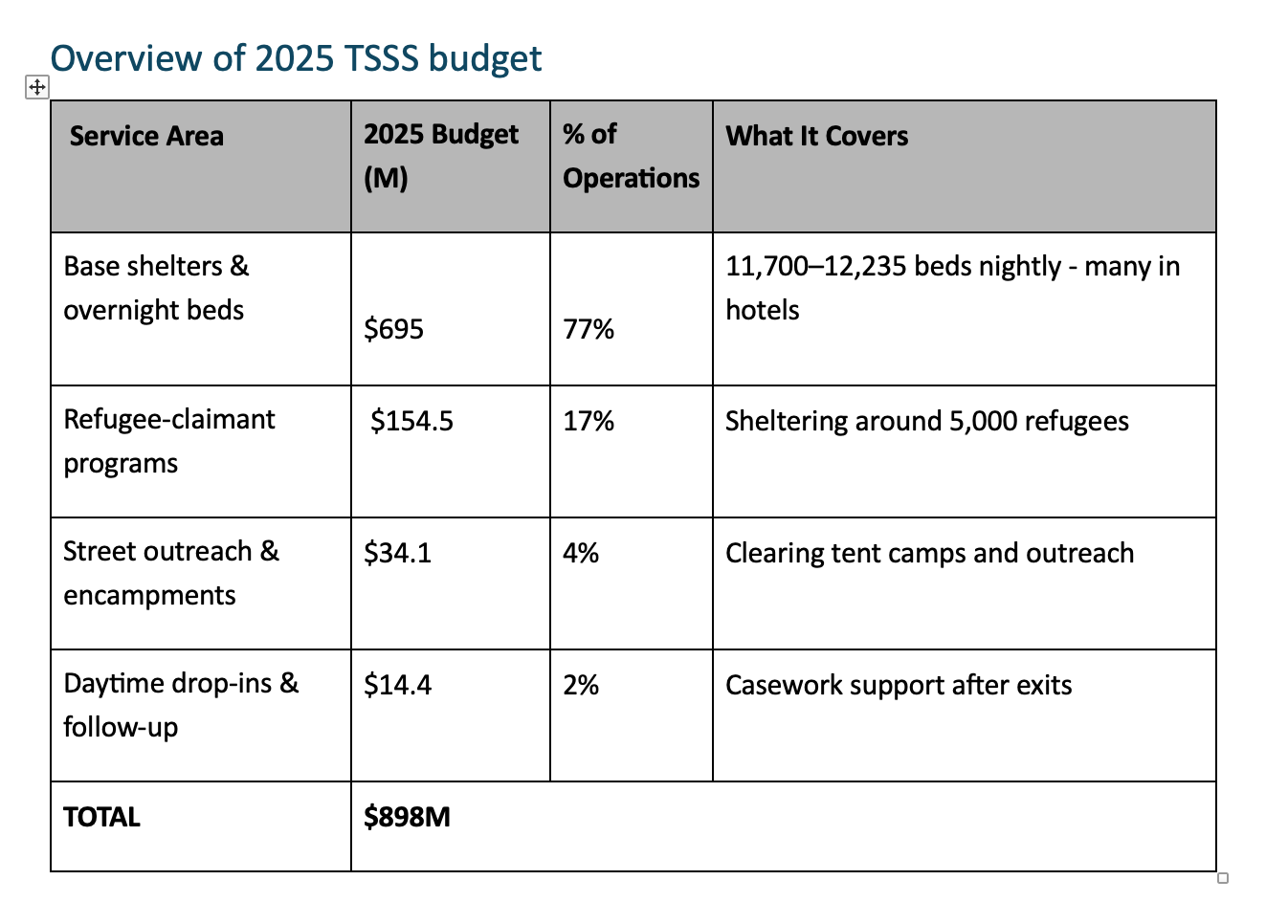
Source: [2]
The Hidden Costs of Shelters
Toronto’s shelter system doesn’t just cost the City nearly $900 million a year to operate - it also silently drains millions from the budgets of Toronto Fire, EMS, and Police Services. Every day, first responders are pulled from other calls to handle incidents inside or around shelter sites.
Emergency costs are not reflected in the TSSS budget, but they are very real, and they are disproportionately incurred by shelters and shelter users. Every day, first responders are pulled from other calls to handle incidents - often preventable ones - inside or around shelter sites. These include:
- Overdoses and drug poisoning
- Mental health breakdowns and psychotic episodes
- Weapons calls, assaults, and public disturbances
- Fires in encampments or shelter-adjacent areas
- Public health hazards like human waste, needles, or biohazard cleanup
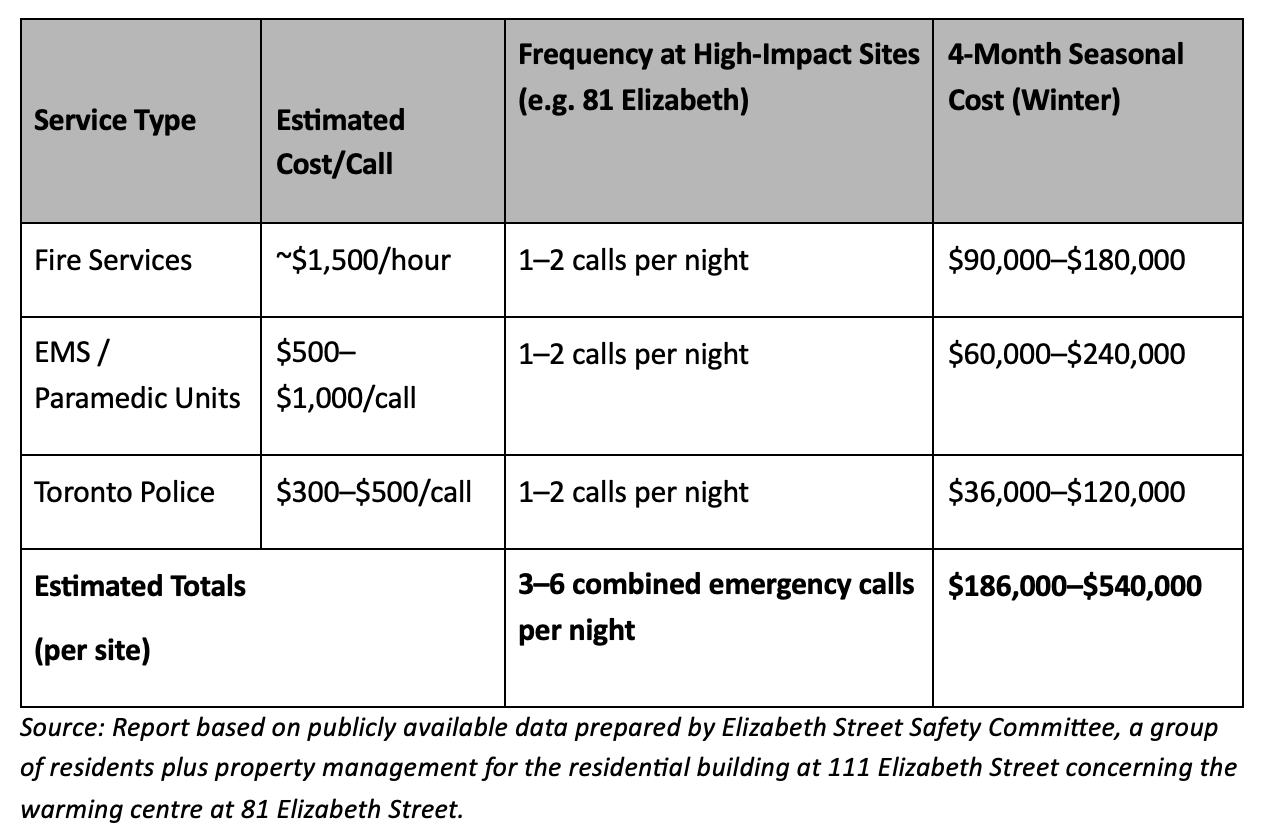
Data on these exact costs is difficult to find. However, based on publicly available data we have gathered about incidents at just one warming centre (81 Elizabeth Street), emergency costs are estimated between $180 - $500k over a four-month winter period. If scaled across the city for all warming centres and shelters, the total hidden cost to emergency services would be in the tens of millions each year. Yet none of these costs are included in the TSSS budget, meaning the true financial burden of the shelter system is even higher than reported.
Based on public data, the below table summarizes ancillary emergency costs to the city:
Read the shocking report on 81 Elizabeth Street HERE:
The above estimates reflect the costs for just one warming centre (not necessarily a ‘shelter’’) over the cold season. Toronto operates multiple such sites. If scaled across the city for all warming centres, the total hidden cost to emergency services likely exceeds $2 million per winter.
Yet none of these costs are included in the TSSS budget, meaning the true financial burden of the shelter system is even higher than reported. A truly independent audit of TSSS must include these emergency response expenditures to provide an honest picture of what Toronto’s shelter model really costs.
Bureaucratic Bloat
In 2025, TSSS spent more than $172 million on salaries and benefits for its 1,497 staff [10] [11]. The average salary of a TSSS employee is $115,000, effectively making the average TSSS employee a member of the Sunshine List. Again, the average salary for Toronto is $79,000/year.
Moreover, since 2021, TSSS has spent an astonishing $1.26 million on diversity, equity and inclusion (DEI) and anti-black racism training. In a cash-strapped city, is this an appropriate expenditure of public money?
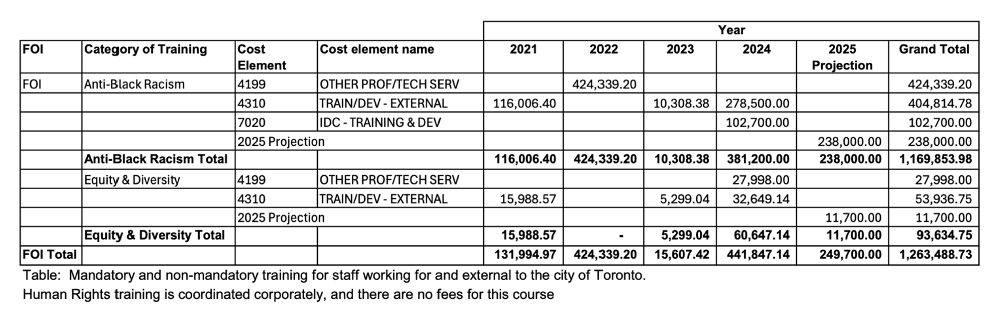
Source: City of Toronto, obtained via FOI request, April 10, 2025
Shelter Services in Numbers
And TSSS wants even more of your money! Mayor Chow has raised taxes almost 17% to date since taking office in 2023. And Chow and budget chief Shelley Carroll have publicly warned that Council may impose an additional Federal Impacts Levy of 6.5% if the federal government doesn’t step in to cover the costs of housing refugees in the shelter system [5].
For this kind of money, you’d expect a reduction in homelessness, crime and addiction. In fact, for this kind of money, you’d expect that the TSSS budget might even decrease over time as the problems are reduced. Instead, since 2023, the TSSS budget has increased by about 22%:
- 2023 Gross Expenditure: $707.150 M
- 2024 Gross Expenditure: $787.487 M
- 2025 Gross Expenditure: $897.957 M
Toronto is pouring this money into a system where shelter beds now serve only 2.3 people per year, down from almost 5 people per year a decade ago [1]. What this means is that shelter users are occupying beds for a longer amount of time, which reduces the availability of beds for other users. It’s a band-aid solution at best and demonstrates that users are not moving on to gainful employment and/or treatment opportunities.
More money for less results.
The Debt Burden
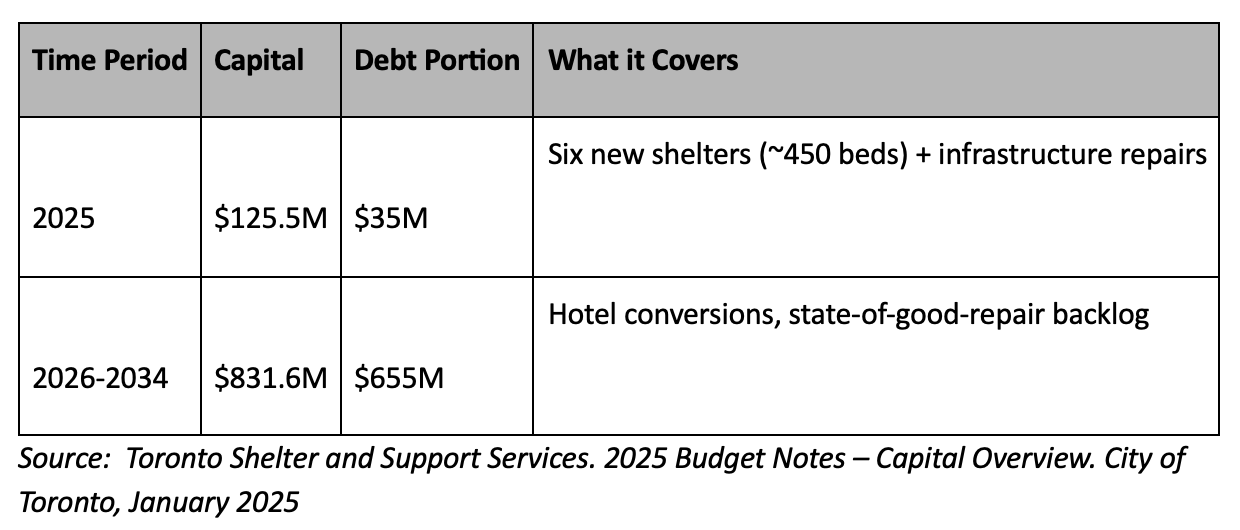
In addition to its operational budget of $900 million, the City is spending $957 million over the next decade in capital costs to expand or repair shelters, and 72% - or $690 million - of that spending is financed with debt.
That’s $690 million of debt spending at a time when the City tells us that it’s effectively broke - and where interest costs of these loans aren't even fully disclosed to the public [2]. And yet, TSSS is building up to 20 new purpose‑built shelter sites by 2033 under its 10‑year Homelessness Services Capital Infrastructure Strategy [6].
Overview of Shelter Debt Allocation:
The Impact of Refugees
Nearly half the beds in the shelter system are now used by non-Canadian refugee claimants. As of late 2024, about 4,800 refugee claimants were sleeping in Toronto shelters each night [3]. Of these, 2,400 were in designated refugee sites, while the other 2,400 took up beds in the general system - beds that used to be available for the Canadian homeless population [3].
Between 2016 and 2023, refugee usage exploded - from 459 nightly users to 3,344 by August 2023 [4]. This is an immigration policy problem - not a shelter capacity problem - that Ottawa has downloaded onto Toronto, except that it is a problem which Council and Mayor Chow have actively embraced, except without adequate support, funding, or infrastructure. Instead of pushing back against the influx of refugees (aka, “Sorry, we cannot take refugees right now!”) Council and Mayor Chow have provided them with scarce City resources - resources that are not available to taxpaying Torontonians who live and work here.
Meanwhile, the public is told there’s no “capacity” in the shelter system, and that the City needs more money for more shelters. Is it fair that newcomers, refugees, and undocumented and illegal migrants can access shelter beds and services subsidized by Canadian citizens, often at the expense of citizens who may have fallen on hard times and now need access to those services? What resource and financial drain are the servicing of non-residents having on our city, our infrastructure, and our tax base?
Lack of Consultation
TSSS doesn’t meaningfully consult residents and communities about the locations of new shelters. Since 2017, Council has delegated the administration of shelter systems, including how, where and when to open new shelters to City staff, effectively by-passing local Councillors (the idea being that, by reducing the involvement of councillors, shelters will face less opposition from residents). What happens to the democratic process when residents are denied a voice?
Some councillors like Gord Perks, Alejandra Bravo, and Shelley Carroll try to discredit this argument by stating “you don’t get to decide who your neighbours are!” but this is a disingenuous claim because the paradigm changes when you are subsidizing your neighbour's home, and they have a high propensity to be disruptive due to behavioural issues, mental illness and drug use.
Since shelters are funded by public money, the public has a right to scrutinize placement, operations, and outcomes. You can’t argue for a shelter’s funding through shared social responsibility, then dismiss local stakeholders as irrelevant when the siting decision is made. If a community is forced to carry the burden, it should also have the right to assess whether the shelter improves outcomes or simply displaces problems from one area to another.
To name but a few recent instances:
- There has been a lack of community consultation for the proposed shelter site at 1615 Dufferin St. (Dufferin and St. Clair). The Concerned Davenport Citizens’ group launched a petition in February 2025 voicing its concerns [7]. The site is directly adjacent to a public library with daily infant programs, within 100 meters of an all-girls high school, and within walking distance to 6 schools and 5 daycares
- Regarding the proposed new shelter site at 2535 Gerrard St E., there has been a documented lack of public consultation. Local Councillor Parthi Kandavel has publicly stated that there doesn’t seem to be a list of criteria about how shelters sites are selected and has expressed concern about the lack of community engagement in such decisions [8]
- Regarding a proposed shelter site for 629 Adelaide St W, the community was told in November 2023 - without notice - that a 50-bed emergency shelter would be created there; the original plan was for a 24-hr low-barrier respite site [9]. The location is within 50 metres of an elementary school. The Niagara Neighbours for Community Safety has launched a petition asking the City to reconsider the site and has also filed legal claims against the City.
Conclusion
This is a call for accountability.
The sheer enormity of public financial resources that are being drained to support an increasingly growing and worsening problem demands deeper examination. We demand a forensic financial, human resources, and operational audit of Toronto Shelter and Support Services.
This division is funded by the people, and we the people demand accountability and transparency on how our money is being spent.
Please sign our petition, and make your voice heard today!
Sources
[1] Toronto Shelter and Support Services. 2025 Capital and Operating Budget Notes. City of Toronto, January 2025, pp. 2–5. https://www.toronto.ca/legdocs/mmis/2025/bu/bgrd/backgroundfile-252522.pdf
[2] Toronto Shelter and Support Services. 2025 Budget Notes – Capital Overview. City of Toronto, January 2025, p. [3] https://www.toronto.ca/legdocs/mmis/2025/bu/bgrd/backgroundfile-252522.pdf
[3] Chan McNally, Diana. Notes on the Toronto Shelter and Support Services (TSSS) Budget. January 2025.
[4] CBC News. “Toronto Says Federal Government Must Help House Refugees as Shelters Overwhelmed.” CBC News, 1 August 2023.
[5] CBC News. “Toronto Faces 10.5% Property Tax Hike, Up to 16.5% if Ottawa Doesn't Provide Funds, Mayor Chow Warns.” CBC/Yahoo News, 17 January 2024.https://www.cbc.ca/news/canada/toronto/toronto-city-budget-launch-1.7078446
[6] Homelessness Services Capital Infrastructure Strategy https://www.toronto.ca/community-people/housing-shelter/homeless-help/about-torontos-shelter-system/developing-shelter-sites/
[7] https://www.change.org/p/relocate-proposed-shelter-at-dufferin-st-clair-1615-dufferin-st
[10] https://niagaraneighbours.org/
[11] Toronto Shelter and Support Services. 2025 Capital and Operating Budget Notes. City of Toronto, January 2025, pp. 10 https://www.toronto.ca/legdocs/mmis/2025/bu/bgrd/backgroundfile-252522.pdf
[12] Toronto Shelter and Support Services. 2025 Capital and Operating Budget Notes. City of Toronto, January 2025, pp.24 https://www.toronto.ca/legdocs/mmis/2025/bu/bgrd/backgroundfile-252522.pdf

2,973
The Issue
For a downloadable PDF version of this petition click HERE
This petition demands an independent, third-party audit of Toronto Shelter and Support Services (TSSS), which spends close to $1 billion annually on a system that continues to deteriorate. Despite escalating budgets, homelessness, encampments, drug use, and public disorder have worsened. TSSS serves 12,000 people daily—at a per-user cost of over $75,000/year. Refugees now occupy nearly half of all beds, and emergency service costs go unaccounted for. Internal audits lack true independence. Torontonians deserve transparency, accountability, and fiscal responsibility. A forensic audit—by either the Auditor General of Ontario or an external firm—is urgently needed to restore public trust and ensure this massive budget is being stewarded wisely.
Every year, the City of Toronto, through the Toronto Shelter and Support Services (TSSS) division, spends close to $1 billion in operating costs on the shelter system for the homeless. Not to build new housing, not to treat addiction, not to reduce street encampments - just to keep the status quo limping along [1].
Most of us - everyday people - instinctively know that something is wrong with this shelter model. We are forced to navigate hard drug use in public spaces, psychotic episodes in our parks and neighbourhoods, aggressive panhandling, increased criminality, needles in the streets, and illegal encampments. We can see and feel how these issues have gotten significantly worse in recent years. The situation does not improve. In fact, it’s getting worse despite TSSS throwing more money at the problem. This begs many questions:
- Do Torontonians fully appreciate the enormous, true cost of this broken model?
- Why do illegal encampments and instances of open drug abuse get worse each year when we spend more and more public money on homelessness?
- When did we, the citizens agree to spend close to $1 billion a year on perpetuating a poverty-industrial-complex that gets worse over time?
- With this enormous budget, how come we are playing whack-a-mole with illegal encampments which take over our parks, playgrounds, and public spaces?
- How do third-party agencies, companies, consultants, and non-profits who receive this money spend it? Who is monitoring them?
- Why are refugees taking up 50% of available shelter space? Why are they being housed on some of the most expensive land in the entire country?
Our Demand
While TSSS has undergone an audit by the City of Toronto’s Auditor General, these audits lack the controls, autonomy, and enforcement powers that a Provincial or third-party audit instructed by City Council could deliver.
The City’s auditor has more pronounced staff and budget constraints, beholden to City Council thus diminishing impartiality, and lacks enforcement power. They simply do not have the resources, oversight or enforcement powers that a forensic examination of this department warrants.
That is why we are calling for an independent, third-party financial and operational audit of TSSS.
We demand this audit happen through a process led by either:
a) Toronto City Council in cooperation with an external auditor, such as KPMG; or,
b) The Office of the Auditor General of Ontario, under the direction of the Minister of Municipal Affairs and Housing (Hon. Rob Flack)
Our research indicates that the TSSS has never been forensically audited via an impartial third-party. The time for this exercise in due diligence has come.
Where is the accountability?
This petition is not intended to dehumanize the homeless population. This is not a matter of lack of compassion. We recognize that homelessness is multi-faceted, and involves issues of employment, mental health, criminality, and addiction. We recognize that this is a difficult situation filled with only difficult choices.
Rather, this petition is about accountability and the opaque nature of TSSS’ nearly $1 billion annual budget. What’s more, within the context of the allocation of scarce public resources, where Toronto is strapped for cash, where our infrastructure is crumbling (nevermind repair and expansion), and where Torontonians face double-digit hikes in property taxes, this is about value for money.
The Numbers
TSSS is the third most costly divisional budget in the City of Toronto. The only two divisions which the City spends more are:
TTC: $2.8 billion
Toronto Police Services: $1.2 billion
In fact, since 2023, the TSSS budget has increased by almost 22%.
Unlike the TTC and Toronto Police Service, which are vital services and serve all Torontonians, the TSSS budget serves only about 12,000 people on any given day. That means a shelter user is subsidized by an average of about $75,000 in service per year from the City (consider that the average salary for Toronto is $79,000/year).
The total City of Toronto operating budget for 2025 is $18.8 billion. To put that into context, 5% of the entire annual City budget goes to homelessness services - a system that perpetuates a never-ending cycle of chronic homelessness, crime and addiction.
And, if you do not include the refugee migrants living in the shelter system (since 2013, Toronto designated itself a “sanctuary city” under the AccessTO banner, despite not having adequate resources to house and support these refugees), the total cost per Canadian-citizen shelter user is a staggering $128,000 per year. This is your money!
Source: [2]
The Hidden Costs of Shelters
Toronto’s shelter system doesn’t just cost the City nearly $900 million a year to operate - it also silently drains millions from the budgets of Toronto Fire, EMS, and Police Services. Every day, first responders are pulled from other calls to handle incidents inside or around shelter sites.
Emergency costs are not reflected in the TSSS budget, but they are very real, and they are disproportionately incurred by shelters and shelter users. Every day, first responders are pulled from other calls to handle incidents - often preventable ones - inside or around shelter sites. These include:
- Overdoses and drug poisoning
- Mental health breakdowns and psychotic episodes
- Weapons calls, assaults, and public disturbances
- Fires in encampments or shelter-adjacent areas
- Public health hazards like human waste, needles, or biohazard cleanup
Data on these exact costs is difficult to find. However, based on publicly available data we have gathered about incidents at just one warming centre (81 Elizabeth Street), emergency costs are estimated between $180 - $500k over a four-month winter period. If scaled across the city for all warming centres and shelters, the total hidden cost to emergency services would be in the tens of millions each year. Yet none of these costs are included in the TSSS budget, meaning the true financial burden of the shelter system is even higher than reported.
Based on public data, the below table summarizes ancillary emergency costs to the city:
Read the shocking report on 81 Elizabeth Street HERE:
The above estimates reflect the costs for just one warming centre (not necessarily a ‘shelter’’) over the cold season. Toronto operates multiple such sites. If scaled across the city for all warming centres, the total hidden cost to emergency services likely exceeds $2 million per winter.
Yet none of these costs are included in the TSSS budget, meaning the true financial burden of the shelter system is even higher than reported. A truly independent audit of TSSS must include these emergency response expenditures to provide an honest picture of what Toronto’s shelter model really costs.
Bureaucratic Bloat
In 2025, TSSS spent more than $172 million on salaries and benefits for its 1,497 staff [10] [11]. The average salary of a TSSS employee is $115,000, effectively making the average TSSS employee a member of the Sunshine List. Again, the average salary for Toronto is $79,000/year.
Moreover, since 2021, TSSS has spent an astonishing $1.26 million on diversity, equity and inclusion (DEI) and anti-black racism training. In a cash-strapped city, is this an appropriate expenditure of public money?
Source: City of Toronto, obtained via FOI request, April 10, 2025
Shelter Services in Numbers
And TSSS wants even more of your money! Mayor Chow has raised taxes almost 17% to date since taking office in 2023. And Chow and budget chief Shelley Carroll have publicly warned that Council may impose an additional Federal Impacts Levy of 6.5% if the federal government doesn’t step in to cover the costs of housing refugees in the shelter system [5].
For this kind of money, you’d expect a reduction in homelessness, crime and addiction. In fact, for this kind of money, you’d expect that the TSSS budget might even decrease over time as the problems are reduced. Instead, since 2023, the TSSS budget has increased by about 22%:
- 2023 Gross Expenditure: $707.150 M
- 2024 Gross Expenditure: $787.487 M
- 2025 Gross Expenditure: $897.957 M
Toronto is pouring this money into a system where shelter beds now serve only 2.3 people per year, down from almost 5 people per year a decade ago [1]. What this means is that shelter users are occupying beds for a longer amount of time, which reduces the availability of beds for other users. It’s a band-aid solution at best and demonstrates that users are not moving on to gainful employment and/or treatment opportunities.
More money for less results.
The Debt Burden
In addition to its operational budget of $900 million, the City is spending $957 million over the next decade in capital costs to expand or repair shelters, and 72% - or $690 million - of that spending is financed with debt.
That’s $690 million of debt spending at a time when the City tells us that it’s effectively broke - and where interest costs of these loans aren't even fully disclosed to the public [2]. And yet, TSSS is building up to 20 new purpose‑built shelter sites by 2033 under its 10‑year Homelessness Services Capital Infrastructure Strategy [6].
Overview of Shelter Debt Allocation:
The Impact of Refugees
Nearly half the beds in the shelter system are now used by non-Canadian refugee claimants. As of late 2024, about 4,800 refugee claimants were sleeping in Toronto shelters each night [3]. Of these, 2,400 were in designated refugee sites, while the other 2,400 took up beds in the general system - beds that used to be available for the Canadian homeless population [3].
Between 2016 and 2023, refugee usage exploded - from 459 nightly users to 3,344 by August 2023 [4]. This is an immigration policy problem - not a shelter capacity problem - that Ottawa has downloaded onto Toronto, except that it is a problem which Council and Mayor Chow have actively embraced, except without adequate support, funding, or infrastructure. Instead of pushing back against the influx of refugees (aka, “Sorry, we cannot take refugees right now!”) Council and Mayor Chow have provided them with scarce City resources - resources that are not available to taxpaying Torontonians who live and work here.
Meanwhile, the public is told there’s no “capacity” in the shelter system, and that the City needs more money for more shelters. Is it fair that newcomers, refugees, and undocumented and illegal migrants can access shelter beds and services subsidized by Canadian citizens, often at the expense of citizens who may have fallen on hard times and now need access to those services? What resource and financial drain are the servicing of non-residents having on our city, our infrastructure, and our tax base?
Lack of Consultation
TSSS doesn’t meaningfully consult residents and communities about the locations of new shelters. Since 2017, Council has delegated the administration of shelter systems, including how, where and when to open new shelters to City staff, effectively by-passing local Councillors (the idea being that, by reducing the involvement of councillors, shelters will face less opposition from residents). What happens to the democratic process when residents are denied a voice?
Some councillors like Gord Perks, Alejandra Bravo, and Shelley Carroll try to discredit this argument by stating “you don’t get to decide who your neighbours are!” but this is a disingenuous claim because the paradigm changes when you are subsidizing your neighbour's home, and they have a high propensity to be disruptive due to behavioural issues, mental illness and drug use.
Since shelters are funded by public money, the public has a right to scrutinize placement, operations, and outcomes. You can’t argue for a shelter’s funding through shared social responsibility, then dismiss local stakeholders as irrelevant when the siting decision is made. If a community is forced to carry the burden, it should also have the right to assess whether the shelter improves outcomes or simply displaces problems from one area to another.
To name but a few recent instances:
- There has been a lack of community consultation for the proposed shelter site at 1615 Dufferin St. (Dufferin and St. Clair). The Concerned Davenport Citizens’ group launched a petition in February 2025 voicing its concerns [7]. The site is directly adjacent to a public library with daily infant programs, within 100 meters of an all-girls high school, and within walking distance to 6 schools and 5 daycares
- Regarding the proposed new shelter site at 2535 Gerrard St E., there has been a documented lack of public consultation. Local Councillor Parthi Kandavel has publicly stated that there doesn’t seem to be a list of criteria about how shelters sites are selected and has expressed concern about the lack of community engagement in such decisions [8]
- Regarding a proposed shelter site for 629 Adelaide St W, the community was told in November 2023 - without notice - that a 50-bed emergency shelter would be created there; the original plan was for a 24-hr low-barrier respite site [9]. The location is within 50 metres of an elementary school. The Niagara Neighbours for Community Safety has launched a petition asking the City to reconsider the site and has also filed legal claims against the City.
Conclusion
This is a call for accountability.
The sheer enormity of public financial resources that are being drained to support an increasingly growing and worsening problem demands deeper examination. We demand a forensic financial, human resources, and operational audit of Toronto Shelter and Support Services.
This division is funded by the people, and we the people demand accountability and transparency on how our money is being spent.
Please sign our petition, and make your voice heard today!
Sources
[1] Toronto Shelter and Support Services. 2025 Capital and Operating Budget Notes. City of Toronto, January 2025, pp. 2–5. https://www.toronto.ca/legdocs/mmis/2025/bu/bgrd/backgroundfile-252522.pdf
[2] Toronto Shelter and Support Services. 2025 Budget Notes – Capital Overview. City of Toronto, January 2025, p. [3] https://www.toronto.ca/legdocs/mmis/2025/bu/bgrd/backgroundfile-252522.pdf
[3] Chan McNally, Diana. Notes on the Toronto Shelter and Support Services (TSSS) Budget. January 2025.
[4] CBC News. “Toronto Says Federal Government Must Help House Refugees as Shelters Overwhelmed.” CBC News, 1 August 2023.
[5] CBC News. “Toronto Faces 10.5% Property Tax Hike, Up to 16.5% if Ottawa Doesn't Provide Funds, Mayor Chow Warns.” CBC/Yahoo News, 17 January 2024.https://www.cbc.ca/news/canada/toronto/toronto-city-budget-launch-1.7078446
[6] Homelessness Services Capital Infrastructure Strategy https://www.toronto.ca/community-people/housing-shelter/homeless-help/about-torontos-shelter-system/developing-shelter-sites/
[7] https://www.change.org/p/relocate-proposed-shelter-at-dufferin-st-clair-1615-dufferin-st
[10] https://niagaraneighbours.org/
[11] Toronto Shelter and Support Services. 2025 Capital and Operating Budget Notes. City of Toronto, January 2025, pp. 10 https://www.toronto.ca/legdocs/mmis/2025/bu/bgrd/backgroundfile-252522.pdf
[12] Toronto Shelter and Support Services. 2025 Capital and Operating Budget Notes. City of Toronto, January 2025, pp.24 https://www.toronto.ca/legdocs/mmis/2025/bu/bgrd/backgroundfile-252522.pdf
The Decision Makers

Supporter Voices
Petition Updates
Share this petition
Petition created on July 14, 2025