

The 2024 General Election was a "landslide victory"...
Das Anliegen
It's not right that 1/3 of Voters are represented by 2/3 of Parliament, effectively giving them all of the power over the rest of us.
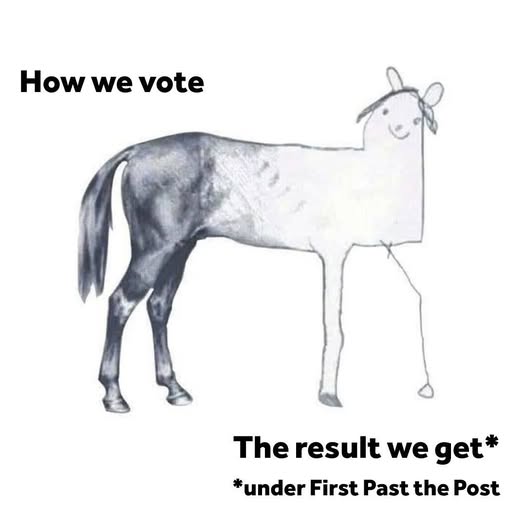
This happened because we still use the "First Past The Post" electoral system to determine the winner.
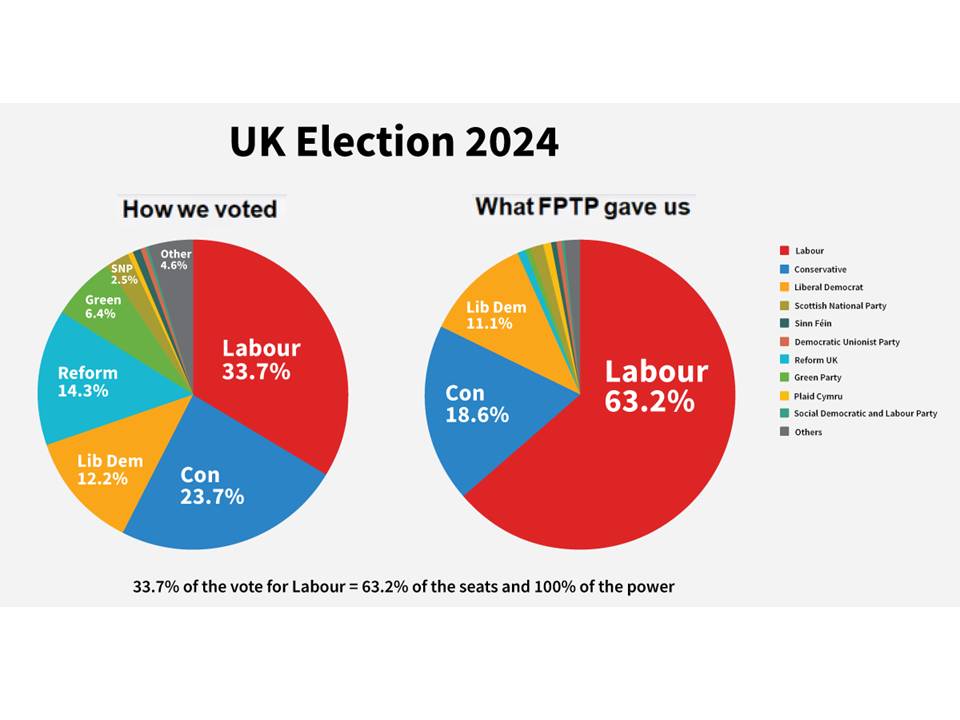
Changing to Proportional Representation would make Seats% equal Votes%
The graphic below shows
a) [green] the difference between
- the percentage of votes cast for the winning Party to
- the percentage of the Seats they got in the House of Commons.
Ideally, the difference would be 0, but the reality of the matter is nearer to 30
b) [red] that when Voter Turnout is added to the mix, it is hard to deny a relationship between the two as, since the end of World War 2, they are a close-matching "mirror-image" of each other.
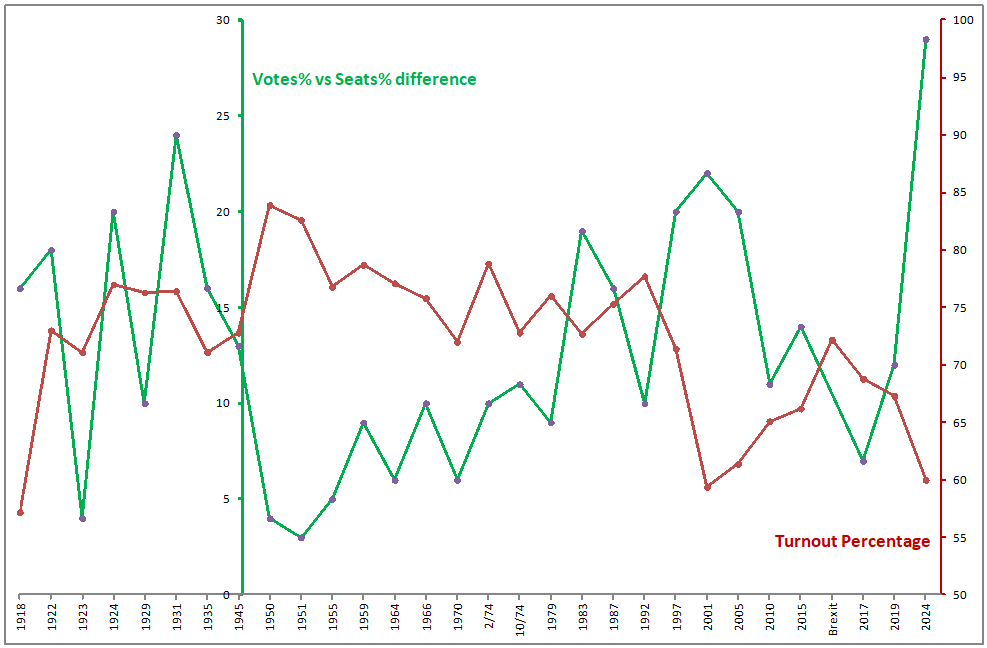
Put bluntly, the one that needs to go down has gone up and vice versa.
The results of our voting system have played a considerable part in leaving people apathetic about voting, or being forced to vote for the lesser evil instead of for something they actually want.
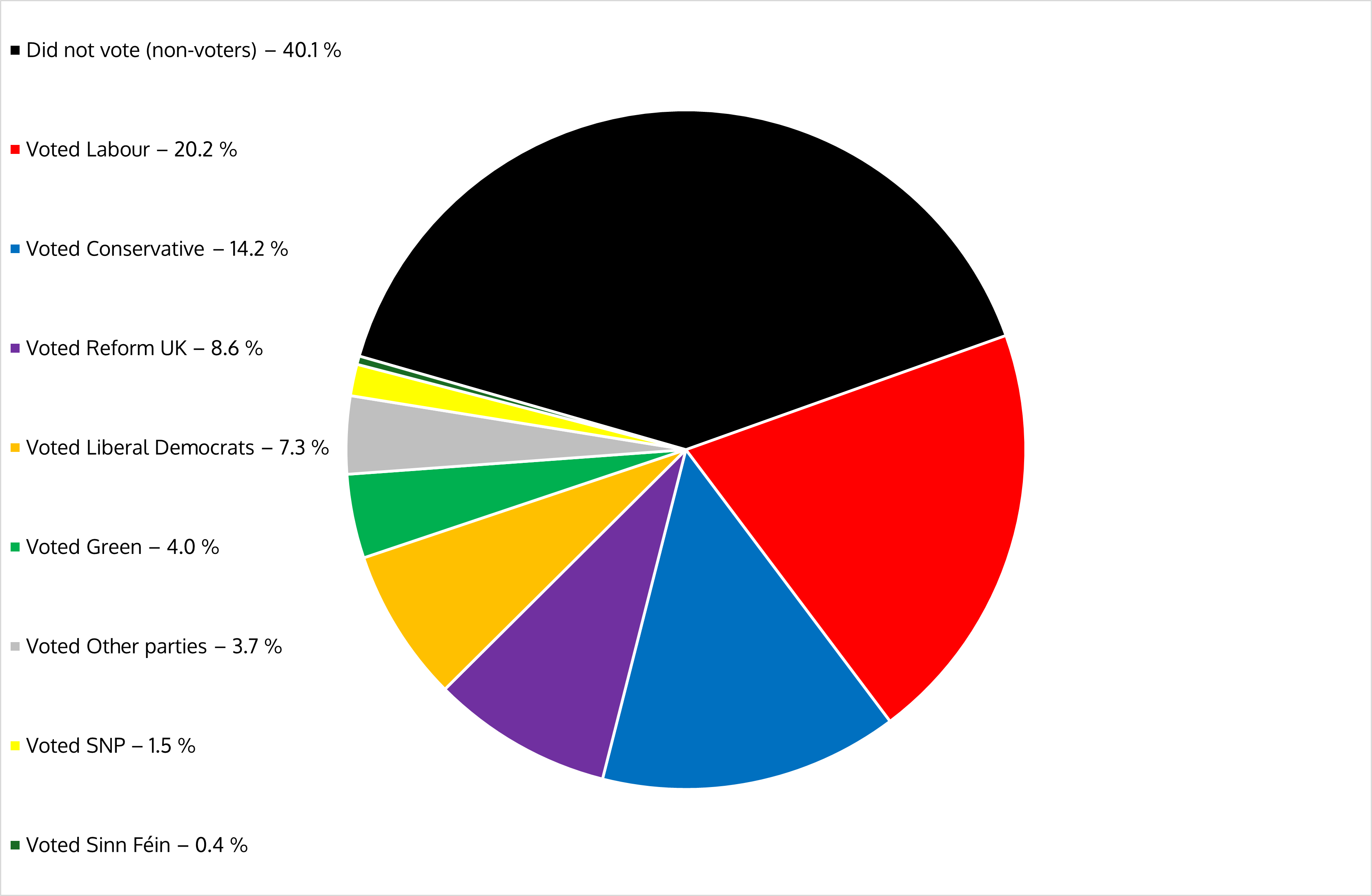
If you add in all those who didn't vote (for whatever reasons), you see the actual, positive, support each Party got...
Contact your MP today and get them to Get PR Done!
PR - a better way to elect our representatives!
Proportional Representation isn’t one electoral system, it’s the simple idea that the strength of each faction in parliament should closely match their popularity in the country.
- For many people, that is what living in a democracy means.
There are over 130 countries which use either a Proportional Representation or a mixed system to elect their lower chamber across the world.
44 use the First Past The Post system, a minority of countries globally, one of which is the United Kingdom.
- Those who still use First Past the Post tend to have it as a result of being former British colonies.
The following videos (of varying lengths) are worth watching/a laugh!
"But under PR you lose local representation!", only you don't...
- The Single Transferrable Voting system
- The Multi-Member Proportional system
- but what about Ranked Choice Voting?
PR means that politicians are compelled to work for everyone, not just marginal voters in swing seats, and where the Governments formed actually represent more than 50% of the voters!
Countries that use PR tend to have
- higher voter turnout,
- better representation of women in Parliament and
- higher satisfaction with democracy.
Better yet, this translates into concrete policy outcomes.
Countries that use PR have
- lower income inequality,
- lower levels of poverty, and
- are more likely to take action to tackle the climate crisis.
Hypocrisy:
The Conservatives elected their new leader.
Did they use FPTP? No!
They knew that FPTP would be a terrible way to choose a sustainable route forward for their party.
So why would it be suitable for the country?
The Conservatives used a "multi-round" system to elect leaders because they know that FPTP risks giving them leaders with minority support.
And the Scottish Conservatives used a "preferential" voting system to elect the successor to Douglas Ross.
The Labour Party have even gone all the way and used "Proportional Representation" for member seats on their National Executive Committee.
Across the political spectrum, the political parties know that FPTP gives you poorer quality leaders.
- What does that tell you?
If it's not good enough for them, it's not good enough for us!
Recent good news:
12th February 2026: The "Representation of the People Bill" has just been published.
This is now the official name of what was previously informally known as the Elections Bill!
Here are some of the measures it includes:
- Lowering the voting age to 16
- Improving voter registration
- Expanding the range of accepted voter ID
- Tightening rules around political donations to prevent the influence of dark money
- Measures against the harassment of candidates and campaigners
Many of these policies are welcome. However, one crucial piece is missing.
In its current form, the Bill doesn't include scrapping our chaotic First Past the Post voting system.
Sign the petition to fix this!
4th-6th July 2025: The Make Votes Matter "Democracy Action Weekend" exceeded its' own target by reaching at least 250,000 people, if not a lot more!
25th June 2025: Public support for electoral reform has never been greater.
A record 60% of people who responded to the BSA Survey believe that our electoral system needs to be changed.
What’s more, for the first time ever, a majority of supporters of ALL parties are in favour of electoral reform:
- Green - 90%
- Reform - 78%
- Liberal Democrats - 56%
- Labour - 55%
- Conservatives - 52%
25th November 2024: Public launch of the All-Party Parliamentary Group for Fair Elections - watch Phil Moorhouse talk about it here.
Early October 2024: Cyngor Gwynedd released the results of its consultation on whether to change the voting system used at local elections. The results weren’t even close, demonstrating clear support in Gwynedd to adopt the Single Transferable Vote (STV) version of proportional representation at local elections.
Thank you for reading, and hopefully signing, my "info-petition".
If you need further information please use the following links:
- First Past The Post (FPTP) explained
- Labour Campaign for Electoral Reform (also see: Labour for a new democracy)
- Conservative Action for Electoral Reform
- Liberal Democrats for Electoral Reform
- Electoral Reform Society
- Make Votes Matter
- GPRD email list - subscribe and get involved today!
- "Free But Not Fair" - The All Party Parliamentary Group for Fair Elections' new report.
- The Movement Forward
- Proportional Commons - "Recounting UK House of Commons divisions in proportion to the GE24 popular vote"
- Let me know if I've missed any others...
- email: roger.cracknell@volteuropa.org
Please use this link when promoting the Petition :
https://www.change.org/MakeVotingMeaningful

245
Das Anliegen
It's not right that 1/3 of Voters are represented by 2/3 of Parliament, effectively giving them all of the power over the rest of us.
This happened because we still use the "First Past The Post" electoral system to determine the winner.
Changing to Proportional Representation would make Seats% equal Votes%
The graphic below shows
a) [green] the difference between
- the percentage of votes cast for the winning Party to
- the percentage of the Seats they got in the House of Commons.
Ideally, the difference would be 0, but the reality of the matter is nearer to 30
b) [red] that when Voter Turnout is added to the mix, it is hard to deny a relationship between the two as, since the end of World War 2, they are a close-matching "mirror-image" of each other.
Put bluntly, the one that needs to go down has gone up and vice versa.
The results of our voting system have played a considerable part in leaving people apathetic about voting, or being forced to vote for the lesser evil instead of for something they actually want.
If you add in all those who didn't vote (for whatever reasons), you see the actual, positive, support each Party got...
Contact your MP today and get them to Get PR Done!
PR - a better way to elect our representatives!
Proportional Representation isn’t one electoral system, it’s the simple idea that the strength of each faction in parliament should closely match their popularity in the country.
- For many people, that is what living in a democracy means.
There are over 130 countries which use either a Proportional Representation or a mixed system to elect their lower chamber across the world.
44 use the First Past The Post system, a minority of countries globally, one of which is the United Kingdom.
- Those who still use First Past the Post tend to have it as a result of being former British colonies.
The following videos (of varying lengths) are worth watching/a laugh!
"But under PR you lose local representation!", only you don't...
- The Single Transferrable Voting system
- The Multi-Member Proportional system
- but what about Ranked Choice Voting?
PR means that politicians are compelled to work for everyone, not just marginal voters in swing seats, and where the Governments formed actually represent more than 50% of the voters!
Countries that use PR tend to have
- higher voter turnout,
- better representation of women in Parliament and
- higher satisfaction with democracy.
Better yet, this translates into concrete policy outcomes.
Countries that use PR have
- lower income inequality,
- lower levels of poverty, and
- are more likely to take action to tackle the climate crisis.
Hypocrisy:
The Conservatives elected their new leader.
Did they use FPTP? No!
They knew that FPTP would be a terrible way to choose a sustainable route forward for their party.
So why would it be suitable for the country?
The Conservatives used a "multi-round" system to elect leaders because they know that FPTP risks giving them leaders with minority support.
And the Scottish Conservatives used a "preferential" voting system to elect the successor to Douglas Ross.
The Labour Party have even gone all the way and used "Proportional Representation" for member seats on their National Executive Committee.
Across the political spectrum, the political parties know that FPTP gives you poorer quality leaders.
- What does that tell you?
If it's not good enough for them, it's not good enough for us!
Recent good news:
12th February 2026: The "Representation of the People Bill" has just been published.
This is now the official name of what was previously informally known as the Elections Bill!
Here are some of the measures it includes:
- Lowering the voting age to 16
- Improving voter registration
- Expanding the range of accepted voter ID
- Tightening rules around political donations to prevent the influence of dark money
- Measures against the harassment of candidates and campaigners
Many of these policies are welcome. However, one crucial piece is missing.
In its current form, the Bill doesn't include scrapping our chaotic First Past the Post voting system.
Sign the petition to fix this!
4th-6th July 2025: The Make Votes Matter "Democracy Action Weekend" exceeded its' own target by reaching at least 250,000 people, if not a lot more!
25th June 2025: Public support for electoral reform has never been greater.
A record 60% of people who responded to the BSA Survey believe that our electoral system needs to be changed.
What’s more, for the first time ever, a majority of supporters of ALL parties are in favour of electoral reform:
- Green - 90%
- Reform - 78%
- Liberal Democrats - 56%
- Labour - 55%
- Conservatives - 52%
25th November 2024: Public launch of the All-Party Parliamentary Group for Fair Elections - watch Phil Moorhouse talk about it here.
Early October 2024: Cyngor Gwynedd released the results of its consultation on whether to change the voting system used at local elections. The results weren’t even close, demonstrating clear support in Gwynedd to adopt the Single Transferable Vote (STV) version of proportional representation at local elections.
Thank you for reading, and hopefully signing, my "info-petition".
If you need further information please use the following links:
- First Past The Post (FPTP) explained
- Labour Campaign for Electoral Reform (also see: Labour for a new democracy)
- Conservative Action for Electoral Reform
- Liberal Democrats for Electoral Reform
- Electoral Reform Society
- Make Votes Matter
- GPRD email list - subscribe and get involved today!
- "Free But Not Fair" - The All Party Parliamentary Group for Fair Elections' new report.
- The Movement Forward
- Proportional Commons - "Recounting UK House of Commons divisions in proportion to the GE24 popular vote"
- Let me know if I've missed any others...
- email: roger.cracknell@volteuropa.org
Please use this link when promoting the Petition :
https://www.change.org/MakeVotingMeaningful
Die Entscheidungsträger

Updates zur Petition
Diese Petition teilen
Petition am 23. Mai 2024 erstellt