

Hem's Law: Mercy, When Death Has Begun
The issue
There is a word for the mercy we extend to suffering animals. We call it humane. That word shares its Latin root with human: humanus, which could mean not only human, but also civilised and kind. For centuries, the two words were closely linked. Showing mercy was once considered part of what it meant to be human. It was the standard to which humanity was held.
Our law has severed that connection.
We give a humane death to a dog. We give it to a horse, a cat, a bird, a snake.....literally any animal in pain. We call it the right thing to do and we do not hesitate.
But when it is our own mother, our father, our grandparent, our partner, or any of our loved ones - dying in front of us, unable to speak, their body wasting away until their heart stops beating - we call that same mercy illegal.
My mother's name was Helen. She called herself Hem - a name she invented because she thought "Grandma" made her sound old, and she was far too vibrant for that. She was passionate and joyful and full of life.
And she died a slow and painful death from starvation.
Not from famine. Not from neglect. From a disease the law would not allow us to bring to a merciful end.
⚠️ Content warning: This petition contains a photograph of Hem in the final stage of dying from Alzheimer's Disease. It is confronting. It is included because this death has been invisible for too long and because the people experiencing it deserve for this to no longer be hidden. Please continue only if you are comfortable doing so. If you have recently lost someone to dementia, please take care of yourself first.
What most people don't know about Alzheimer's and Dementia
When people think of Alzheimer's and Dementia, they think of memory loss. A person who forgets names, who repeats themselves, who gets confused about where they are. They do not think of starvation.
But dementia is a terminal illness. It kills slowly, progressively, and ultimately by dismantling the body's most basic functions. In the late stages, the brain forgets how to swallow. This is not a metaphor. As the disease progresses, the brain loses the ability to coordinate the complex muscular and neurological processes required to swallow, and ultimately to swallow at all. When that ability is gone, it does not come back.
The landmark New England Journal of Medicine study of advanced dementia found that 85.8% of nursing home residents in the final stage of the disease developed an eating problem during follow-up, increasing to 90.4% in the last 3 months of life
What makes this so prolonged is that the rest of the body keeps fighting. Even in advanced frailty, the body's organs do not all fail at once. Without food, the body slows its use of energy, burns its stores of fat, and holds on to protein for as long as it can. Its survival mechanisms do not switch off. They keep going.
When a person with dementia loses the ability to swallow completely, they can no longer take in the food and water they need to sustain life. Tube feeding has not been shown to help and is not recommended. And so they starve, their body fighting to survive, consuming itself from the inside out, until the rest of the organs finally shut down. This can take days, and sometimes weeks, while their family watches helplessly.
Research that has followed people with dementia through to death has found cachexia and dehydration to be the most commonly recorded cause of death. Australian data does not record this separately, so the number has to be estimated. Based on that research, it is reasonable to infer that between 9,000 and 13,000 Australians die this way every year. Every year. That range is deliberately conservative, because dementia so often goes unrecorded on death certificates. With the number of Australians living with dementia projected to more than double to over one million by 2065, the number dying this way will grow with it. Without legislative change, it will compound with every decade.
Dying from Dementia
Hem was receiving excellent community palliative care from kind and compassionate clinicians. After she lost the ability to swallow, we were told it may take up to a week, and that she would be kept comfortable.
It took ten days. She was not comfortable. She weighed around 24 kilograms by the end of it. Her mouth was open continuously for ten days - her mouth and tongue cracked and dry despite our hourly attempts to moisten it with swabs and sprays. Pressure sores were forming on her arms where they rested on her own body because there was no longer enough flesh between her skin and her bones to protect her. She lay in the same position for days, as repositioning caused her to grimace in pain despite the pain relief being administered.
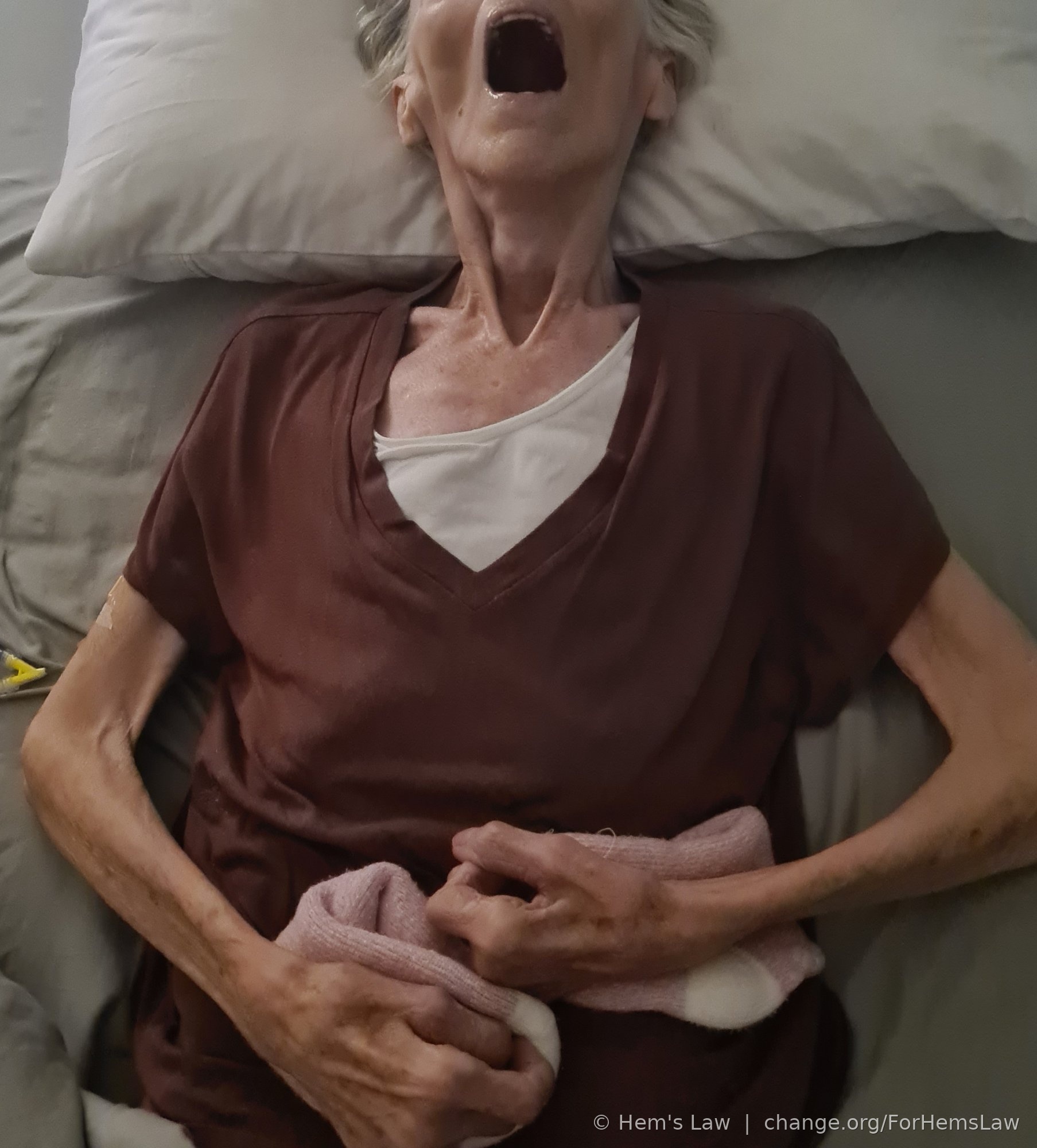
If that photograph were of an animal in my care, I could be charged with abuse, cruelty and neglect....
The law already allows decisions that lead to this death. Just not a merciful end to it.
Across Australia, the law already allows an authorised substitute decision-maker, in defined circumstances, to agree to withhold or withdraw life-sustaining treatment for a person who can no longer decide for themselves, knowing that death will follow. That includes switching off a ventilator. For a person with advanced dementia who can no longer swallow, it means accepting that they will die from cachexia and dehydration.
That decision is lawful, in every state and territory, right now.
What no law currently allows is to bring that already imminent and irreversible death to a merciful end, rather than wait for starvation to conclude it.
Hem's Law asks that the same substitute decision-maker, at the same medically confirmed moment, be able to choose a merciful end to the dying, and not only accept that it will happen.
What Hem's Law asks for
A dedicated, narrowly drawn provision in the criminal law of each state and territory. It would allow an authorised substitute decision-maker, the person guardianship law already empowers to make medical decisions for someone who has lost capacity, to choose a merciful death through medication that ends the dying process. This would apply ONLY when two independent practitioners certify all of the following:
- Swallowing has been permanently and irreversibly lost as a result of end-stage disease, documented over a sustained period of observation.
- All life-sustaining treatment has been lawfully withdrawn or is no longer clinically appropriate, and comfort-focused care is the only remaining pathway.
- The dying process has begun, and death is imminent and irreversible, expected within weeks
Before any decision is made, the substitute decision-maker must be given clear information about the person's condition, prognosis and palliative care options. Clinicians acting in good faith, with reasonable care and skill, would be legally protected. Clinicians who conscientiously object would never be required to take part.
This is not VAD and addresses a different kind of decision. VAD is a decision made by a person with the required capacity to end their life before their illness does. Hem’s Law engages only once a person’s death is already imminent and irreversible, and the dying process has begun. This is not a quality of life judgement. It is a decision about the quality of a death. Once swallowing is permanently lost, death is certain within days or weeks. The only decision is whether it is protracted, painful and distressing for all involved, or merciful and swift.
We are calling on every state and territory parliament to hold a formal inquiry, consult clinicians, ethicists, advocates and bereaved families, and bring forward draft legislation within 24 months.
This works both ways - and that is non-negotiable
Hem's Law must include a clear and legally binding opt-out. Any person who does not want this option for any reason, whether personal, cultural or religious, should be able to record that objection while they still have capacity. It would be binding on any substitute decision-maker and on every clinician involved.
For people who never recorded anything, the substitute decision-maker would have to confirm in writing that they have made reasonable inquiries and know of no objection the person expressed, formally or informally. If they know of one, they cannot proceed.
Just as nobody should be forced into a prolonged death, nobody should be given a hastened death they did not want. And no family's choice should be made for them by someone else's faith.
Here is the part that matters just as much as the opt-out itself
Nobody can make that choice, in either direction, if they have never been told what the end of dementia can look like.
I didn't know. Most families don't know until they are at the bedside. People diagnosed with dementia are not routinely given a clear account of how the disease ends. They may hear that swallowing difficulties can occur, but not what the complete loss of swallowing means, what dying this way looks like, or how long families may keep vigil. And so nobody plans for it.
That has to change, whether or not Hem's Law is ever passed. People can already record their wishes about future care while they still have capacity, but those choices are only as good as the information behind them. Hem's Law asks the parliamentary inquiry to examine what people diagnosed with dementia, and their families, are currently told about the end stage. This campaign will keep pushing for that information to be offered honestly and early.
Not because a merciful death should become the default. But because nobody should arrive at those final days without ever having had the chance to decide for themselves.
The numbers
9,000 to 13,000 Australians. Every year. Dying from cachexia and dehydration, the slow starvation of a body that can no longer swallow, with no lawful way to bring it to a merciful end.
This is not a hidden tragedy. It is a permitted one - unspoken, unnamed, and unfolding behind closed doors in homes, hospitals and aged care facilities across this country, one family at a time, with the full knowledge of the law.
Sign for Hem.
Sign for your mother, your father, your grandparent, your aunt or uncle, brother or sister or other loved one that has experienced this death.
Sign for the estimated 446,500 Australians with dementia and their families that may be facing this horrific death in their future.
Sign so that our children do not have to experience this trauma should we also suffer the cruel fate of a dementia diagnosis.
There are several other ways you can directly support this campaign:
Follow the campaign on Facebook | Join the Supporters & Advocates Group | Read the evidence on Substack | Follow on Instagram
Changing the law in 8 states & territories will take years of sustained effort & funds to cover travel, materials & time. Help fund the fight by donating to the campaign.
If your family is one of the thousands of Australians who experience this horrific death every year, please share your story here. Together, our voices will be too loud to ignore.
I promised Hem her suffering would not be for nothing. Help us put "human" back in "humane" and grant Hem's Law.
Petitioned to: All Australian State and Territory governments
The photographs of Helen ("Hem") are shared here with the permission of her family as part of the Hem's Law campaign. These image may not be downloaded, reproduced, or shared outside the context of this petition without the express consent of her family.

51,048
The issue
There is a word for the mercy we extend to suffering animals. We call it humane. That word shares its Latin root with human: humanus, which could mean not only human, but also civilised and kind. For centuries, the two words were closely linked. Showing mercy was once considered part of what it meant to be human. It was the standard to which humanity was held.
Our law has severed that connection.
We give a humane death to a dog. We give it to a horse, a cat, a bird, a snake.....literally any animal in pain. We call it the right thing to do and we do not hesitate.
But when it is our own mother, our father, our grandparent, our partner, or any of our loved ones - dying in front of us, unable to speak, their body wasting away until their heart stops beating - we call that same mercy illegal.
My mother's name was Helen. She called herself Hem - a name she invented because she thought "Grandma" made her sound old, and she was far too vibrant for that. She was passionate and joyful and full of life.
And she died a slow and painful death from starvation.
Not from famine. Not from neglect. From a disease the law would not allow us to bring to a merciful end.
⚠️ Content warning: This petition contains a photograph of Hem in the final stage of dying from Alzheimer's Disease. It is confronting. It is included because this death has been invisible for too long and because the people experiencing it deserve for this to no longer be hidden. Please continue only if you are comfortable doing so. If you have recently lost someone to dementia, please take care of yourself first.
What most people don't know about Alzheimer's and Dementia
When people think of Alzheimer's and Dementia, they think of memory loss. A person who forgets names, who repeats themselves, who gets confused about where they are. They do not think of starvation.
But dementia is a terminal illness. It kills slowly, progressively, and ultimately by dismantling the body's most basic functions. In the late stages, the brain forgets how to swallow. This is not a metaphor. As the disease progresses, the brain loses the ability to coordinate the complex muscular and neurological processes required to swallow, and ultimately to swallow at all. When that ability is gone, it does not come back.
The landmark New England Journal of Medicine study of advanced dementia found that 85.8% of nursing home residents in the final stage of the disease developed an eating problem during follow-up, increasing to 90.4% in the last 3 months of life
What makes this so prolonged is that the rest of the body keeps fighting. Even in advanced frailty, the body's organs do not all fail at once. Without food, the body slows its use of energy, burns its stores of fat, and holds on to protein for as long as it can. Its survival mechanisms do not switch off. They keep going.
When a person with dementia loses the ability to swallow completely, they can no longer take in the food and water they need to sustain life. Tube feeding has not been shown to help and is not recommended. And so they starve, their body fighting to survive, consuming itself from the inside out, until the rest of the organs finally shut down. This can take days, and sometimes weeks, while their family watches helplessly.
Research that has followed people with dementia through to death has found cachexia and dehydration to be the most commonly recorded cause of death. Australian data does not record this separately, so the number has to be estimated. Based on that research, it is reasonable to infer that between 9,000 and 13,000 Australians die this way every year. Every year. That range is deliberately conservative, because dementia so often goes unrecorded on death certificates. With the number of Australians living with dementia projected to more than double to over one million by 2065, the number dying this way will grow with it. Without legislative change, it will compound with every decade.
Dying from Dementia
Hem was receiving excellent community palliative care from kind and compassionate clinicians. After she lost the ability to swallow, we were told it may take up to a week, and that she would be kept comfortable.
It took ten days. She was not comfortable. She weighed around 24 kilograms by the end of it. Her mouth was open continuously for ten days - her mouth and tongue cracked and dry despite our hourly attempts to moisten it with swabs and sprays. Pressure sores were forming on her arms where they rested on her own body because there was no longer enough flesh between her skin and her bones to protect her. She lay in the same position for days, as repositioning caused her to grimace in pain despite the pain relief being administered.
If that photograph were of an animal in my care, I could be charged with abuse, cruelty and neglect....
The law already allows decisions that lead to this death. Just not a merciful end to it.
Across Australia, the law already allows an authorised substitute decision-maker, in defined circumstances, to agree to withhold or withdraw life-sustaining treatment for a person who can no longer decide for themselves, knowing that death will follow. That includes switching off a ventilator. For a person with advanced dementia who can no longer swallow, it means accepting that they will die from cachexia and dehydration.
That decision is lawful, in every state and territory, right now.
What no law currently allows is to bring that already imminent and irreversible death to a merciful end, rather than wait for starvation to conclude it.
Hem's Law asks that the same substitute decision-maker, at the same medically confirmed moment, be able to choose a merciful end to the dying, and not only accept that it will happen.
What Hem's Law asks for
A dedicated, narrowly drawn provision in the criminal law of each state and territory. It would allow an authorised substitute decision-maker, the person guardianship law already empowers to make medical decisions for someone who has lost capacity, to choose a merciful death through medication that ends the dying process. This would apply ONLY when two independent practitioners certify all of the following:
- Swallowing has been permanently and irreversibly lost as a result of end-stage disease, documented over a sustained period of observation.
- All life-sustaining treatment has been lawfully withdrawn or is no longer clinically appropriate, and comfort-focused care is the only remaining pathway.
- The dying process has begun, and death is imminent and irreversible, expected within weeks
Before any decision is made, the substitute decision-maker must be given clear information about the person's condition, prognosis and palliative care options. Clinicians acting in good faith, with reasonable care and skill, would be legally protected. Clinicians who conscientiously object would never be required to take part.
This is not VAD and addresses a different kind of decision. VAD is a decision made by a person with the required capacity to end their life before their illness does. Hem’s Law engages only once a person’s death is already imminent and irreversible, and the dying process has begun. This is not a quality of life judgement. It is a decision about the quality of a death. Once swallowing is permanently lost, death is certain within days or weeks. The only decision is whether it is protracted, painful and distressing for all involved, or merciful and swift.
We are calling on every state and territory parliament to hold a formal inquiry, consult clinicians, ethicists, advocates and bereaved families, and bring forward draft legislation within 24 months.
This works both ways - and that is non-negotiable
Hem's Law must include a clear and legally binding opt-out. Any person who does not want this option for any reason, whether personal, cultural or religious, should be able to record that objection while they still have capacity. It would be binding on any substitute decision-maker and on every clinician involved.
For people who never recorded anything, the substitute decision-maker would have to confirm in writing that they have made reasonable inquiries and know of no objection the person expressed, formally or informally. If they know of one, they cannot proceed.
Just as nobody should be forced into a prolonged death, nobody should be given a hastened death they did not want. And no family's choice should be made for them by someone else's faith.
Here is the part that matters just as much as the opt-out itself
Nobody can make that choice, in either direction, if they have never been told what the end of dementia can look like.
I didn't know. Most families don't know until they are at the bedside. People diagnosed with dementia are not routinely given a clear account of how the disease ends. They may hear that swallowing difficulties can occur, but not what the complete loss of swallowing means, what dying this way looks like, or how long families may keep vigil. And so nobody plans for it.
That has to change, whether or not Hem's Law is ever passed. People can already record their wishes about future care while they still have capacity, but those choices are only as good as the information behind them. Hem's Law asks the parliamentary inquiry to examine what people diagnosed with dementia, and their families, are currently told about the end stage. This campaign will keep pushing for that information to be offered honestly and early.
Not because a merciful death should become the default. But because nobody should arrive at those final days without ever having had the chance to decide for themselves.
The numbers
9,000 to 13,000 Australians. Every year. Dying from cachexia and dehydration, the slow starvation of a body that can no longer swallow, with no lawful way to bring it to a merciful end.
This is not a hidden tragedy. It is a permitted one - unspoken, unnamed, and unfolding behind closed doors in homes, hospitals and aged care facilities across this country, one family at a time, with the full knowledge of the law.
Sign for Hem.
Sign for your mother, your father, your grandparent, your aunt or uncle, brother or sister or other loved one that has experienced this death.
Sign for the estimated 446,500 Australians with dementia and their families that may be facing this horrific death in their future.
Sign so that our children do not have to experience this trauma should we also suffer the cruel fate of a dementia diagnosis.
There are several other ways you can directly support this campaign:
Follow the campaign on Facebook | Join the Supporters & Advocates Group | Read the evidence on Substack | Follow on Instagram
Changing the law in 8 states & territories will take years of sustained effort & funds to cover travel, materials & time. Help fund the fight by donating to the campaign.
If your family is one of the thousands of Australians who experience this horrific death every year, please share your story here. Together, our voices will be too loud to ignore.
I promised Hem her suffering would not be for nothing. Help us put "human" back in "humane" and grant Hem's Law.
Petitioned to: All Australian State and Territory governments
The photographs of Helen ("Hem") are shared here with the permission of her family as part of the Hem's Law campaign. These image may not be downloaded, reproduced, or shared outside the context of this petition without the express consent of her family.
The Decision Makers

Supporter voices
Petition Updates
Share this petition
Petition created on 11 March 2026