
Dear friends and supporters,
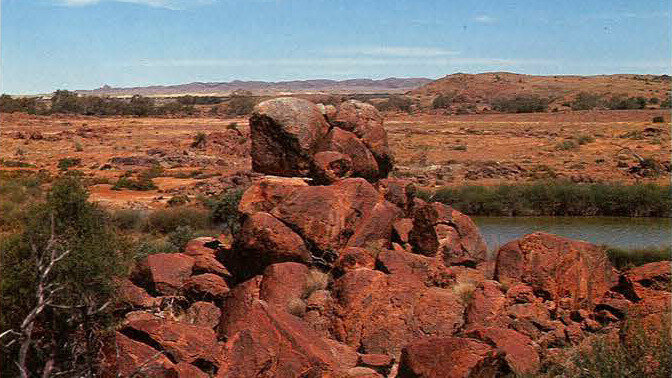
I haven’t seen the rocks, but I have looked at them in a photograph. They aren’t as spectacular as Uluṟu, but they are enchanting mainly because of the story they tell, and the story is about an Arabana rainmaker and his little grandson. The Arabana and the Wangkangurru who have lived in the area from deepest of times call it Thantji-wanparda, which means ‘he is holding up his grandson’.
The site is located on the southern bank of The Peake River in South Australia, less than a hundred kilometres west of Kati-thanda (Lake Eyre).
Luise Hercus, the famous anthropologist and an expert on Australian indigenous languages notes that ‘because this is the driest part of Australia it is not surprising that there was a vast interlinking network of rain myths and rain-stone sites,’ in the area. She recorded the story of Thantji-wanparda in 1970. It was sung to her by Mick Irinyili McLean, a Wangkangurru rainmaker, who to use her words, was ‘the last minbaru, the clever man, from the desert. “The stories of the rain went in all direction,’ he had said to her, ‘it is because clouds go anywhere.’
In the story, an Arabana rainmaker succeeds in making rain which floods in the area drowning many people who die and turn into rocks. This is when the grandfather rainmaker ‘in a desperate bid to save the little child raises him and places him on his shoulders.’ The two are saved and stand nowadays on the riverbank as boulders of rusted granite.
In the photograph I can make out the shape of the old man, and sitting on his shoulders, his grandson. The face of the old man is looking away from the river beyond which one can see the rocky landscape of the stony desert.
The story also tells about two hawks: Wantu-wantu, the man-eating, black-breasted buzzard, who is killed, and karrawara, the wedge-tailed eagle, his kinder companion, who survives. As the eagle rises in the sky, it transforms into a thunder cloud, and blood from its slashed veins falls as rain drops. The rain is followed by a hailstorm which changes into shiny white fragments of quartz scattered on and around the rocky mounds.
So why do I like Thantji-wanparda?
Firstly, because the rocks and the story associated with it reveal that this land with which the indigenous peoples have lived for thousands of years wasn’t empty but dotted with marks, tracks, and footprints of the ancestral beings who during the deep time-space of the everywhen-where (commonly known as Dreamtime) created all the human and non-human entities populating it. Therefore, this land is nothing but a large map of their life and living. This is what defines the enduring spiritual and emotional connection the indigenous peoples feel with the land.
Secondly, and perhaps more importantly, when I look at the photograph of Thantji-wanparda, it reminds me of the tender love that the old rainmaker grandfather had for his young grandson, and for the land he would hand over to him, making him its custodian and caretaker. There is grace in the way he holds the young child on his shoulders, reassuring him that the danger of the flood would pass.
In a strange way, the invitation the Uluṟu Statement from the Heart extends to the non-indigenous inhabitants of this country represents a similar act of grace and humility. There is no ‘symbolic declaration of war,’ in it, no intention to harm, blame, or incriminate anyone. It simply asks us to walk with the indigenous peoples together so that they can once again find their just and rightful place in the land on which they have lived for many thousands of years: a place of mutual respect and pride. Voting YES for the Voice in the referendum will be an act of grace and humility on our part; an opportunity to reveal our true human spirit; it will make us all proud of ourselves.
The photograph of Thantji-wanparda is by Luise Hercus. It is included in the chapter Aboriginal Landscapes of the book Australians: A Historical Atlas (Fairfax, Syme & Welden, Broadway, 1987).
The rainmaking story of Thantji-wanparda can be read in:
Hercus, L. A. (Luise Anna), 1926-2018 & Irinyili, Mick McLean & Macdonald, Colin & Koch, Grace. 2017, The rain history / told and sung by Mick McLean Irinyili; recorded and translated by Luise Hercus; edited by Colin Macdonald who has also made the maps; musical notation by Grace Koch.
This is going to be my last update.
I send it worried that the Voice would fail to get the majority support it needs. As always fear created by lies and misinformation will win.
However, if you are interested you can read Noel Pearson's 2023 Carumba Institute Meanjin Oration: Change the country for the good at:
Thanks once again to you all for your comments and support. I would also like to acknowledge the support of my wife Hanna, and Merlinda Bobis, a friend and a wonderful writer.
Subhash