
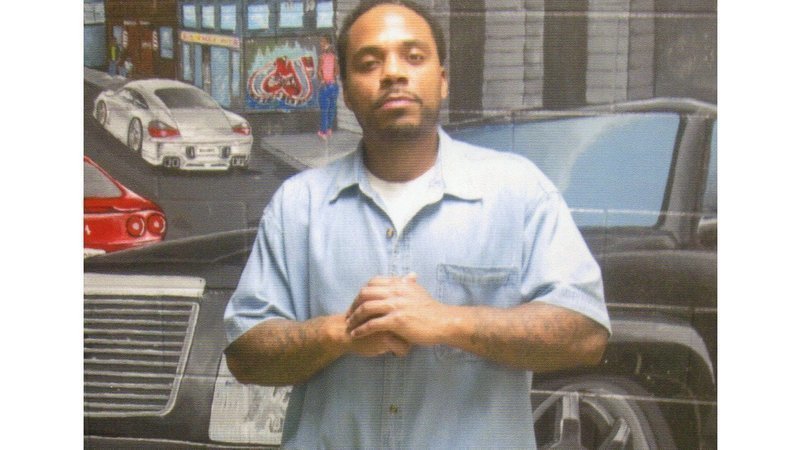
“I was confident that moments later I was going to be hearing the words that would end this nightmare.” – Mike Crump
Learn more about Mike’s case by reading Part 3 of Mike's own description of his wrongful conviction, presented by the Death Row Soul Collective on Facebook on April 11, 2022.
Michael “Mike” Crump was wrongfully convicted of murder in 1996 in Virginia and sentenced to 40 years in prison at the age of 19 based on a cross-racial misidentification by an eyewitness who was present in a home when an intruder suddenly burst in and shot the victim, Eric “Nike” Jones.
Mike had alibi witnesses and no history of violence or firearm possession. No physical evidence connected him to the crime. The prosecution’s case rested solely on the identification of Mike by the traumatized young woman who initially told 911, “I think [the shooter is] a black male” and she could not see the intruder because the room was dark. Immediately after the shooting, the eyewitness also told police that she had not seen the shooter's face because he wore a hooded sweatshirt drawn tightly around it, covering all but his eyes, nose, and mouth.
A week later, after the young woman saw someone she thought was the shooter at a convenience store, detectives twice showed her an improper photo lineup where Mike was the only individual wearing a hoodie. The eyewitness’s uncertainty then shifted to certainty that Mike was the shooter.
Below is Part 3 of Mike’s description of his wrongful conviction:
* * * * *
Part 3 - The ONE DAY fight for my freedom
Mike speaks...
After a restless night’s sleep, I woke up on March 12, 1996, exhausted and nervous. However my adrenalin kicked in, and I soon felt ready to go into that courtroom to fight and clear my name.
Nike’s real killer had still not been arrested by the day of my trial, but my defender had convinced me that I would not be convicted. I was also confident that the truth would prevail. I was so sure my nightmare was over that before I left the jail, I gave away my food, stationary; everything I had accumulated over those past 5 months, which I would no longer need. I picked up my mail and paperwork, and said good-bye to my fellow inmates. I had told them I was going home that day.
I had started to look forward to doing all the things I had missed while I had been sitting in that jail cell. I wanted to see my friends. I missed my girlfriend. I wanted to eat my mom’s home cooked food again. I missed looking after my two sisters. I was sure that I would be doing all of those things again soon. I just needed to get through the trial and everything would be ok.
A guard collected me and we took the short walk via the underground corridor to where the courthouse was located. I was placed in a holding cell where I changed into my suit.
My attorney came to see me and as always, was full of confidence that things would go our way. I prayed whilst waiting to be called in, and prepared to face those who had falsely accused me of this despicable crime.
When I walked into the courtroom, I saw my mom, sisters, and some of my friends. I also saw my girlfriend, and her mom and brother who were due to testify that day. The courtroom was packed. I felt reassured with my loved ones being there to support me. I knew that they would be taking me home that day, after watching me get justice after my wrongful incarceration for the past 5 months.
I guessed Nike’s family must have been in the courtroom too. I had no idea who what they looked like or where they were sitting, but I knew they must have hated me. I felt mixed emotions. On one hand, I felt bad for them, as I knew they were grieving. However, I wanted to shout out that I wasn’t the person who did this, and they needed to find the real killer if they wanted justice for Nike.
After I entered the courtroom, all those who were due to testify that day were asked to leave, and I was sworn in. It was at that point that the option of a jury trial was raised again. I used the opportunity to tell my attorney that yes; I wanted my case to be heard by a jury of my peers. However, my attorney shut me down, once again telling me it was not necessary. What could I do? They weren’t going to listen to a teenager. I was going to have to watch this play out in front of me, and I was unable to do anything to stop it. I wish I knew then what I know now. Perhaps I could have changed the course of the next two and a half decades.
The trial commenced, and I sat there watching and listening as various testimonies were made. My confidence increased. The testimonies were inconsistent. Even the homicide detectives contradicted themselves at times.
When the key eyewitness was brought out to testify, my main feeling for her was pity. I could see she had an eye condition. It looked painful, and she appeared nervous. I thought that perhaps when she saw me in the courtroom she would realize she had made a mistake, and tell everyone it was not me. Instead, she told the court what had happened that night, pointing me out as the person who had pulled the trigger ending Nike’s life. She also claimed that she had seen me at a convenience store me the day after the murder, where I had behaved in a threatening way towards her. That was when she said she recognized me as Nike’s killer, as I was wearing exactly the same clothes as the shooter had the night before.
I was dumbfounded. I knew she was not telling the truth. I was not at the house where Nike was killed. Nor was I at that convenience store, I had never seen this woman before. I questioned why was she doing this to me. Who had persuaded her to do it? How much was she being paid? All of these thoughts ran through my mind, yet I remained confident as her testimony continued. Her story had changed so much between the night of the murder and what she was now telling the courtroom, and a lot of it made no sense.
At one point, the courtroom had erupted in laughter when she had described the shooters sneakers. She was adamant that they had the words Nike printed on them. When the sneakers I was wearing on the day of my arrest were presented to the court to support my guilt, they were Reeboks; yet more conflicting evidence which did not support the prosecution’s case. Tellingly, the eyewitness had described the shooter’s footwear as “dark tennis shoes” just after the murder. However, 17 days after my arrest (at which time, photographs were taken of my black, green and white colored Reebok sneakers), and almost a month after the murder, the eyewitness had given a revised description of the shooter’s appearance to police, now telling them he had been wearing black, green and white sneakers. Coincidence?
Surely, the judge was taking all of this in. Surely, he was seeing that the eyewitness had changed her story and her description of the shooter. No other person could place me at the house where Nike lost his life, and there was no evidence or surveillance tape to prove I had been at that convenience store the next day either.
In fact, there was no physical evidence whatsoever to support me being the shooter- not a hair, a fingerprint, a fiber.. No DNA... NOTHING.
The eyewitness had described the gun used by the shooter as a nine-millimeter but the ballistics report confirmed it was a 38 revolver. The eyewitness also had an eye condition resulting in visual loss. She had been unable to pick me out of a photo lineup the first time the police showed her. She did not identify me in that photo lineup until 9 days after the murder. The judge must be seeing that there is no way she could be a reliable witness in the dark home where the murder took place in a matter of seconds.
I thought that the judge must have been noting that despite others being present when Nike’s tragic murder took place, no one else was there to testify against me. No one else had picked me out of that faulty police photo line-up as Nike’s killer; a photo lineup where I was the only individual wearing a dark hoodie - the same clothing that the shooter had allegedly been wearing that night.
Surely, the judge would see that the police’s theory that I had been involved in a robbery gone wrong did not make sense. I had no history of violence. I had never carried a weapon. It was ridiculous to think that I had picked up a weapon to not only rob someone that night, but to end a life.
As the trial went on, I remained confident, but was annoyed with my defender at points. He was listening to the same inconsistencies as me. I had seen courtroom scenes on TV shows and movies and expected him to jump out of his seat shout “objection” but he didn’t say a thing. I almost wanted to shout out objection myself, but I wasn’t legally trained, so I reassured myself that my defender knew what he was doing, and I remained silent.
I was desperate for everyone to hear my side. I wanted to tell the entire courtroom that I did not kill anybody. However, my attorney had decided that I would not be testifying that day- another decision I wasn’t entirely happy about. Had I been allowed to speak that day, I would have told the court that I was nowhere near the house where Nike was murdered. That I was clearly being set up. That I was desperately sorry for his family, but I did not take Nike’s life. I could not kill anybody!
After several hours of testimony from the prosecution, there was a recess. My attorney came to my holding cell, and told me that despite my alibi witnesses being there and ready to testify, there was no need for them to do so. My girlfriend was there to attest to the fact that I had arrived to her home earlier in the evening when the murder took place, and had not left until the next day, oblivious to the events that had taken place the night before as we slept. Her mom and brother were there to also confirm I was there that night. There was no way I could have left and committed this murder.
I was surprised my attorney didn’t feel it was necessary for them to testify, but his words convinced me everything would be ok. He said that the judge knew I was innocent. He could see that the prosecution’s case was not strong enough, and he definitely did not believe a word that the eyewitness had said. He insisted that the sooner we got the trial over with, the sooner I could go home. He told me I could be home by 5pm eating dinner with my family, and there was no need to waste any more of the judge’s time.
I was excited. I knew that the entire case against me was fabricated. I was not guilty of this heinous crime, and I was relieved that the judge could see that. We had only been in that courtroom for a matter of hours, but this was finally going to be over!
As the recess ended, my attorney asked if I was ready to go home, and I answered yes. As we re-entered the courtroom I smiled at my mom and sisters, signaling to them I was on my way. I was confident that moments later I was going to be hearing the words that would end this nightmare.
I watched on as my attorney confirmed to the court that he would not be calling the alibi witnesses and the defense was resting its case. Then both sides then began to sum up. I listened intently, feeling angered once again as the prosecution described to the court that I was a cold-blooded murderer, who had been involved in a robbery gone wrong, resulting in the tragic loss of Nike’s life. However, I tried to remain calm; the words from my attorney ringing in my ears...“the judge knows you are innocent”, “he doesn’t believe the eyewitness”, “you will not be found guilty”…“you will be home with your family soon."
Then I stood, and waited to hear the verdict.
* At the age of just 18 years old, Michael Crump was arrested and wrongfully convicted of the tragic murder of 21-year-old Eric “Nike” Jones in Virginia after an eyewitness misidentified Mike due to his hoodie.
* Please sign and share this petition, which the nonprofit UNCUFF THE INNOCENT will be using to support Michael Crump's case for freedom by urging Virginia’s Governor and Attorney General to investigate his wrongful conviction.
#WrongfulConviction
#InnocenceMatters
#FreeMikeCrump