

Urge Infold Games to address long-standing Issues and listen to their community
The Issue
We, the dedicated player base of Love and Deepspace, are calling on Infold Games to address the severe and long-standing issues that have plagued the game.
An otome game relies heavily on a "trust economy" - the understanding that players are investing not just their money, but their time and emotional attachment into the game's world and characters. Recently, this trust has been broken. While the abrupt introduction and subsequent cancellation of the new character Valko (Ao Yin)—alongside culturally insensitive lore references and controversial marketing—acted as a catalyst for recent protests, the community’s frustration is rooted in months and years of neglected feedback.
Despite generating immense monthly revenue, the game has become increasingly hostile to both its free-to-play base and its most dedicated spenders. We demand that Infold Games stop prioritizing short-term, aggressive monetization over the quality of the game and the respect of its community.
We demand immediate action and transparency regarding the following unaddressed issues:
1. Severe neglect of the main story and original characters
Instead of investing in expensive 3D-rendered story cutscenes that advance the main plot, the studio focuses on producing unrelated “Alternate Universe” (AU) events in rapid close succession. These time-limited events generate massive profits, but from a world-building perspective, they offer no added value. Critics point out that the stories in these premium cards are often generic and force diametrically different characters to behave identically in order to fulfill predetermined “checklists” of genre clichés (e.g., ubiquitous kissing scenes or forced romance without context), which undermines character continuity. According to many veterans, this shift from deep narrative to shallow events has transformed the title into a “glorified slot machine boyfriend simulator,” where the primary goal is simply to force players to spend money on premium “spicy” visuals lacking any narrative depth.
- Stalled content: Main story chapters for existing beloved characters have been neglected, with some characters going over 500 days without a meaningful main story update.
- Declining quality and recycled assets: Instead of progressing the lore, resources are poured into limited-time "Alternate Universe" events that often force characters out of their established personalities just to meet a checklist of romantic tropes. Furthermore, players have noticed a heavy reliance on recycled expressions and generic animations between the love interests, shattering the illusion of character uniqueness.
2. Predatory monetization and unfair gacha mechanics
- Split cosmetic rewards: The introduction of independent crates for event outfits and hairstyles is mathematically punishing. Forcing players to execute up to 285 pulls just to unlock a complete set of cosmetics for all characters is an exclusionary tactic that completely prices out low-spenders and free-to-play (F2P) users.
- Punishing banner mechanics: The current "Fate Points" system, especially during Triple Banners, is overly punishing and mathematically disadvantages the player*.
- No event roadmap: The absolute refusal to provide a schedule or roadmap for upcoming banners creates immense anxiety and FOMO (Fear Of Missing Out), leaving players completely unable to plan their spending or save up in-game currency.
- Splitting up rewards: Previously, cosmetic items such as unique hairstyles and outfits were delivered with the corresponding cards. However, Infold’s current practice introduces separate milestones (crates). In order for a player to obtain a complete set of outfits and hairstyles for all characters from a single event, they must make a set number of draws: 85, 135, 185, 235, and finally a staggering 285 draws. This setup creates an absolute divide. Players point out that at this pace, free-to-play and occasional paying players are completely shut out of the possibility of meaningfully participating in events.
- Furthermore, the community reports silent nerfs (downgrades) to drop rates: as soon as an account makes its first financial deposit, algorithms allegedly reduce the player’s so-called “luck,” forcing them to rely on a hard pity.
*With the original five characters, a player had roughly a 20% chance within mixed banners that, upon receiving a premium 5-star card, they would get one belonging to their preferred character (known as “bias”). Adding another character would mathematically reduce this chance to 16.7%. Furthermore, the so-called Fate Points system is designed in a highly disadvantageous way, especially in so-called Triple Banners, where limited cards for three different characters are released simultaneously. If a player loses a so-called “50/50” roll (receiving a card from the standard pool instead of a limited event card), they receive a guaranteed point toward their chosen goal; however, 150 rolls are required to earn a guaranteed limited Myth card. To obtain the complete pair of Myth cards required to unlock a Companion, a player must deposit thousands of diamonds into the system. Any mistake in navigating this system results in the loss of Destiny Points, causing the player to forfeit all their investments.
3. Scarcity of end-game resources
- No renewable diamond farming: Once players hit the maximum limits in modes like Abyssal Chaos, Unicorn Operations, and Orbits, they become dead features that no longer reward diamonds.
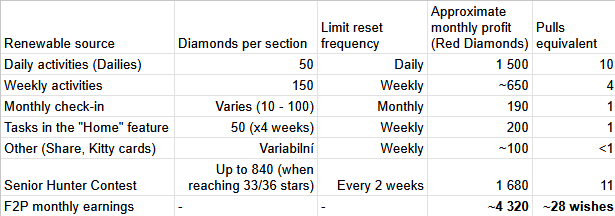
- F2P Impossibility: The Senior Hunter Contest remains the only truly renewable diamond source. Even if a F2P player maxes out all dailies, weeklies, and the Senior Hunter Contest, it takes approximately five months of saving to guarantee a single limited banner card.
- Ignored Quality of Life features: Features like the Chocolate Shop require immense, years-long grinding for new players to catch up, while older players are left with a stagnant pool of rewards.
More detailed presentation:
Abyssal Chaos: This battle mode offers rewards in the form of diamonds, but only until the player maxes out all companions' genes and collects all available codes, items, incidents and cases, and reaches the level 120 that they level up by simply playing the mode each time it resets. There is no long-time renewability of the diamond rewards.
Unicorns Operations: Similarly as with the Abyssal Chaos, this battle mode caps the players rewards to the maximum reward level 120, and after the player collects all the available intel branches, gear sets, items, operations and cases, the mode becomes nonproductive.
Orbits/Deepspace trials: The orbits once again remain artificially capped (300 for stable orbits, and 150-210 directional orbits). Additionally, completing the higher orbits requires massive investment into perfect protocores and specific cards to match the stellacrum, which can realistically only be obtained with real money.
Chocolate Shop: The illusion of content. Players can exchange "chocolate" earned from playing the Playtime Minigames for cosmetics, like poses, outfits or accessories, etc. The weekly cap is set to 2400 chocolates. To unlock all available outfits and poses for just one character, you would need 173 800 chocolates. This means that earning the complete sortiment for all the characters would take a new player likely more than a year and a half of continuous weekly farming. On the other hand, almost no new content is being added to the shop, so much so that the lasting players took to ignoring it due to the lack of content updates.
4. Failure of inclusivity and technical neglect of dark skin tones
- Broken lighting engine: The game was marketed on its hyper-realistic graphics, yet players utilizing the darkest skin tones are treated as an afterthought. Because the developers applied a flat color filter over pale skin shaders rather than adjusting light absorption physics, dark-skinned MCs look flat, ashy, or completely vanish into the shadows during dimly lit "Kindled" romantic scenes.
- Cosmetic glitches and white splotches: The lack of testing for darker skin models results in severe immersion-breaking bugs. Recently, dirt/sand decals on new outfits rendered as bright white splotches on dark skin, rendering paid cosmetics completely unusable.
5. Broken Customer Service at All Levels
- Unresponsive support systems: The in-game customer service loop is broken, frequently deleting chat histories when the app crashes, and email support relies heavily on automated, unhelpful macro responses.
- Alienating the VIP clientele: Even players who spend thousands of dollars to reach VIP tiers report that their dedicated customer service agents are unhelpful, lack basic information regarding their accounts, and offer no real channel for the community to provide feedback.
We are not just a source of revenue; we are a passionate community that wants to see Love and Deepspace thrive for years to come. We demand that Infold Games publicly acknowledges these structural issues, provides a transparent development roadmap, fixes the inclusive technical issues regarding MC skin tones, and reforms its resource economy so that players of all spending levels can enjoy the game fairly.
Listen to your players. Fix the game. Restore the trust.

54
The Issue
We, the dedicated player base of Love and Deepspace, are calling on Infold Games to address the severe and long-standing issues that have plagued the game.
An otome game relies heavily on a "trust economy" - the understanding that players are investing not just their money, but their time and emotional attachment into the game's world and characters. Recently, this trust has been broken. While the abrupt introduction and subsequent cancellation of the new character Valko (Ao Yin)—alongside culturally insensitive lore references and controversial marketing—acted as a catalyst for recent protests, the community’s frustration is rooted in months and years of neglected feedback.
Despite generating immense monthly revenue, the game has become increasingly hostile to both its free-to-play base and its most dedicated spenders. We demand that Infold Games stop prioritizing short-term, aggressive monetization over the quality of the game and the respect of its community.
We demand immediate action and transparency regarding the following unaddressed issues:
1. Severe neglect of the main story and original characters
Instead of investing in expensive 3D-rendered story cutscenes that advance the main plot, the studio focuses on producing unrelated “Alternate Universe” (AU) events in rapid close succession. These time-limited events generate massive profits, but from a world-building perspective, they offer no added value. Critics point out that the stories in these premium cards are often generic and force diametrically different characters to behave identically in order to fulfill predetermined “checklists” of genre clichés (e.g., ubiquitous kissing scenes or forced romance without context), which undermines character continuity. According to many veterans, this shift from deep narrative to shallow events has transformed the title into a “glorified slot machine boyfriend simulator,” where the primary goal is simply to force players to spend money on premium “spicy” visuals lacking any narrative depth.
- Stalled content: Main story chapters for existing beloved characters have been neglected, with some characters going over 500 days without a meaningful main story update.
- Declining quality and recycled assets: Instead of progressing the lore, resources are poured into limited-time "Alternate Universe" events that often force characters out of their established personalities just to meet a checklist of romantic tropes. Furthermore, players have noticed a heavy reliance on recycled expressions and generic animations between the love interests, shattering the illusion of character uniqueness.
2. Predatory monetization and unfair gacha mechanics
- Split cosmetic rewards: The introduction of independent crates for event outfits and hairstyles is mathematically punishing. Forcing players to execute up to 285 pulls just to unlock a complete set of cosmetics for all characters is an exclusionary tactic that completely prices out low-spenders and free-to-play (F2P) users.
- Punishing banner mechanics: The current "Fate Points" system, especially during Triple Banners, is overly punishing and mathematically disadvantages the player*.
- No event roadmap: The absolute refusal to provide a schedule or roadmap for upcoming banners creates immense anxiety and FOMO (Fear Of Missing Out), leaving players completely unable to plan their spending or save up in-game currency.
- Splitting up rewards: Previously, cosmetic items such as unique hairstyles and outfits were delivered with the corresponding cards. However, Infold’s current practice introduces separate milestones (crates). In order for a player to obtain a complete set of outfits and hairstyles for all characters from a single event, they must make a set number of draws: 85, 135, 185, 235, and finally a staggering 285 draws. This setup creates an absolute divide. Players point out that at this pace, free-to-play and occasional paying players are completely shut out of the possibility of meaningfully participating in events.
- Furthermore, the community reports silent nerfs (downgrades) to drop rates: as soon as an account makes its first financial deposit, algorithms allegedly reduce the player’s so-called “luck,” forcing them to rely on a hard pity.
*With the original five characters, a player had roughly a 20% chance within mixed banners that, upon receiving a premium 5-star card, they would get one belonging to their preferred character (known as “bias”). Adding another character would mathematically reduce this chance to 16.7%. Furthermore, the so-called Fate Points system is designed in a highly disadvantageous way, especially in so-called Triple Banners, where limited cards for three different characters are released simultaneously. If a player loses a so-called “50/50” roll (receiving a card from the standard pool instead of a limited event card), they receive a guaranteed point toward their chosen goal; however, 150 rolls are required to earn a guaranteed limited Myth card. To obtain the complete pair of Myth cards required to unlock a Companion, a player must deposit thousands of diamonds into the system. Any mistake in navigating this system results in the loss of Destiny Points, causing the player to forfeit all their investments.
3. Scarcity of end-game resources
- No renewable diamond farming: Once players hit the maximum limits in modes like Abyssal Chaos, Unicorn Operations, and Orbits, they become dead features that no longer reward diamonds.
- F2P Impossibility: The Senior Hunter Contest remains the only truly renewable diamond source. Even if a F2P player maxes out all dailies, weeklies, and the Senior Hunter Contest, it takes approximately five months of saving to guarantee a single limited banner card.
- Ignored Quality of Life features: Features like the Chocolate Shop require immense, years-long grinding for new players to catch up, while older players are left with a stagnant pool of rewards.
More detailed presentation:
Abyssal Chaos: This battle mode offers rewards in the form of diamonds, but only until the player maxes out all companions' genes and collects all available codes, items, incidents and cases, and reaches the level 120 that they level up by simply playing the mode each time it resets. There is no long-time renewability of the diamond rewards.
Unicorns Operations: Similarly as with the Abyssal Chaos, this battle mode caps the players rewards to the maximum reward level 120, and after the player collects all the available intel branches, gear sets, items, operations and cases, the mode becomes nonproductive.
Orbits/Deepspace trials: The orbits once again remain artificially capped (300 for stable orbits, and 150-210 directional orbits). Additionally, completing the higher orbits requires massive investment into perfect protocores and specific cards to match the stellacrum, which can realistically only be obtained with real money.
Chocolate Shop: The illusion of content. Players can exchange "chocolate" earned from playing the Playtime Minigames for cosmetics, like poses, outfits or accessories, etc. The weekly cap is set to 2400 chocolates. To unlock all available outfits and poses for just one character, you would need 173 800 chocolates. This means that earning the complete sortiment for all the characters would take a new player likely more than a year and a half of continuous weekly farming. On the other hand, almost no new content is being added to the shop, so much so that the lasting players took to ignoring it due to the lack of content updates.
4. Failure of inclusivity and technical neglect of dark skin tones
- Broken lighting engine: The game was marketed on its hyper-realistic graphics, yet players utilizing the darkest skin tones are treated as an afterthought. Because the developers applied a flat color filter over pale skin shaders rather than adjusting light absorption physics, dark-skinned MCs look flat, ashy, or completely vanish into the shadows during dimly lit "Kindled" romantic scenes.
- Cosmetic glitches and white splotches: The lack of testing for darker skin models results in severe immersion-breaking bugs. Recently, dirt/sand decals on new outfits rendered as bright white splotches on dark skin, rendering paid cosmetics completely unusable.
5. Broken Customer Service at All Levels
- Unresponsive support systems: The in-game customer service loop is broken, frequently deleting chat histories when the app crashes, and email support relies heavily on automated, unhelpful macro responses.
- Alienating the VIP clientele: Even players who spend thousands of dollars to reach VIP tiers report that their dedicated customer service agents are unhelpful, lack basic information regarding their accounts, and offer no real channel for the community to provide feedback.
We are not just a source of revenue; we are a passionate community that wants to see Love and Deepspace thrive for years to come. We demand that Infold Games publicly acknowledges these structural issues, provides a transparent development roadmap, fixes the inclusive technical issues regarding MC skin tones, and reforms its resource economy so that players of all spending levels can enjoy the game fairly.
Listen to your players. Fix the game. Restore the trust.
Supporter Voices
Petition Updates
Share this petition
Petition created on July 1, 2026