
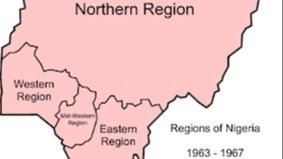
On 15 January 1966, Nigeria was composed of 4 regions. Section 3 of the 1963 Republic Constitution provided as follows:
‘(1) There shall be four Regions, that is to say, Northern Nigeria, Eastern Nigeria, Western Nigeria and Mid-Western Nigeria.
(2) The Regions and Federal territory shall consist of the areas comprised in those territories respectively on the thirtieth day of September, 1963.’
The Constitution described at Section 4, an elaborate system for creating additional administrative regions or states from these territories:
(3) Alterations to section 3 of this Constitution for the purpose of establishing new Regions out of other territories shall be effected only in accordance with the following procedure-
(a) a proposal for the alteration shall be submitted to each House of Parliament and, if that proposal is approved by a resolution of each of those Houses supported by the votes of at least two-thirds of all the members of that House, the proposal shall then be submitted to the legislative houses of all the Regions; and
(b) if the proposal is approved-
(i) by a resolution of each legislative house of a majority of all the Regions; or
(ii) by a resolution of each legislative house of at least two Regions, including any Region comprising any part of Nigeria that would be transferred to the new Region under the proposal,
Parliament may provide for the alteration.’
The procedure described in the Section 4 of the 1963 Constitution, was a carryover from the 1960 Independence Constitution, had been used previously to create in 1963 a new region, the Midwestern Region, from the Benin and Delta provinces of the Western Region. There was a Midwestern Region Act 1962, following which a plebiscite was conducted on 13 July 1963. The voters were asked:
‘Do you agree that the Midwestern Region Act, 1962, shall have effect so as to secure that Benin Province including Akoko Edo District in the Afenmai Division and Delta Province including Warri Division and Warri Urban Township area shall be included in the proposed Mid-Western Region?’
89% voted in the affirmative, well in excess of the required 60%. The Midwestern Region that was born on 9 August 1963 as a result of that plebiscite remains the only major administrative unit of Nigeria created by due constitutional process after the independence of Nigeria on 1 October 1960.
On 15 January 1966, Nigerian army officers carried out a bloody coup d’état in which Chief Akintola, the Premier of the Western Region was murdered. There then followed a series of military dictatorships. 4 of the 8 military dictators at their own whims, carved out 36 states from the regions.
I. 27 May 1967 - Yakubu Gowon created 12 states out of the four regions that existed at that time - Bendel, Benue-Plateau, Cross River, East Central, North Central, Kano, Kwara, Lagos, Northeastern, Northwestern, Rivers, and Western.
II. 3 February 1976 - Murtala Muhammed created Bauchi, Benue, Borno, Imo, Niger, Ogun, and Ondo to bring the total number to 19.
III. 27 August 1991 – Ibrahim Babangida created Abia, Enugu, Delta, Jigawa, Kebbi, Osun, Kogi, Taraba and Yobe to bring the total number to 30.
IV. 1 October 1996 - Sani Abacha created Ebonyi, Bayelsa, Nasarawa, Zamfara, Gombe and Ekiti to bring the total number to 36.
These acts of state creation by the Nigerian military are unlawful and a nullity in law.
First, the 1966 coup was a crime against the state. It was an insurrection. It was an internal treason. The soldiers attacked the state to which they had sworn, and owed, allegiance. The Nigeria Penal Code provides no means by which this treasonous crime could be expunged or forgiven. There is no statute of limitation applicable.
Nigeria Penal Code 37 (1) provides:
‘Any person who levies war against the State, in order to intimidate overall the President or the Governor of a state, is guilty of treason, and is liable to the punishment of death. [L.N.112 of 1964, 1967 No. 27].’
Nigeria Penal Code 61 provides:
‘Any person who advisedly does any unlawful act calculated to interfere with the free exercise by the President or a Governor of the duties or authority of his office or with the free exercise by a member of the Federal Executive Council, or a State Executive Council of his duties as such member, is guilty of a felony, and is liable to imprisonment for three years. [L.N. 2 of 1960. L.N. 112 of 1964. 1967 No. 27.]’
All governance and political acts by the military from 15 January 1966, including the creation of states, are the offspring of the 1966 coup. They are all unlawful because they are by-products of a crime. The military simply did not have the power to erase or whitewash their crimes against the state.
Yaqoob Ali, J held in Asma Jilani v Government of the Punjab & Anor (1972) PLD SC 139:
‘A person who destroys the national legal order in an illegitimate manner cannot be regarded as a valid source of law-making. May be, that on account of his holding the coercive apparatus of the State, the people and the Courts are silenced temporarily, but let it be laid down firmly that the order which the usurper imposes will remain illegal and Courts will not recognize its rule and act upon them as de jure. As soon as the first opportunity arises, when the coercive apparatus falls from the hands of the usurper; he should be tried for high treason and suitably punished. This alone will serve as a deterrent to would be adventurers.’
Second, the 1966 coup and subsequent others were staged for bogus reasons. The Nigeria military staged the 1966 coup ostensibly because the men at the helm of affairs were running Nigeria aground with their corrupt ways. Ministers were living flamboyant lifestyles and looting public funds at the expense of ordinary citizens. The same claims were made each time to justify each of a further 7 coups between 1967 and 1993, against both civilian governments and military juntas. The same accusations have been levied against every civilian regime since the military voluntarily handed over power in 1999. The claimed problems of Nigeria thus have not been cured by the several unlawful military interventions.
Butts K & Metz S Armies and democracy in the new Africa: Lessons from Nigeria and South Africa. US Army War College Monograph Series (Strategic Studies Institute, 1996):
‘During the decades of military rule the Nigerian armed forces have lost nearly all semblance of professionalism and became thoroughly corrupted. Senior officers all became immensely rich through theft, while junior officers and enlisted men live in poverty.’
Third, the military interventions in Nigeria were more about muscle-flexing than revolution. The military have intervened as a matter of ‘It is my turn, and I can’ rather than for the benefit or needs of the country. The military megalomaniacs as a result have saddled Nigeria with 36 States and a Federal Territory out of which only a handful are economically viable whilst at least 17 are bankrupt. In 2021, the 36 States incurred a Personnel Cost of N1.4tr, and a Debt Stock of N6.37tr (BudgIT, State of States. 2022 Edition).
Fourth, the power of the military usurpers to make laws, if any, was confined entirely to the period when they were illegally in office. The military usurpers of their own volition handed over power to civilians in 1999, when they themselves found their usurpations to be counterproductive and tiresome. The states created by the military usurpers terminated the day the usurpers finally left office in 1999.
Garba v Federal Civil Service Commission and Another (1988) I NWLR 449.
‘[t]he rule of law knows no fear, it is never cowed down, it can only be silenced. But once it is not silenced by the only arm that can silence it, it must be accepted in full confidence to be able to justify its existence.’
Fifth, the procedure for creating states as described in the Section 4 of the 1963 Republic Constitution is sacrosanct. This is an ‘entrenched clause’, a virtually immovable constitutional provision, agreed to by Nigerians at the independence negotiations. The Secretary of State for the colonies (Mr Ian MacLeod) when moving the Second Reading of the Nigeria Independence Bill, on 15 July 1960, in the British House of Commons, described it as follows:
‘On fundamental matters, however – I am sure that Nigeria is right again in this - there will be a rather more elaborate procedure for what are called the entrenched clauses. For these clauses, there will be a two-thirds majority required of all members of both Houses of the Federal Parliament and the concurrence, although by bare majority in this case, of both Houses of at least two of the regions. Thus, although change can take place, there is and there will be a considerable degree of firmness and stability and the foundations of which the independence of Nigeria is built.’
The 36-state structure currently being operated by Nigeria’s ruling class, the last vestiges of military rule, is illegal and unlawful. Section 4 of the 1963 Republic Constitution is explicit on how to create states. The military dictators who created the 36-state structure did not follow the constitutional roadmap. The 1999 Constitution cannot cure the illegality. Restructuring cannot cure the illegality. The oft touted ‘fiscal federalism’ cannot cure the illegality. Nigeria must be returned to the pre-1967 4-region structure. Until then, the internal arrangement of Nigeria since 1967 is unconstitutional.
The practical consequence of these unlawful acts of state creation is that if your father was born in one part of the Western Region, and your mother was born in another different part, you would have two different states of origin. These acts of state creations thus are reminiscent of the Berlin Act 1885, when Europeans carved Africa into different countries, and separated kith from kin.