
We, the Yoruba Descendants send you yuletide greetings.
As you know sir, the British monarch is accountable for whatever was done by, or in the name of, the Church of England. The monarch since 1531 has appointed the archbishops, bishops, and deans of cathedrals. The Act of Supremacy (1534) established the monarch as the Supreme Head of the Church of England in perpetuity. It therefore is right and proper sir for us to implore you to restitute for the Church of England’s role as principal sponsors of the transatlantic slavery.
The Church Commissioners has acknowledged that the Church were principal sponsors of the transatlantic slavery. The Most Rev Justin Welby, Archbishop of Canterbury, and Chair of the Church Commissioners said this about it:
‘I am deeply sorry for the links with transatlantic chattel slavery that the Church Commissioners have identified. This abominable trade took men, women and children created in God’s image and stripped them of their dignity and freedom. The fact that some within the Church actively supported and profited from it is a source of shame. It is only by facing this painful reality that we can take steps towards genuine healing and reconciliation – the path that Jesus Christ calls us to walk. This is a moment for lament, repentance and restorative action. I pray for those affected by this news and hope that we may work together to discern a new way forward.’
The Church Commissioners is the body that administers the property assets of the Church of England. Established in 1948, it combined the assets of the Queen Anne's Bounty, the fund dating from 1704 for the relief of poor clergy, with that of the Ecclesiastical Commissioners formed in 1836. The Church Commissioners is a major financial institution with responsibility for an endowment fund valued at £10.1 billion as of 31 December 2021. It has more than enough resources to fund Welby’s proposed ’restorative action’.
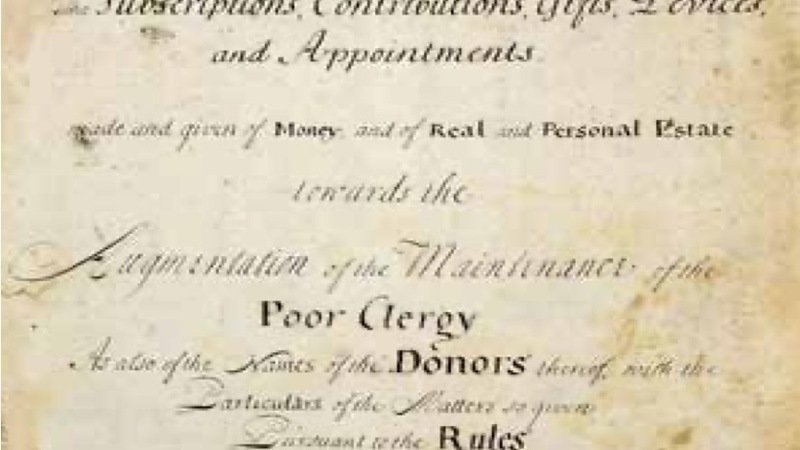
The endowment fund managed by the Church Commissioners has part of its origins in the Queen Anne’s Bounty, founded in 1704. The Bounty was set up to augment the income of the poorest clergy. For this, the Crown collected the ‘first fruits’, first year’s income of newly appointed clerics, and ‘tenths’, the tenth of subsequent year’s income. The money, which the Crown passed on to the Church, was meant to buy land for poor parishes but was often invested instead in financial speculation. Significant amounts were invested in annuities in the South Sea Company, a company that had monopoly of transporting slaves from Africa to the Americas. A third or more of the Bounty’s income came from interest and dividends from its South Sea Company investments, worth over £400 million in today’s money. As a second source of its income, the Bounty received numerous benefactions (about a fifth of its income) from individuals, such as Edward Colston, who were linked to, or who profited from, the transatlantic slavery and the plantation economy. In 1948, the Bounty funds became subsumed into the Church Commissioners’ endowment fund, through which the legacy of the Queen Anne’s Bounty’s slave-trade linkages lives on.
The British government set aside £110 billion in today’s money (equivalent of 5% of the country’s annual GDP) to compensate 46,000 British slave owners for losing their ‘property’, ie their slaves. Under the Slavery Abolition Act (1833), at least 100 clergy received compensation worth £46 million in today’s money. Henry Phillpotts, the Bishop of Exeter alone received £1.5 million compensation as executor for claims for slaves on 3 Jamaica plantations belonging to William Ward, 1st Earl of Dudley. Thomas Phillpotts, the bishop’s brother too received compensation for his own slaves.
The wealth of the Church thus was deeply intertwined with the transatlantic slavery. Also, Churches received taxes from congregants, such as, in the form of produce farmed by the enslaved. Plantations owned by the Church were worked by slaves. Churches and clergy owned slaves. Wealthy slave owners left slaves to the Church when they died. For example, Christopher Codrington, a Barbados plantation owner, left 750 slaves to the Church. The Society for the Propagation of the Gospel inherited slaves who they then branded with the word ‘Society’ on their chest with hot iron. The Society was the missionary arm of the Church of England.
Some clergy used money from the slavery to construct churches in England. James Scott, for example, paid for the construction of Holy Trinity in Barnstaple from payouts for his father’s plantations in Jamaica. Churches in turn celebrated slave owners. There were dedications to the slave merchant, Edward Colston, in two significant places of worship in Bristol. The tomb of Thomas Picton, a soldier who executed dozens of slaves during his time as Governor of Trinidad, lies in St Paul’s Cathedral. Wall monuments to slave merchants like Charles Todd, a member of the East India Company, adorned London’s St James’s Church.
The Church of England made the transatlantic slavery acceptable, justifiable and palatable to their people and to the peoples of Europe in general. Church and clergy were as barbaric and as savage as others in the treatment of their slaves. Slaves owned by the Church and clergy were treated no more humanely. Church and clergy made their slaves, human beings like themselves, into beasts of burden. They branded their slaves with hot iron to denote ownership. From cradle to grave, Church slaves were made to work for at least 12 hours every day without pay; regardless of the conditions or weather. Church slaves were flogged till they bled; many were so murdered. Church slaves were shackled with iron chains and metal/wood blocks around their necks, wrists and ankles. And when they became weak and could do no more, Church and clergy sold their slaves rather than set them free.
The Church of England must voluntarily restitute for the pain and suffering, for the blood and tears, and for lives needlessly lost. The Church of England must restitute directly to the Yoruba for the disrupted and fractured families and communities, for the devastated Yoruba life, for our culture and traditions torn asunder.
10 million of our people, especially young men, were abducted and forcibly transported as slaves by sea to the Americas in the 400 years between 15th and 18th centuries. They were treated like cattle during the crossing, overcrowded and stuffed between decks in spaces too low for standing; the heat unbearable, the air nearly unbreathable. The deck hands and sailors used the enslaved women as their sexual toys. The terrible conditions, which lasted for 2 or more months, meant dysentery, fever, small-pox and eye diseases. Up to a third of the slaves on the ships perished or were thrown overboard.
The cost of the loss of the millions to the advancement and development of Yorubaland is incalculable. Targeted ‘restorative action’ by the Church of just £1 billion would bring Yorubaland up to speed. For example, Yorubaland has one of the longest coast lines with a deep sea on the continent of Africa. Exploitation of this natural resource would bring tens of thousands of local jobs and prosperity, and renewable energy too. Sir, £1 billion from the Church endowment fund would easily achieve that.
Support the Yoruba: sign, spread, donate, share, retweet http://chng.it/QJp8yJ6hPs More than 8,500 have now signed. Target: 10,000 signatures by the end of December 2022. Signatures cost nothing! And you don’t even have to be Yoruba to sign!