
The UNPO is an international organisation established to give voice to unrepresented and marginalised peoples and to protect their human rights. UNPO is funded primarily by its members. The organisation comprises of a General Assembly of members and a number of Foundations which provide secretarial services to the Assembly. Yoruba Nation is a member through Ilana Omo Oodua.
The UNPO report was annexed to a draft document prepared by the UN Committee on Economic, Social and Cultural Rights (No. 26 2021). The general comment clarified State Parties’ obligations under the International Convention on Economic, Social and Cultural Rights (ICESCR. Those general comments had inferred the right to land from the provisions in Articles 6, 9, 11 and 12, and had described effects of violating land rights. The first part of the report is important in the context of the Nigeria State where the Fulani Buhari government seeks to allocate to itself land and natural resources belonging to the indigenous. Ethnic nations.
The UNPO report reiterates that the right to land was crucial to the right to self-determination, universally understood to mean something external to a state’s current constitutional order; that is, right to secession. This is the implication of Article 1 of the UN Charter and of the 1960 decolonisation resolution of the General Assembly. All peoples are entitled to the occupation and use of their land, which would enable them to ‘freely pursue, economic, social and cultural development’ and ‘freely dispose of their natural wealth and resources’. UN Charter Article 2.4 respect for territorial integrity of a state implies external forces only not internal, and therefore did not negate the right to self-determination.
The UNPO report reiterates that international law provided that the right of self-determination entailed the right to land. The right to self-determination implied permanent sovereignty of the indigenous peoples over natural resources. The common Article 1 of ICCPR and ICESCR protected against ex-colonial states imposing permanent sovereignty to infringe the indigenous peoples’ right to their land. Both ICCPR Article 47. And ICESCR Article 25 protected against ex-colonial states using imperialists tactics to deprive indigenous peoples of their land. Indeed, the 1955 report of the UN Secretary General on the debates at the time confirmed that the right to self-determination was meaningless if the people had no sovereignty over their land.
The UNPO report reviews the customary international legal norm that the land right of indigenous peoples could not be abrogated without consent. Article 10 of the UN Declaration on the Rights of Indigenous peoples (UNDRIP) says that ‘Indigenous peoples shall not be forcibly removed from their land or territories…without prior and informed consent’. International Labour Organisation (ILO) Convention concerning Indigenous and Tribal Peoples in Independent Countries (ILO N0. the local interests above that of the state. The inter-America Court in Suramaka People v Suriname (HR (ser.C) 174, 2007), held that state interests could not violate the right of the indigenous people to their very survival. Indeed, according to Amodu Tijani v Secretary of Southern Nigeria (1921) AC 399, 401, consent was required before an Oba could cede land to the government.
The UNPO report reiterates that sovereignty of a state was not an absolute. The modern state signs treaties all the time voluntarily limiting and transferring sovereignty to others. The US Supreme Court in the case of Worcester v Georgia (1832) 31US (6 Pet.) 515, 520 said: ‘…a weaker power does not surrender…its right to self-government…by associating with a stronger, and taking its protection…’ but rather…’a weak state may place itself under the protection of one more powerful, without stripping itself of sovereignty’. The Yoruba did not cede sovereignty to Britain, the British colonialists simply took over. IlanaUK intends this to be subject to litigation in London in the near future.
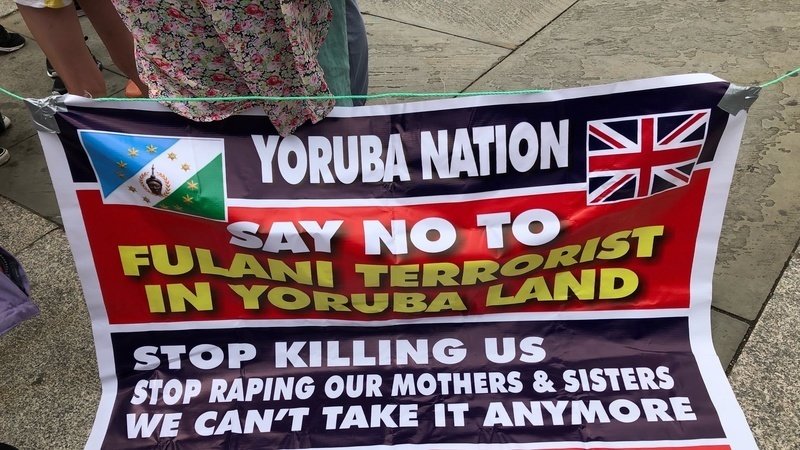
The incorporation into the Nigeria state in 1914 did not deprive Yorubaland of its inherent sovereignty. Indeed, that was the basis of the regional arrangement that was ended in a bloody insurrection by the military in 1966. The Yoruba did not consent to the 1999 constitution, which was designed to rob Yorubaland of the benefits of its mineral resources and oil deposits. The frequent Fulani targeting of the Yoruba for extra-judicial killings and for terrorism is pursuant to the 1999 constitution. IlanaUK believes that these Fulani-inspired violations will continue as long as the Yoruba remain in Nigeria. To achieve our true potential requires that Yorubaland becomes an independent state out of Nigeria.
Over 8,000 people worldwide have now signed our petition to the UN for self-determination for the Yoruba people of Nigeria - http://chng.it/QJp8yJ6hPs 10,000 signatures is the target. We are nearly there. Please make it happen. Your signature costs you nothing.