Deepfake Of Zelenskyy Tells Ukrainian Troops To ‘Surrender'

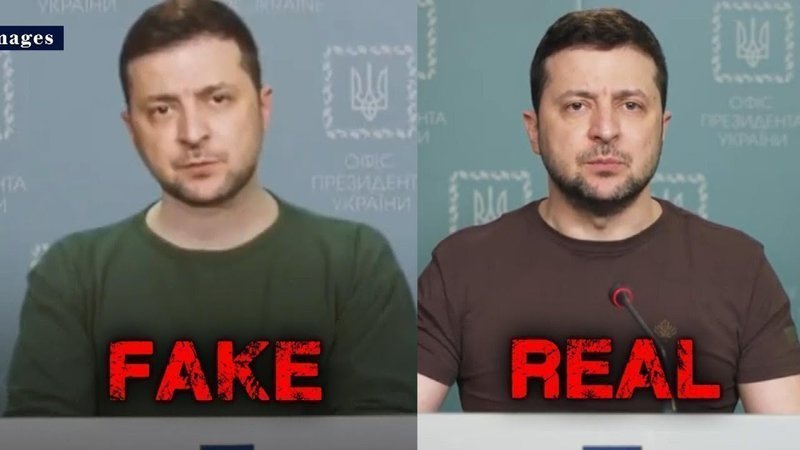
A manipulated video of Ukrainian President Volodymyr Zelensky calling on his soldiers to surrender is being shared online, with Russian hackers thought to be responsible.
The deep fake video shows Zelensky asking Ukrainians to "lay down their arms" and was uploaded to the hacked Ukraine 24 TV channel, according to Shayan Sardarizadeh, a journalist who works on the spread of disinformation at BBC Monitoring.
Deepfake videos are doctored with artificial intelligence to create convincing video and audio hoaxes showing individuals making statements they didn't actually say. The Zelensky video has been viewed hundreds of thousands of times on Twitter.
Zelensky has reportedly responded to the manipulated video, saying: "If I can offer someone to lay down their arms, it's the Russian military. Go home. Because we're home. We are defending our land, our children & our families."
"This is the first deepfake that we've seen used in an intentional and broadly deceptive way," Sam Gregory, programme director at Witness, a human rights and technology group, told Euronews.
"It's not an effective deepfake, partly because it's not an extremely well-made deepfake, but also because Ukraine has done a masterful job pre-bunking and then swiftly rebutting the video," he added.
The video comes days after Kyiv warned soldiers and civilians that Russia could use deepfakes or other technologies to spread misinformation to lower Ukrainian resolve.
Ukrainian authorities claimed that among the fake videos, hackers could make one of President Zelensky ordering troops to surrender to Russian forces.
Moscow is known for using digital technologies to spread disinformation and falsehood in order to sow chaos among its rivals. During its invasion of Ukraine, a series of videos emerged on social media allegedly showing "killings" and "provocations" by Ukrainians in an attempt to justify its invasion of the country.
Most famously, the Kremlin is accused of interfering in the 2016 US Presidential Election with the goal of harming the campaign of Hilary Clinton in favour of Donald Trump, who was seen as soft on Russia. Trump, who became president, was repeatedly accused of a pro-Putin foreign policy to the detriment of US interests.
Russia's brutal invasion of Ukraine, launched on 24 February, has killed thousands of civilians and forced more than 2 million to flee their homes, according to the UN.
The International Court of Justice (ICJ) has called on Russia to halt its brutal invasion of Ukraine. The court ruled by 13 votes to two in favour of the provisional order that "the Russian Federation shall immediately suspend military operations that it commenced on 24 February 2022 in the territory of Ukraine".
Indian judge Justice Dalveer Bhandari voted in favour of the motion alongside his western colleagues. New Delhi has so far refrained from condemning Russia's aggression in Ukraine to protect its relations with Moscow, despite Western pressure.
New Delhi is reportedly considering purchasing discounted oil from Russia, a move which has sparked criticism from the US which has been keen to isolate Moscow over its invasion of Ukraine.
Rulings by the International Court of Justice (ICJ) are binding under the UN Charter but are difficult to enforce. The judgment is unlikely to directly affect Russian president Vladimir Putin's plan but is a definitive rebuke of his invasion of Ukraine. Only the Russian and Chinese judges voted against the order.
Ukraine's President Volodymyr Zelensky welcomed the vote, tweeting: "Ukraine gained a complete victory in its case against Russia at the International Court of Justice."
"We welcome the court order and call on the Russian Federation to comply with the order, immediately cease its military operations in Ukraine, and to establish unhindered humanitarian access in Ukraine," said US State Department spokesperson Ned Price.
The court president, US judge Joan Donoghue, said the ICJ had found no evidence of Moscow's allegations that the Ukrainians were committing "genocide" against Russian speakers in the east of the country.
"The court considers that Ukraine has a plausible right not to be subjected to military operations by the Russian Federation," he said, according to The Guardian.
Russia’s invasion of Ukraine has killed thousands of civilians and forced more than 2 million to flee their homes, according to the UN.