
Nuclear weapons can curse more damage to a land as it destroys plant life and if launch onto Ukraine it will destroy of all chops and stop any means of growing anything for 20 to 30 years. Leaving radiation in the ground, damaging it. There are four major types of radiation: alpha, beta, neutrons, and electromagnetic waves such as gamma rays. They differ in mass, energy and how deeply they penetrate people and objects. The first is an alpha particle.
During the Second World War, Summer of Japan. August, cities Hiroshima and Nagasaki were hit days between each other with bombs called the atom bombs. The United States detonated two nuclear weapons over the Japanese cities of Hiroshima and Nagasaki on 6 and 9 August 1945, respectively. The two bombings killed between 129,000 and 226,000 people, most of whom were civilians, and remain the only use of nuclear weapons in armed conflict.
Russia's President Vladimir Putin wants to launch weapons like that on Ukraine destroying the land as if he can't have it, no one will have Ukraine.
As of 2022, the Federation of American Scientists estimates that Russia possesses 5,977 nuclear weapons, while the United States has 5,428; Russia and the U.S. each have about 1,600 active deployed strategic nuclear warheads. Russia's stockpile is growing in size, while the United States' is shrinking.
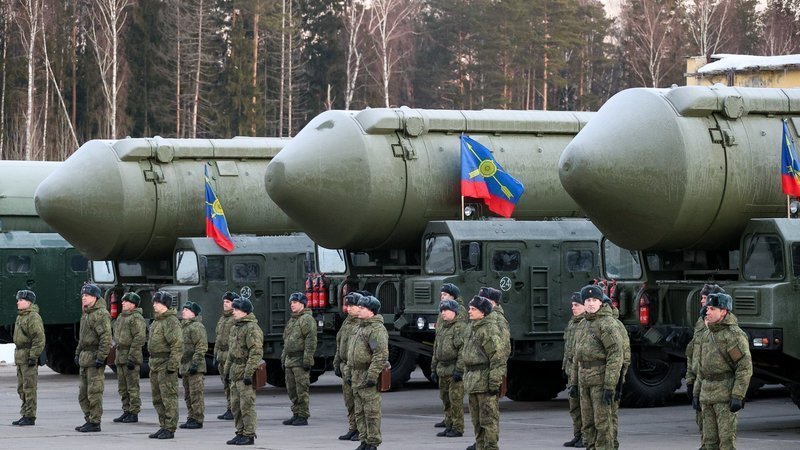
The RS-28 Samrat (Russian: РС-28 Сармат; NATO reporting name: SATAN 2), is a Russian liquid-fuelled, MIRV-equipped, super-heavy thermonuclear armed intercontinental ballistic missile in development by the Makeyevka Rocket Design Bureau from 2009, intended to replace the previous R-36 missile. Its large payload would allow for up to 10 heavy warheads or 15 lighter ones, or a combination of warheads and massive amounts of countermeasures designed to defeat anti-missile systems; it was heralded by the Russian military as a response to the U.S. Prompt Global Strike.
Russia’s president summoned the defence minister, Sergei Shoigu, and military chief of staff, Valery Gerasimov, to a public meeting on Sunday and ordered them to “transfer the deterrence forces” – a reference to nuclear weapons – “of the Russian army to a special mode of combat duty”.
Although the diplomatic threat was clear enough, the exact phrasing confused nuclear experts and defence ministries, who did not recognise what a “special mode of combat duty” might specifically entail. But there was agreement that the threat, though it had gone up a notch, remained at a low level.
Pavel Podvig, widely considered a leading expert on Russian nuclear forces, tweeted that that Putin’s order “most likely” meant “the nuclear command and control system received what is known as a preliminary command”. This would turn the system on, in effect, allowing “a launch order” to “go through if issued”.
It would also allow, he wrote, for the nuclear weapons to be launched “if the president is taken out or can not be reached”, but he added, only in the case “it detects actual nuclear detonations on the Russian territory”.
David Cullen, of the Nuclear Information Service, said this was, in a way, “analogous to the British system”, where the commanders of Trident nuclear submarines are given letters of last resort, signed by the prime minister, of instructions on how to act if it is believed that the UK has been destroyed by an all-out nuclear attack.
Putin’s nuclear posturing requires west to tread extremely carefully. Both Podvig and other experts, such as James Acton, a nuclear expert with the Carnegie Endowment, said Putin’s order could also entail further operational changes. That could include sending further nuclear armed submarines to sea or dispersing long range nuclear missiles around Russian territory, from where they could theoretically be used.
But that may not necessarily be the case, Podvig added, given Putin’s phrasing was deliberately ambiguous.