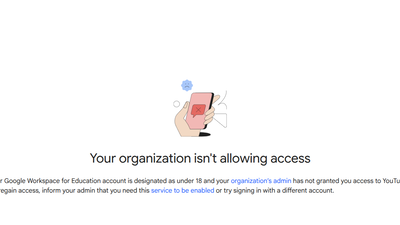

Unblock Youtube
The Issue
I am asking Google to reconsider restrictions that prevent students from accessing YouTube. YouTube is not just an entertainment platform; it is a valuable resource for education, independent learning, creativity, and personal growth. Blocking the entire platform prevents students from accessing useful educational videos, tutorials, demonstrations, and explanations that could help them succeed in school.
According to Pew Research Center’s 2024 survey of 1,391 U.S. teenagers ages 13–17, 90% of teens use YouTube, and 73% visit it daily. This shows how widely YouTube is used by young people. Although not every video is educational, the platform provides access to a vast range of learning materials, including mathematics tutorials, science experiments, history lessons, programming guides, language lessons, and step-by-step explanations of difficult subjects. Source: Pew Research Center
Students do not all learn in the same way. Some understand a difficult topic more easily when they can watch someone demonstrate it rather than read about it in a textbook. Videos can be paused, replayed, and reviewed as many times as necessary, allowing students to learn at their own pace. Blocking YouTube can remove a useful way for students to review lessons, complete assignments, develop new skills, and explore subjects beyond the classroom.
If 90% of teenagers already use YouTube, shouldn't the focus be on helping them use it responsibly rather than eliminating access to the entire platform? Restricting all of YouTube treats educational videos and distracting content as though they serve the same purpose. They do not. A science lesson, a mathematics tutorial, and a video teaching computer programming can directly support a student's education.
I recognize that online safety, inappropriate content, and classroom distractions are legitimate concerns. However, completely blocking YouTube is a broad solution to problems that could be addressed more selectively. Google and schools could consider stricter content filters, supervised access, approved educational channels, and restrictions during instructional time while still allowing students to access appropriate learning resources. This would help protect students without unnecessarily limiting their educational opportunities.
Technology is an increasingly important part of education, and students should have opportunities to develop digital literacy, research skills, creativity, and independent learning habits. Access to educational videos can complement classroom instruction and help students take greater responsibility for their own learning. The goal should not be unrestricted access to everything online, but reasonable access to useful information with appropriate safeguards.
I respectfully urge Google to reconsider student restrictions on YouTube and explore options that distinguish educational use from unnecessary distractions. Students should not lose access to an entire educational resource simply because some of its content may be misused. A balanced approach would protect students while giving them more opportunities to learn, create, and prepare for the future.
Please consider making YouTube more accessible to students through responsible, education-focused access policies. Students deserve the opportunity to benefit from the educational resources available online, and blocking the entire platform may prevent them from using tools that could make a meaningful difference in their learning.

87
The Issue
I am asking Google to reconsider restrictions that prevent students from accessing YouTube. YouTube is not just an entertainment platform; it is a valuable resource for education, independent learning, creativity, and personal growth. Blocking the entire platform prevents students from accessing useful educational videos, tutorials, demonstrations, and explanations that could help them succeed in school.
According to Pew Research Center’s 2024 survey of 1,391 U.S. teenagers ages 13–17, 90% of teens use YouTube, and 73% visit it daily. This shows how widely YouTube is used by young people. Although not every video is educational, the platform provides access to a vast range of learning materials, including mathematics tutorials, science experiments, history lessons, programming guides, language lessons, and step-by-step explanations of difficult subjects. Source: Pew Research Center
Students do not all learn in the same way. Some understand a difficult topic more easily when they can watch someone demonstrate it rather than read about it in a textbook. Videos can be paused, replayed, and reviewed as many times as necessary, allowing students to learn at their own pace. Blocking YouTube can remove a useful way for students to review lessons, complete assignments, develop new skills, and explore subjects beyond the classroom.
If 90% of teenagers already use YouTube, shouldn't the focus be on helping them use it responsibly rather than eliminating access to the entire platform? Restricting all of YouTube treats educational videos and distracting content as though they serve the same purpose. They do not. A science lesson, a mathematics tutorial, and a video teaching computer programming can directly support a student's education.
I recognize that online safety, inappropriate content, and classroom distractions are legitimate concerns. However, completely blocking YouTube is a broad solution to problems that could be addressed more selectively. Google and schools could consider stricter content filters, supervised access, approved educational channels, and restrictions during instructional time while still allowing students to access appropriate learning resources. This would help protect students without unnecessarily limiting their educational opportunities.
Technology is an increasingly important part of education, and students should have opportunities to develop digital literacy, research skills, creativity, and independent learning habits. Access to educational videos can complement classroom instruction and help students take greater responsibility for their own learning. The goal should not be unrestricted access to everything online, but reasonable access to useful information with appropriate safeguards.
I respectfully urge Google to reconsider student restrictions on YouTube and explore options that distinguish educational use from unnecessary distractions. Students should not lose access to an entire educational resource simply because some of its content may be misused. A balanced approach would protect students while giving them more opportunities to learn, create, and prepare for the future.
Please consider making YouTube more accessible to students through responsible, education-focused access policies. Students deserve the opportunity to benefit from the educational resources available online, and blocking the entire platform may prevent them from using tools that could make a meaningful difference in their learning.
The Decision Makers
Supporter Voices
Petition Updates
Share this petition
Petition created on October 19, 2026