
Petition to reduce the use of bird deterrents on buildings.
'Ring the bells that still can ring Forget your perfect offering There is a crack, a crack in everything That's how the light gets in..' - from 'Anthem', Leonard Cohen
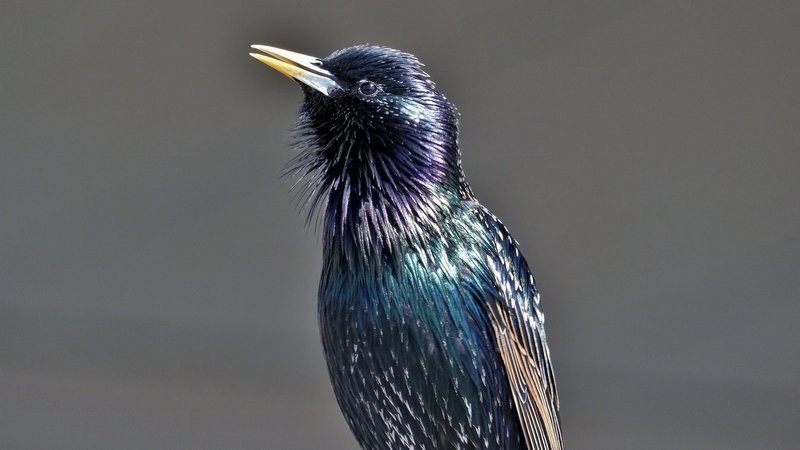
Thanks to ©Maït Foulkes who kindly donated this week’s magnificent shiny Starling image.
Will you let the light in? Please will you consider signing and sharing the petition to reduce the use of cruel bird deterrents on buildings such as metal spike strips and mesh netting using the link below? Thank you.
A sunny news update and a victory! Thanks to your help and support in getting this petition noticed, The Deputy Minister of Climate Change in Wales; Lee Waters AS/MS, has just given a helpful response to the petition. He will be ‘writing to advise all Local Planning Authorities (across Wales) to avoid permitting such spikes and nets and also to encourage all Local Authorities to take steps to remove spikes and nets as opportunities arise.’
The Minister pointed out that the human-bird tensions in urban areas are primarily dealt with by Local Authorities and went on to say that spikes and nets (deterrents) have proved ineffective; that in his view their use has been in decline, and noted there remains a substantial legacy of installations.
It is fantastic news that the Welsh Government are acting to reduce the use of these bird deterrent methods that cause injuries and deaths to birds. Let’s hope George Eustice will respond as positively for the whole of the UK. The fight against cruelty to our rooftop birds goes on…
In more good news… I learnt this week about a ‘Gull Trial' organised by the founder of innovative pest controller company Humane Wildlife Solutions. It’s an exciting initiative to save gull eggs and young chicks from three species that are often discovered in nests on rooftops by licensed pest controllers in Scotland. The trial organised the humane transport of them to cooperating animal rescue facilities for future care with eventual release back into the wild. The ‘Gull Trial’ involved considerable cooperation between Scottish pest control companies and animal rescues centres incurring some costs. The ‘Gull Trial’ appears to have been a success and the company owner is awaiting a response and hopefully follow up from the Scottish Government.
I started this petition after seeing a dead Herring Gull seemingly killed by bird deterrent spikes on a rooftop. Herring Gulls are not the only rooftop birds affected by the bird deterrents. For example Kittiwakes are affected also and like Herring Gulls are red listed as of conservation concern. The Lesser Black-backed Gull is also on the amber list. All seven species of gull are birds of conservation concern. The causes of their decline is still uncertain. It may be due to changes in their maritime environment such as pollution and overfishing.
Populations of other rooftop birds such as Swallows are fluctuating for a variety of reasons including climate change, while Swifts are on the amber list having declined by over half in recent years. Rooftop birds ranging from gulls to pigeons, birds of prey, crows, swifts and swallows, are all vulnerable to being injured or killed by the rooftop bird deterrent netting or spikes.
'In nature nothing exists alone.' - Rachel Carson, ‘Silent Spring’, Penguin Classics
Please will you consider signing and sharing the petition to reduce the use of cruel bird deterrents on buildings using the link below? Thank you.
Bright Light in Murky Waters
It’s been an interesting week in the news as COP26 in Glasgow begins on 31st October. World leaders must surely decide to reduce CO2 emissions to ensure global warming doesn’t go above 1.5c to avoid catastrophic climate change. Leaders will gather to agree what they intend to do on our behalf to tackle the global warming which is already causing life threatening, food and habitat destroying floods, fires and drought.
Here in the UK, a furore (or maybe a stink:)) was raised by environmental campaigners this last week after a large number of MPs effectively voted to allow raw sewage to be released by private water companies into our rivers and then into our oceans. The amendments put forward to this Environment Bill included one (which MPs voted out) that aimed to prevent human effluent being released to pollute rivers. Such releases of sewage damage our rivers and oceans and also impact on riverine and marine nature and of course seabirds such as the squawking gulls found on our rooftops also being affected by cruel bird deterrent measures.
Later in this update I try to dig deep, looking at how we as individuals and communities have agency, and how this power can also be lost because of lack of rights to information, transparency and power. Influenced by the very public recent debate around sewage pollution. I hope it creatively highlights how, not just human rights, but also environmental rights are essential to our common future.
A Scottish pest controller shared with me that he has had to retrieve 20 dead gulls and more than 100 pigeons and even the smaller swifts caught in rooftop netting in the last year.
Will you take the 2 simple actions below for birds? Thank you.
Action 1: Sign and share the petition using the link above. If you can afford to support the petition financially it helps to get more supporters.
Action 2: Copy, paste and then email the letter text below to your local politician or preferably send one to George Eustice as Secretary of State for Environment, Food and Rural Affairs at DEFRA including your name and address. Thank you. If George Eustice is your MP, you can also directly email him as a constituent, but do include your name and address.
Email the short letter using the text below to George Eustice, MP, Secretary of State for Environment, Food and Rural Affairs at DEFRA. Please use the Defra hotline email -
defra.helpline@defra.gov.uk OR for constituents of George Eustice, MP in Cornwall use george.eustice.mp@parliament.uk
Feel free to also email your local MP, MS or MSP or councillor, to get them on board. Contact details of all local representatives can be found at writetothem.com
Remember to change who you address your email to and include your address and contact details.
Scotland: Michael Matheson, MSP for Falkirk West, Cabinet Secretary for Net Zero, Energy and Transport. (Use above website for representatives).
Suggested text for the letter..
______________________________________________________
Dear Rt Hon George Eustice MP,
Reduce the use of cruel bird deterrents on buildings
I write to you to ask you to speak up for rooftop birds and urban wildlife. In the face of the climate and biodiversity crises ahead of this autumn’s proposed COP26 meeting in Glasgow, please make a commitment to ensure a reduction in the use cruel bird deterrent measures such as cruel mesh netting and metal bird spikes on buildings.
I am alarmed many declining or even red listed birds are injured or killed as a result of the cruel deterrent measures on rooftops in the UK. Despite current methods to ensure ‘humane’ control of birds causing ‘nuisance’, wildlife rescue centres, pest controllers and roofers are reporting slow, lingering deaths or injuries to declining and common bird species.
Birds affected importantly include red or amber listed gull species, birds of prey, and declining species such as swallows and swifts.
Faced with the climate and biodiversity crises, it would be timely to better understand and reassess our relationship with urban nature species including rooftop and even common birds reconsidering how they are treated in our towns. The definition of bird nuisance could be better nuanced so inappropriate use of bird deterrents is designed out.
Since the use of bird deterrents crosses many areas of administration it would be helpful to focus on stamping out cruelty and species loss by action across agencies rather than simply focusing on reducing bird nuisance.
Please stand up for urban wildlife. In particular commit to a new vision for our diverse rooftop bird species and ensure urban wildlife crimes are followed up and prosecuted.
The recent report from the IPCC and IPBES made clear ‘- every local nature-based biodiversity solution in our cities and towns matter as they accumulate together on a global scale’. Changing public and industry behaviours on how we treat our urban wildlife can help mitigate the interrelated crises of biodiversity and climate change. It will also importantly help accelerate collective action by the community.
I trust you will help stop the cruel bird deterrent measures and will fully support this collective campaign.
Yours sincerely
(Your Signature)
____________________________________________________
Cracks of light - how freedom of information and Environmental Rights Matter
Have you heard of the Aarhus Convention or the 'three pillars of Aarhus'? I hadn’t until this week. The Aarhus Convention is an important United Nations Economic Commission for Europe (UNECE) treaty which provides access to information, public participation in decision making and access to justice in environmental matters.
In a previous update I suggested that despite the commonly held public perception that we all are responsible for our individual destinies, not everyone has equal agency in becoming the best of who they could be. The pressure to 'get on' in modern society and that it is all entirely 'in our own hands' is actually a fallacy. Where we happen to grow up, our parents, our culture, our wealth, our power and much more contribute or limit us achieving our potential.
Reading the quote from the Leonard Cohen song 'Anthem' that started this update you may have seen it suggests that perfection is rarely possible and that it is the imperfections (or cracks) that somehow teach us something new.
We now face the climate emergency and look forward to the spectacle that is COP26 when our global future is being decided. It’s therefore, perhaps timely, to learn about the three pillars of Aarhus. Remember they are most simply put; the right to know, the right to engage and the right to challenge. Their relevance will become apparent..
In a recent UN environmental rights convention, the meeting detailed how the UK is failing to comply with the provisions of the Aarhus Convention. The UK has also been asked to provide a plan as to how it will make legal action more affordable for the public (agency again..). The UK Government’s overall implementation of the Convention has been fragmentary. It turns out the three pillars which include the right to access information held by public authorities, the right to participate in decision-making and the right to challenge unlawful actions by public bodies in the courts have only been partially transposed into UK law with the first two rights becoming law in 2005 through EU directives.
After a challenge brought by Greenpeace in 2012 the High Court decided the Aarhus Convention is irrelevant as its incorporation has not been extensive. It cannot therefore be directly enforced in the UK Courts and is what is apparently known as ‘Soft law’! The future of nature and the environment looks bleaker still, thanks to Brexit. Because of Brexit, in effect the first two pillars were ‘rolled over’ as mere Statutory Instruments and are now vulnerable to Parliamentary amendment with limited scrutiny and access for public involvement.
A few readers may be aware that the ‘Planning for the Future’ White paper of August 2020 proposed the watering down of environmental assessments and a considerable reduction in the rights of the public to take part in planning decisions. Whilst that paper may not yet advance to legislation there are however other concerns. Two types of Quashing Orders being introduced in the ongoing Judicial Review and Courts Bill may make it uncertain that even if in court action on environmental matters claimants are successful they may not get the environmentally appropriate remedy they asked for. In other words ‘quashed justice’
What this means, is that the Government’s current approach to Aarhus implementation undermines the public right to challenge the lawfulness of major roads, HS2 or Heathrow runway for example. So too; the public’s ability to obtain sewage outflow data or to be heard in the planning process. In effect our collective right to question change in our neighbourhoods, combat climate change and indeed catastrophic loss of wildlife is entirely at stake.
As I suggested in a previous update we may as early humans have hidden in caves, originally, but with curiosity and security in numbers we constructed a world of certainty, of home and our 'civilizing', and amazing but gas guzzling cities. With our sense of ownership, our actual homes became the castles we so often defend against all odds. This is what underlies the reason why some try to kill the birds on our roofs, prevent access to wildlife with fences or even use them to keep out neighbours. I also spoke also about the deep fear; a human survival mechanism that drives us to fight and sadly go to war even with our friends and neighbours.
What you may ask does all of the above have to do with the cruel killing of birds on roofs by bird deterrents? The truth is, many of us long ago lost our connection with nature, finding it almost unclean post war (as we were marketed chemicals to kill) and something to own and manage and even worse seen as a perceived though often not real threat. The unknown becomes a mystery, and is misunderstood and so the wildlife or even our actual neighbours becomes feared. On the other hand when there is open dialogue, be it with neighbours or in the case of wildlife, interaction with the biodiversity around us; we can instead learn to understand each other better, to value the other and even want to take care of our neighbourhood and community for the common good. Interestingly, the connection outward is encouraged by curiosity and a desire to trust in a shared and better future; something surely relevant now as we come out of the pandemic?
When access to information and agency is endangered, we lack the possibility to communicate with or question the behaviours of those who have power over us. It can build walls between us, dividing us into different camps, nations or worse still send us backward in evolution to be fearful, angry and violent humans.
When Leonard Cohen sings about the sounding of the bell in the lyrics at the start of this update, he is, perhaps, referring to the Philadelphia’s Liberty Bell. The Bell was made in 1751 and cracked when it was first rung. It predated the American Constitution and indeed the American Revolution. The bell was rung on important occasions and became a metaphor for freedom summoning people to assemble and take action.
A cracked bell may indeed lack perfect pitch but in the crack lies the light that can transform. Just as doubt grows with uncertainty, so a crack grows, but with doubt comes questioning and a desire for the knowledge that can lead to both helpful solutions and empowerment. The cracks provide insights and an incentive to do better. We can do the best we can, until we know better; we can then move on to ultimately actually doing better so public information is empowering. The Liberty Bell may have at the time been rung by the privileged white drafters of the American Constitution who were sadly invested in slave enterprise. They most certainly were not perfect. Just three years later after the Constitution was ratified they revisited it and passed the first ten amendments which became the Bill of Rights. The very same mechanism is used to this day to change the law with for example women in the USA finally being given the right to vote in 1919.
In my own view, how we choose to treat our rooftop birds often cruelly and with disdain is not unlike the cracked Liberty Bell. You may understandably think cruelty to our humble rooftop birds is just a minor matter. The flaws that are exposed about ourselves in how we treat rooftop birds or indeed our ‘different’ neighbours can be pointers or chinks of light that can direct us to change ourselves and wider society. Only by understanding our common flaws that centre around fear, trust and our desire for security (and corrupting power) can we use doubt as a force to begin conversations, break down walls that divide us; find and agree solutions and build community-stabilising and sustaining connection.
'The most powerful person in the room is the one with the least to hide.' - Rick Julian
We as the public have the potential, in the face of the climate emergency, of being those people in the room with the least to hide. With our own loved ones, we usually demand honesty, transparency and authenticity, yet we live in a culture of secrecy where hiding information and lying is commonplace or, in the words of Greta Thunberg on solutions to climate change we are subjected to - “blah, blah, blah”; greenwashing PR and cover ups even though we dislike to be taken as fools. This is the murky water, or the if you like; the opaque wall that we must find ways to smash through so we can ride out the climate emergency and reach the highest peaks of our capacity for common good and not stall our simple evolution.
As UN Secretary General Kofi Annan, said in a speech at the United Nations in 1997 -
‘ - information has a great liberating power waiting to be harnessed to our global struggle for peace, development and human rights. We believe this because we are convinced that it is ignorance, not knowledge, that makes enemies of men. It is ignorance, not knowledge, that makes fighters of children. It is ignorance, not knowledge, that leads some to advocate tyranny over democracy.'
In 1999, Nobel Prize winning economist Joseph Stiglitz argued in an Oxford lecture 'On Liberty, the Right to Know, and Public Disclosure.' that information gathered by public officials at public expense is owned by the public just as public assets such as the very chairs used by officials in public buildings belong also to the public.
Access to public records gives citizens the opportunity to participate in public life, help set priorities, and hold their governments accountable. The free flow of information can be helpful in building trust between a government and its citizens and helps mould services tailored to the changing communities they are meant to serve. As we face huge change with the joint climate and biodiversity crises, the public and campaigners must hold our Governments, tech companies, multi-nationals, corporations and public bodies fully accountable.
Access to information is a fundamental human right and will be crucial in helping people exercise critical human rights, such as clean water, heathcare and education. We must now, surely, add a healthy planet as the crowning glory in that important list.
Holding information away from the public makes us subjects not citizens.
‘Nothing so diminishes democracy as secrecy.’ Ramsey Clark, 1967. U.S. Attorney General
Whilst total transparency arguably may not be a good thing for national security or terrorism for example, relations between the public and the Government should not be based on deceit. Secrecy for the perpetrator provides insulation against being accused of making a mistake and enables easy cover up of errors. It also provides a murky curtain behind which ‘special’ interests can hold sway, leading to corruption and an undermining of democratic government.
‘Publicity is one of the purifying elements of politics. Nothing checks all the bad practices of politics like public exposure.’ Woodrow Wilson. Quoted in R. Goodin, 1992, Motivating Political Morality, Cambridge, Mass.; Blackwell.
To avoid public unrest and even potential anarchy in facing the approaching challenges leaders must;-
'Let the people know the facts, and the country will be safe.' - Abraham Lincoln
Now is not the time to allow our Governments and those in power, to ‘go to earth’ like the fox dives deep into its home when faced by howling hounds. Those in power must learn to not 'bare their teeth' with misuse of power and cover ups and instead should be encouraged to show their cracks, share information and knowledge and let the light in so there is open discourse.
If as seems likely if the powerful build barriers to prevent others gaining equality and justice, communities and organisations will need to ‘wise up’ to the importance of freedom of information and organise to make it available. Environmental rights just like human rights must be protected not only for nature and the planet but also so we all can survive and flourish in our wonderful humanity.
‘There are some who do not have the ability to hide. For our hearts will not fit under a rock.’ - Tom Althouse
We can be those people who's hearts do not fit under a rock. The people do indeed have the power… we must use it well.
Let’s not simply accept just who we are, or what we’ve become. Let’s redefine who we could be, reconsider the how; of how we get there, and the limits of and possibilities of what that world and indeed we together might be. Question, doubt, be furious, be mad, be rebellious about all injustices. Be it poor opportunities, murky, dirty water or dead birds on a rooftop. The world is all our business.
Let’s keep the squawking gulls, cooing pigeons and chirping sparrows thriving and see the wondrous possibilities of this planet, vision them and open ourselves to transparency, trust and connection.
Please sign and share the petition and kindly consider supporting it if you have the means. Thank you for reading this far! PD