

UCI Drift Needs More Fishing Time & Fish State/Federal Waters Same Day
The Issue
To: The North Pacific Fishery Management Council
RE: NPFMC Council, October 8-13, 2026. Agenda Item E, Staff Tasking. Cook Inlet Salmon EEZ Management
Dear Members of the North Pacific Fishery Management Council:
We the undersigned are writing to ask for improvements to Upper Cook Inlet (UCI) Drift Fishery management to support a healthy fishery with optimum yield across all species. With 347 federal permit holders – more than 75% of whom are Alaskans – and over a thousand people who depend on the fishery for our livelihoods, we are the largest and most local commercial fishery managed by this Council. Made up of hundreds small Alaskan businesses and local processors, UCI fishermen have brought important revenues to the Kenai Peninsula since the 1880s. Considering that over 75% of the total UCI salmon harvest occurred in the EEZ in 2026, this Council's management has a huge impact on the viability and health of our fishery. Your decisions will affect Alaskans who are starting their families, buying homes, paying for their kids' education, and putting money away for retirement. In that spirit, we respectfully ask you to invest in two low-cost, high-impact changes to management.
1) The UCI Drift Fleet needs more fishing time early in the season - before coho harvest constrains the fleet - so that we can get closer to our sockeye Total Allowable Catch (TAC) . We propose that the Council allow at least 3 openers per week until July 20 or 22, with openings on Mondays, Thursdays, and Saturdays. Sockeye are how our fishery survives, and it has hurt us financially that we haven't come anywhere near our sockeye TAC for the past three years, even with record returns in 2025.
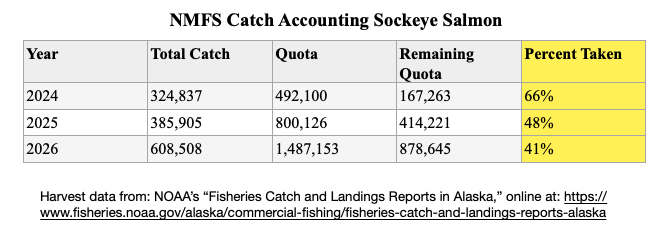
With about 1.5 million fish in “remaining quota” from between 2024 to 2026, the fleet has suffered an estimated loss of $14 million dollars from unharvested “quota” (estimated conservatively at a 5 lb average at $2/lb). That is about a $40,345 loss per permit. On top of that, it is safe to project that processors have lost double that amount of money, not to mention lost jobs and local taxes. We would be much more likely to get in the range of our sockeye TAC if we were allowed one more fishing day per week, until coho harvest becomes a factor. Additionally, there is a real risk that the huge sockeye escapements in recent years – that resulted in part from lack of harvest opportunity – will lead to reductions in return-per-spawner to the Kenai and Kasilof systems. Letting too many fish spawn in constrained lake systems results in lower productivity, as more fish have to compete for limited resources. The results of the extraordinarily high escapements of 2025 remains to be seen, but fishermen are worried about a downturn a few years down the road. This Council should be doing what it can to ensure that the UCI drift fleet is able to fish the harvestable surplus.
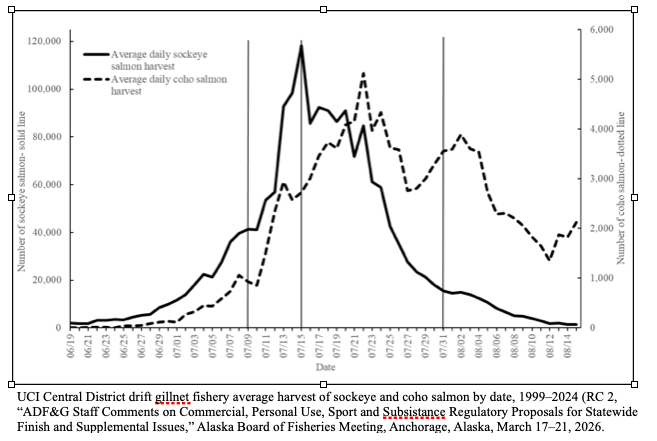
We propose that the Council allow a minimum of 3 openers a week until July 20 or 22, with openings on Mondays, Thursdays, and Saturdays. This would allow for additional sockeye harvest during the period of time with the highest sockeye to coho ratio, maximizing sockeye harvest while minimizing coho harvest. As the below chart shows, sockeye harvest July 10 - 22 is a crucial period for the survival and success of our fishing business, and for achieving maximum sustained yield for both species.
We recognize the complexity of managing a mixed stock fishery, and to ensure that the proposed change does not result in over-harvest, we suggest the creation of a tool to allow managers to reduce our fishing days in-season as we approach a TAC. For example, you could create a system where when we have harvested 75 percent of our TAC, we would switch to two days a week.
2) We ask the Council to lift restrictions on fishing in federal and state waters on the same day. This is a small change that could bring a lot of benefit to fishermen. Fishermen targeting halibut and black cod in state and federal waters are allowed to harvest from both waters on any given day: why treat us differently? We currently keep records of where and when we set, and how many fish we catch per set; our VMS is onboard monitoring our location at all times, and none of this would change under the proposed new rule.
Safeguards against over-harvest are provided by the structural coordination between the Alaska Department of Fish and Game and NOAA/NMFS: the models used to create our TAC factor in harvest in state waters; in turn, state management de-facto accounts for EEZ harvest, because it is an escapement-based system that counts fish after the EEZ harvest, rather than a parallel quota system, like Pacific cod. Additionally the state monitors and samples all harvest.
Every Upper Cook Inlet drifter stores fish in brailer bags in fish holds; these bags are used to deliver fish at the dock and generally hold about 1,000 lbs. It would be easy to sort harvest from federal and state waters in these bags and to identify harvest-by-area at the time of delivery. As observers are not required on vessels under 40 feet, and the great majority of our fleet is smaller than that, observers would not be a useful or necessary tool.
The current restriction on fishing in state and federal waters on the same day may have made sense as an initial precautionary policy, but in practice, it is a major impediment to the prosecution of the fishery for optimum yield. Cook Inlet is famous for having some of the largest tides in the world, and the drift fleet is constantly moving up and down the Inlet with the tides, sometimes at a speed of 7 knots, with our nets acting as a kind of sail in the water. Tidal forces make staying in one regulatory area or another very difficult and expensive: we have to start picking up our gear (stop fishing) several miles before the line, and then we have to spend an hour or two running against the tide to get back to a location where we can safely set out again. Then the process repeats about an hour or so later.
This might not sound like much of a burden, but this rule can result in a loss of a very large percentage of our harvest. Say, for example, a boat loses 4 hours per opener to running and picking up early (it is easy to lose more time than that, depending on the speed of the boat ), that’s 1/3 of that fishermen’s total fishing time per week, and 1/3 of his or her total harvest that week, the extra fuel costs aside. During the peak of the season when we harvest the majority of our fish, this rule is especially harmful. Respectfully, the rule is overly-burdensome relative to any benefit it might offer.
Thank you for your consideration and your commitment to the health of our fishery.

400
The Issue
To: The North Pacific Fishery Management Council
RE: NPFMC Council, October 8-13, 2026. Agenda Item E, Staff Tasking. Cook Inlet Salmon EEZ Management
Dear Members of the North Pacific Fishery Management Council:
We the undersigned are writing to ask for improvements to Upper Cook Inlet (UCI) Drift Fishery management to support a healthy fishery with optimum yield across all species. With 347 federal permit holders – more than 75% of whom are Alaskans – and over a thousand people who depend on the fishery for our livelihoods, we are the largest and most local commercial fishery managed by this Council. Made up of hundreds small Alaskan businesses and local processors, UCI fishermen have brought important revenues to the Kenai Peninsula since the 1880s. Considering that over 75% of the total UCI salmon harvest occurred in the EEZ in 2026, this Council's management has a huge impact on the viability and health of our fishery. Your decisions will affect Alaskans who are starting their families, buying homes, paying for their kids' education, and putting money away for retirement. In that spirit, we respectfully ask you to invest in two low-cost, high-impact changes to management.
1) The UCI Drift Fleet needs more fishing time early in the season - before coho harvest constrains the fleet - so that we can get closer to our sockeye Total Allowable Catch (TAC) . We propose that the Council allow at least 3 openers per week until July 20 or 22, with openings on Mondays, Thursdays, and Saturdays. Sockeye are how our fishery survives, and it has hurt us financially that we haven't come anywhere near our sockeye TAC for the past three years, even with record returns in 2025.
With about 1.5 million fish in “remaining quota” from between 2024 to 2026, the fleet has suffered an estimated loss of $14 million dollars from unharvested “quota” (estimated conservatively at a 5 lb average at $2/lb). That is about a $40,345 loss per permit. On top of that, it is safe to project that processors have lost double that amount of money, not to mention lost jobs and local taxes. We would be much more likely to get in the range of our sockeye TAC if we were allowed one more fishing day per week, until coho harvest becomes a factor. Additionally, there is a real risk that the huge sockeye escapements in recent years – that resulted in part from lack of harvest opportunity – will lead to reductions in return-per-spawner to the Kenai and Kasilof systems. Letting too many fish spawn in constrained lake systems results in lower productivity, as more fish have to compete for limited resources. The results of the extraordinarily high escapements of 2025 remains to be seen, but fishermen are worried about a downturn a few years down the road. This Council should be doing what it can to ensure that the UCI drift fleet is able to fish the harvestable surplus.
We propose that the Council allow a minimum of 3 openers a week until July 20 or 22, with openings on Mondays, Thursdays, and Saturdays. This would allow for additional sockeye harvest during the period of time with the highest sockeye to coho ratio, maximizing sockeye harvest while minimizing coho harvest. As the below chart shows, sockeye harvest July 10 - 22 is a crucial period for the survival and success of our fishing business, and for achieving maximum sustained yield for both species.
We recognize the complexity of managing a mixed stock fishery, and to ensure that the proposed change does not result in over-harvest, we suggest the creation of a tool to allow managers to reduce our fishing days in-season as we approach a TAC. For example, you could create a system where when we have harvested 75 percent of our TAC, we would switch to two days a week.
2) We ask the Council to lift restrictions on fishing in federal and state waters on the same day. This is a small change that could bring a lot of benefit to fishermen. Fishermen targeting halibut and black cod in state and federal waters are allowed to harvest from both waters on any given day: why treat us differently? We currently keep records of where and when we set, and how many fish we catch per set; our VMS is onboard monitoring our location at all times, and none of this would change under the proposed new rule.
Safeguards against over-harvest are provided by the structural coordination between the Alaska Department of Fish and Game and NOAA/NMFS: the models used to create our TAC factor in harvest in state waters; in turn, state management de-facto accounts for EEZ harvest, because it is an escapement-based system that counts fish after the EEZ harvest, rather than a parallel quota system, like Pacific cod. Additionally the state monitors and samples all harvest.
Every Upper Cook Inlet drifter stores fish in brailer bags in fish holds; these bags are used to deliver fish at the dock and generally hold about 1,000 lbs. It would be easy to sort harvest from federal and state waters in these bags and to identify harvest-by-area at the time of delivery. As observers are not required on vessels under 40 feet, and the great majority of our fleet is smaller than that, observers would not be a useful or necessary tool.
The current restriction on fishing in state and federal waters on the same day may have made sense as an initial precautionary policy, but in practice, it is a major impediment to the prosecution of the fishery for optimum yield. Cook Inlet is famous for having some of the largest tides in the world, and the drift fleet is constantly moving up and down the Inlet with the tides, sometimes at a speed of 7 knots, with our nets acting as a kind of sail in the water. Tidal forces make staying in one regulatory area or another very difficult and expensive: we have to start picking up our gear (stop fishing) several miles before the line, and then we have to spend an hour or two running against the tide to get back to a location where we can safely set out again. Then the process repeats about an hour or so later.
This might not sound like much of a burden, but this rule can result in a loss of a very large percentage of our harvest. Say, for example, a boat loses 4 hours per opener to running and picking up early (it is easy to lose more time than that, depending on the speed of the boat ), that’s 1/3 of that fishermen’s total fishing time per week, and 1/3 of his or her total harvest that week, the extra fuel costs aside. During the peak of the season when we harvest the majority of our fish, this rule is especially harmful. Respectfully, the rule is overly-burdensome relative to any benefit it might offer.
Thank you for your consideration and your commitment to the health of our fishery.
The Decision Makers

Supporter Voices
Petition Updates
Share this petition
Petition created on September 25, 2026