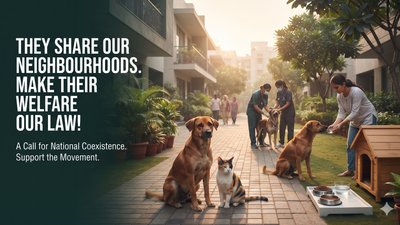
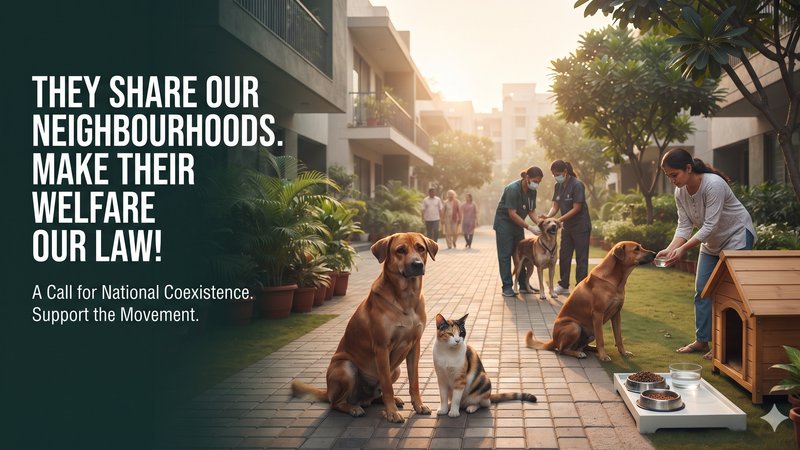
THEY SHARE OUR NEIGHBOURHOODS. MAKE THEIR WELFARE OUR LAW!
The Issue
THE ISSUE
THEY SHARE OUR NEIGHBOURHOODS. MAKE THEIR WELFARE OUR LAW!
Imagine living in a neighbourhood where you have no guaranteed access to food, clean drinking water, medical treatment or even a safe place to rest.
Imagine being injured, sick or hungry, yet having no way to ask for help. Imagine spending your days searching through garbage for something to eat, enduring extreme summer heat, heavy monsoon rains and winter cold, while the world around you carries on as though your existence does not matter.
This is the everyday reality of millions of community animals across India.
They are not visitors to our neighbourhoods. They are not temporary occupants of our streets. They have lived alongside human communities for generations. They are part of the urban and semi-urban ecosystem that we have collectively created.
Yet, when it comes to their fundamental welfare, responsibility is frequently passed from one person to another.
Resident Welfare Associations (RWAs) argue that animal welfare is not their responsibility. Municipal authorities struggle with inadequate infrastructure and resources. Animal caregivers and compassionate residents are left to shoulder responsibilities that should never have been theirs alone.
The result is a fragmented system in which animals suffer, caregivers struggle, residents become frustrated and conflicts continue to escalate.
This is not simply an animal welfare problem. It is a failure of neighbourhood planning, public responsibility, sanitation and compassionate governance.
1. FOOD AND CLEAN WATER SHOULD NOT DEPEND ON CHARITY
No living being should have to search through garbage or depend on the unpredictable kindness of strangers to survive.
Community dogs and cats need access to appropriate food and clean drinking water.
However, feeding arrangements are frequently disputed within residential societies. Caregivers encounter restrictions, confrontations and, in some cases, intimidation for performing what should be recognised as a legitimate act of compassion.
We need properly identified, hygienic feeding stations with mutually agreed locations, reasonable schedules and clear maintenance responsibilities.
Feeding should be organised responsibly, not prohibited arbitrarily or pushed into unsafe locations.
2. MEDICAL CARE MUST BECOME A SHARED RESPONSIBILITY
What happens when a community dog is struck by a vehicle?
What happens when a cat develops a serious infection?
What happens when an animal suffers a fracture, an untreated wound, a skin disease or a life-threatening medical emergency?
Too often, the burden falls upon an individual caregiver who must locate a veterinarian, arrange transportation, raise money and somehow manage the treatment.
This cannot remain the norm.
Every neighbourhood needs an accessible veterinary support mechanism, including emergency response, routine treatment, deworming, preventive healthcare and rehabilitation where medically necessary.
An animal's access to treatment should not depend on whether someone happens to be available or financially capable of helping that day.
3. VACCINATION AND STERILISATION MUST BE SYSTEMATIC
Vaccination, particularly against rabies, and humane sterilisation through authorised Animal Birth Control programmes are essential components of responsible community animal management.
Yet, in many localities, there is no accessible, updated record of the animals living in the neighbourhood, their vaccination status or their sterilisation status.
This creates uncertainty for residents and makes it difficult for caregivers and authorities to coordinate effective interventions.
Every residential cluster must have access to a coordinated programme that identifies community animals, maintains appropriate health records and works with municipal authorities and authorised animal welfare organisations to achieve sustained vaccination and sterilisation coverage.
Prevention must replace crisis management.
4. COMMUNITY ANIMALS NEED SAFE, WEATHER-PROTECTED RESTING SPACES
We construct buildings, landscaped gardens, parking facilities, security cabins and recreational spaces for human residents.
But have we ever considered where the animals who live around these buildings can safely rest?
During peak summer, animals struggle to find shade. During the monsoon, they seek shelter from relentless rain. During extreme weather, even a small, protected resting area can make a significant difference.
We propose that residential complexes and neighbourhood authorities facilitate appropriately designed, weather-protected resting spaces for community animals.
These spaces must be hygienic, safe, appropriately located and designed to avoid obstructing pedestrian movement, parking, emergency access or children's recreational areas.
We are not demanding luxury accommodation.
We are demanding the basic dignity of a safe place to rest.
5. GARBAGE MANAGEMENT MUST BECOME A PRIORITY
One of the most overlooked causes of conflict between humans and community animals is unmanaged food waste.
Open garbage dumps, overflowing bins, exposed organic waste and discarded food attract animals, forcing them to scavenge through hazardous materials.
This exposes animals to plastic, sharp objects, spoiled food, toxic substances and other dangerous waste.
It also creates sanitation concerns for residents and encourages competition around garbage collection points.
We need a comprehensive neighbourhood-level waste management system.
All exposed garbage collection points must be replaced with secure, covered, animal-proof waste storage facilities. Organic waste must be collected regularly, and illegal dumping must be addressed.
A clean neighbourhood benefits everyone.
Animals should not have to search through our discarded waste to find their next meal.
6. A 500-METRE COMMUNITY ANIMAL CARE ZONE
Animal welfare cannot stop at the compound wall of a residential society.
Community animals move through surrounding streets, adjoining lanes, vacant plots and neighbouring residential areas. Their territories and daily movement do not follow property boundaries.
We therefore propose a mapped community animal care zone extending up to 500 metres around every residential complex.
Within this zone, the RWA should coordinate with adjoining societies, municipal authorities, animal caregivers and recognised welfare organisations to ensure that community animals are not left without access to food, water, healthcare, vaccination, sterilisation and safe resting arrangements.
Where zones overlap, the municipal authority must coordinate responsibilities so that no animal is excluded and no single society is unfairly burdened.
This is a neighbourhood responsibility, not a demand that one RWA independently assume all financial and operational obligations.
7. ANIMAL WELFARE COMMITTEES MUST BECOME MANDATORY
Most residential societies have committees for security, maintenance, finance, cultural activities and infrastructure.
Why should animal welfare be treated as an optional afterthought?
We propose that every registered residential complex establish a dedicated Animal Welfare and Coexistence Committee.
It should include:
RWA or housing society representatives.
Community animal caregivers.
Resident volunteers.
Veterinary professionals or authorised veterinary representatives.
Municipal representatives or recognised animal welfare organisations, wherever feasible.
Its responsibilities should include maintaining animal health records, coordinating feeding arrangements, organising vaccination and sterilisation programmes, addressing grievances and preventing unnecessary conflicts.
This would replace confrontation with communication and arbitrary decisions with documented processes.
8. PROTECT ANIMALS FROM CRUELTY, POISONING AND ILLEGAL DISPLACEMENT
Community animals are particularly vulnerable to deliberate poisoning, physical abuse, abandonment, illegal relocation and other forms of cruelty.
There must be an accessible and accountable reporting mechanism through which residents and caregivers can report such incidents.
Complaints must be investigated by the appropriate authorities within defined timelines.
Where relevant, CCTV footage and other evidence must be preserved and made available to authorised investigating agencies in accordance with applicable law.
No animal should disappear from a neighbourhood simply because someone finds its presence inconvenient.
9. EVERY MUNICIPAL WARD NEEDS AN ANIMAL EMERGENCY RESPONSE SYSTEM
When a human being experiences a medical emergency, we expect an emergency response mechanism to exist.
An injured animal deserves a response too.
Every municipal ward should have access to an animal emergency helpline or coordinated response service connecting residents, municipal authorities, veterinary facilities and recognised animal welfare organisations.
The system should address:
Road accident injuries.
Severe illness and distress.
Suspected poisoning.
Rabies-related concerns.
Injured and vulnerable puppies and kittens.
Animals requiring urgent veterinary intervention.
A reporting mechanism without an actual response is not enough. We need defined response standards, accountability and follow-through.
10. MAKE ACCOUNTABILITY AND FUNDING PART OF THE LAW
Rules without accountability often remain words on paper.
The proposed national framework must establish clearly defined responsibilities for RWAs, housing societies, municipal corporations and state authorities.
It should provide for:
Periodic community animal welfare assessments.
Updated vaccination and sterilisation records.
Monitoring of feeding and resting facilities.
Waste management inspections.
Transparent grievance redressal.
Time-bound responses to cruelty and emergency complaints.
Appropriate action against proven violations.
Funding should be supported through municipal allocations, government welfare programmes, CSR contributions, voluntary resident funds and partnerships with recognised animal welfare organisations.
Ordinary residents should not automatically be forced to bear additional maintenance charges.
The objective must be a sustainable system that is practical, transparent and enforceable.
WHY MUST WE ACT NOW?
India cannot continue treating community animal welfare as an issue that belongs exclusively to animal lovers.
It concerns public health, neighbourhood sanitation, responsible urban development, animal protection and the kind of society we wish to build.
A hungry animal scavenging through garbage is not merely an animal welfare concern. It is also a waste management failure.
An unvaccinated community dog is not merely a concern for animal caregivers. It is a public health issue requiring organised intervention.
An injured animal left untreated is not merely someone else's problem. It reflects a gap in our collective response systems.
A residential society that has no structured mechanism for addressing animal welfare will inevitably face recurring disputes.
And a caregiver who is forced to manage an entire neighbourhood's animal welfare alone is being asked to compensate for a system that has failed to organise itself.
We need to move away from the endless debate between those who love animals and those who fear or dislike them.
We need a framework that recognises the legitimate interests of both human residents and community animals.
This is about creating neighbourhoods where people can live safely and animals can live with dignity.
WHAT WE ARE DEMANDING FROM THE GOVERNMENT
We call upon the Government of India, the Animal Welfare Board of India (AWBI), the Ministry of Fisheries, Animal Husbandry and Dairying, the Ministry of Housing and Urban Affairs, State Governments and municipal authorities to:
Introduce a legally enforceable National Community Animal Welfare and Human-Animal Coexistence Framework.
Strengthen and amend existing rules, including the Animal Birth Control Rules, 2023, wherever necessary, to establish clearly defined RWA and municipal responsibilities.
Establish mapped community animal care zones extending up to 500 metres around residential complexes, with coordinated municipal oversight.
Mandate access to food, clean drinking water, veterinary treatment, vaccination, sterilisation and weather-protected resting spaces.
Make secure garbage management and the elimination of exposed food waste compulsory.
Mandate Animal Welfare and Coexistence Committees in registered residential communities.
Establish accessible animal emergency response and cruelty reporting systems.
Introduce periodic monitoring, transparent reporting, grievance redressal and appropriate enforcement mechanisms.
Create sustainable funding arrangements through government support, municipal budgets, CSR and voluntary contributions.
Provide a clear implementation roadmap, defined timelines and measurable outcomes across Indian cities and towns.
THIS IS NOT A DEMAND FOR PRIVILEGES. IT IS A DEMAND FOR BASIC DIGNITY.
We are not asking for community animals to be placed above human beings.
We are asking that they are not treated as though their lives have no value.
We are not asking RWAs to become animal shelters or veterinary hospitals.
We are asking them to become responsible partners in a structured neighbourhood welfare system.
We are not asking individual citizens to carry the entire burden.
We are asking governments, municipalities, residential communities and animal welfare organisations to share that responsibility.
A compassionate society is not measured only by how well it treats those who can speak, vote, complain or demand their rights.
It is also measured by how it treats those who cannot.
They share our neighbourhoods. They breathe the same air. They endure the same weather. They live among us.
It is time our laws and institutions recognised our responsibility towards them.
SIGN THIS PETITION. LET US MAKE COMMUNITY ANIMAL WELFARE A LEGAL RESPONSIBILITY, NOT AN OPTIONAL ACT OF KINDNESS.
LET COMPASSION BECOME POLICY. LET COEXISTENCE BECOME LAW.

153
The Issue
THE ISSUE
THEY SHARE OUR NEIGHBOURHOODS. MAKE THEIR WELFARE OUR LAW!
Imagine living in a neighbourhood where you have no guaranteed access to food, clean drinking water, medical treatment or even a safe place to rest.
Imagine being injured, sick or hungry, yet having no way to ask for help. Imagine spending your days searching through garbage for something to eat, enduring extreme summer heat, heavy monsoon rains and winter cold, while the world around you carries on as though your existence does not matter.
This is the everyday reality of millions of community animals across India.
They are not visitors to our neighbourhoods. They are not temporary occupants of our streets. They have lived alongside human communities for generations. They are part of the urban and semi-urban ecosystem that we have collectively created.
Yet, when it comes to their fundamental welfare, responsibility is frequently passed from one person to another.
Resident Welfare Associations (RWAs) argue that animal welfare is not their responsibility. Municipal authorities struggle with inadequate infrastructure and resources. Animal caregivers and compassionate residents are left to shoulder responsibilities that should never have been theirs alone.
The result is a fragmented system in which animals suffer, caregivers struggle, residents become frustrated and conflicts continue to escalate.
This is not simply an animal welfare problem. It is a failure of neighbourhood planning, public responsibility, sanitation and compassionate governance.
1. FOOD AND CLEAN WATER SHOULD NOT DEPEND ON CHARITY
No living being should have to search through garbage or depend on the unpredictable kindness of strangers to survive.
Community dogs and cats need access to appropriate food and clean drinking water.
However, feeding arrangements are frequently disputed within residential societies. Caregivers encounter restrictions, confrontations and, in some cases, intimidation for performing what should be recognised as a legitimate act of compassion.
We need properly identified, hygienic feeding stations with mutually agreed locations, reasonable schedules and clear maintenance responsibilities.
Feeding should be organised responsibly, not prohibited arbitrarily or pushed into unsafe locations.
2. MEDICAL CARE MUST BECOME A SHARED RESPONSIBILITY
What happens when a community dog is struck by a vehicle?
What happens when a cat develops a serious infection?
What happens when an animal suffers a fracture, an untreated wound, a skin disease or a life-threatening medical emergency?
Too often, the burden falls upon an individual caregiver who must locate a veterinarian, arrange transportation, raise money and somehow manage the treatment.
This cannot remain the norm.
Every neighbourhood needs an accessible veterinary support mechanism, including emergency response, routine treatment, deworming, preventive healthcare and rehabilitation where medically necessary.
An animal's access to treatment should not depend on whether someone happens to be available or financially capable of helping that day.
3. VACCINATION AND STERILISATION MUST BE SYSTEMATIC
Vaccination, particularly against rabies, and humane sterilisation through authorised Animal Birth Control programmes are essential components of responsible community animal management.
Yet, in many localities, there is no accessible, updated record of the animals living in the neighbourhood, their vaccination status or their sterilisation status.
This creates uncertainty for residents and makes it difficult for caregivers and authorities to coordinate effective interventions.
Every residential cluster must have access to a coordinated programme that identifies community animals, maintains appropriate health records and works with municipal authorities and authorised animal welfare organisations to achieve sustained vaccination and sterilisation coverage.
Prevention must replace crisis management.
4. COMMUNITY ANIMALS NEED SAFE, WEATHER-PROTECTED RESTING SPACES
We construct buildings, landscaped gardens, parking facilities, security cabins and recreational spaces for human residents.
But have we ever considered where the animals who live around these buildings can safely rest?
During peak summer, animals struggle to find shade. During the monsoon, they seek shelter from relentless rain. During extreme weather, even a small, protected resting area can make a significant difference.
We propose that residential complexes and neighbourhood authorities facilitate appropriately designed, weather-protected resting spaces for community animals.
These spaces must be hygienic, safe, appropriately located and designed to avoid obstructing pedestrian movement, parking, emergency access or children's recreational areas.
We are not demanding luxury accommodation.
We are demanding the basic dignity of a safe place to rest.
5. GARBAGE MANAGEMENT MUST BECOME A PRIORITY
One of the most overlooked causes of conflict between humans and community animals is unmanaged food waste.
Open garbage dumps, overflowing bins, exposed organic waste and discarded food attract animals, forcing them to scavenge through hazardous materials.
This exposes animals to plastic, sharp objects, spoiled food, toxic substances and other dangerous waste.
It also creates sanitation concerns for residents and encourages competition around garbage collection points.
We need a comprehensive neighbourhood-level waste management system.
All exposed garbage collection points must be replaced with secure, covered, animal-proof waste storage facilities. Organic waste must be collected regularly, and illegal dumping must be addressed.
A clean neighbourhood benefits everyone.
Animals should not have to search through our discarded waste to find their next meal.
6. A 500-METRE COMMUNITY ANIMAL CARE ZONE
Animal welfare cannot stop at the compound wall of a residential society.
Community animals move through surrounding streets, adjoining lanes, vacant plots and neighbouring residential areas. Their territories and daily movement do not follow property boundaries.
We therefore propose a mapped community animal care zone extending up to 500 metres around every residential complex.
Within this zone, the RWA should coordinate with adjoining societies, municipal authorities, animal caregivers and recognised welfare organisations to ensure that community animals are not left without access to food, water, healthcare, vaccination, sterilisation and safe resting arrangements.
Where zones overlap, the municipal authority must coordinate responsibilities so that no animal is excluded and no single society is unfairly burdened.
This is a neighbourhood responsibility, not a demand that one RWA independently assume all financial and operational obligations.
7. ANIMAL WELFARE COMMITTEES MUST BECOME MANDATORY
Most residential societies have committees for security, maintenance, finance, cultural activities and infrastructure.
Why should animal welfare be treated as an optional afterthought?
We propose that every registered residential complex establish a dedicated Animal Welfare and Coexistence Committee.
It should include:
RWA or housing society representatives.
Community animal caregivers.
Resident volunteers.
Veterinary professionals or authorised veterinary representatives.
Municipal representatives or recognised animal welfare organisations, wherever feasible.
Its responsibilities should include maintaining animal health records, coordinating feeding arrangements, organising vaccination and sterilisation programmes, addressing grievances and preventing unnecessary conflicts.
This would replace confrontation with communication and arbitrary decisions with documented processes.
8. PROTECT ANIMALS FROM CRUELTY, POISONING AND ILLEGAL DISPLACEMENT
Community animals are particularly vulnerable to deliberate poisoning, physical abuse, abandonment, illegal relocation and other forms of cruelty.
There must be an accessible and accountable reporting mechanism through which residents and caregivers can report such incidents.
Complaints must be investigated by the appropriate authorities within defined timelines.
Where relevant, CCTV footage and other evidence must be preserved and made available to authorised investigating agencies in accordance with applicable law.
No animal should disappear from a neighbourhood simply because someone finds its presence inconvenient.
9. EVERY MUNICIPAL WARD NEEDS AN ANIMAL EMERGENCY RESPONSE SYSTEM
When a human being experiences a medical emergency, we expect an emergency response mechanism to exist.
An injured animal deserves a response too.
Every municipal ward should have access to an animal emergency helpline or coordinated response service connecting residents, municipal authorities, veterinary facilities and recognised animal welfare organisations.
The system should address:
Road accident injuries.
Severe illness and distress.
Suspected poisoning.
Rabies-related concerns.
Injured and vulnerable puppies and kittens.
Animals requiring urgent veterinary intervention.
A reporting mechanism without an actual response is not enough. We need defined response standards, accountability and follow-through.
10. MAKE ACCOUNTABILITY AND FUNDING PART OF THE LAW
Rules without accountability often remain words on paper.
The proposed national framework must establish clearly defined responsibilities for RWAs, housing societies, municipal corporations and state authorities.
It should provide for:
Periodic community animal welfare assessments.
Updated vaccination and sterilisation records.
Monitoring of feeding and resting facilities.
Waste management inspections.
Transparent grievance redressal.
Time-bound responses to cruelty and emergency complaints.
Appropriate action against proven violations.
Funding should be supported through municipal allocations, government welfare programmes, CSR contributions, voluntary resident funds and partnerships with recognised animal welfare organisations.
Ordinary residents should not automatically be forced to bear additional maintenance charges.
The objective must be a sustainable system that is practical, transparent and enforceable.
WHY MUST WE ACT NOW?
India cannot continue treating community animal welfare as an issue that belongs exclusively to animal lovers.
It concerns public health, neighbourhood sanitation, responsible urban development, animal protection and the kind of society we wish to build.
A hungry animal scavenging through garbage is not merely an animal welfare concern. It is also a waste management failure.
An unvaccinated community dog is not merely a concern for animal caregivers. It is a public health issue requiring organised intervention.
An injured animal left untreated is not merely someone else's problem. It reflects a gap in our collective response systems.
A residential society that has no structured mechanism for addressing animal welfare will inevitably face recurring disputes.
And a caregiver who is forced to manage an entire neighbourhood's animal welfare alone is being asked to compensate for a system that has failed to organise itself.
We need to move away from the endless debate between those who love animals and those who fear or dislike them.
We need a framework that recognises the legitimate interests of both human residents and community animals.
This is about creating neighbourhoods where people can live safely and animals can live with dignity.
WHAT WE ARE DEMANDING FROM THE GOVERNMENT
We call upon the Government of India, the Animal Welfare Board of India (AWBI), the Ministry of Fisheries, Animal Husbandry and Dairying, the Ministry of Housing and Urban Affairs, State Governments and municipal authorities to:
Introduce a legally enforceable National Community Animal Welfare and Human-Animal Coexistence Framework.
Strengthen and amend existing rules, including the Animal Birth Control Rules, 2023, wherever necessary, to establish clearly defined RWA and municipal responsibilities.
Establish mapped community animal care zones extending up to 500 metres around residential complexes, with coordinated municipal oversight.
Mandate access to food, clean drinking water, veterinary treatment, vaccination, sterilisation and weather-protected resting spaces.
Make secure garbage management and the elimination of exposed food waste compulsory.
Mandate Animal Welfare and Coexistence Committees in registered residential communities.
Establish accessible animal emergency response and cruelty reporting systems.
Introduce periodic monitoring, transparent reporting, grievance redressal and appropriate enforcement mechanisms.
Create sustainable funding arrangements through government support, municipal budgets, CSR and voluntary contributions.
Provide a clear implementation roadmap, defined timelines and measurable outcomes across Indian cities and towns.
THIS IS NOT A DEMAND FOR PRIVILEGES. IT IS A DEMAND FOR BASIC DIGNITY.
We are not asking for community animals to be placed above human beings.
We are asking that they are not treated as though their lives have no value.
We are not asking RWAs to become animal shelters or veterinary hospitals.
We are asking them to become responsible partners in a structured neighbourhood welfare system.
We are not asking individual citizens to carry the entire burden.
We are asking governments, municipalities, residential communities and animal welfare organisations to share that responsibility.
A compassionate society is not measured only by how well it treats those who can speak, vote, complain or demand their rights.
It is also measured by how it treats those who cannot.
They share our neighbourhoods. They breathe the same air. They endure the same weather. They live among us.
It is time our laws and institutions recognised our responsibility towards them.
SIGN THIS PETITION. LET US MAKE COMMUNITY ANIMAL WELFARE A LEGAL RESPONSIBILITY, NOT AN OPTIONAL ACT OF KINDNESS.
LET COMPASSION BECOME POLICY. LET COEXISTENCE BECOME LAW.
Petition Updates
Share this petition
Petition created on 15 November 2026