Wicklesham’s UNIQUE geology and status: What the revised documents DON’T TELL YOU

The revised documents submitted by the applicant include a report on the SSSI. In December 2023 Natural England advised that: ‘a more detailed assessment of the geodiversity present on the site and its conservation be undertaken’. What has been submitted is a ‘Geological Site Management Plan’, which gives a general account- but not ‘a detailed assessment’ - of the geology. Here are OBJECTIONS that you might consider worth making.
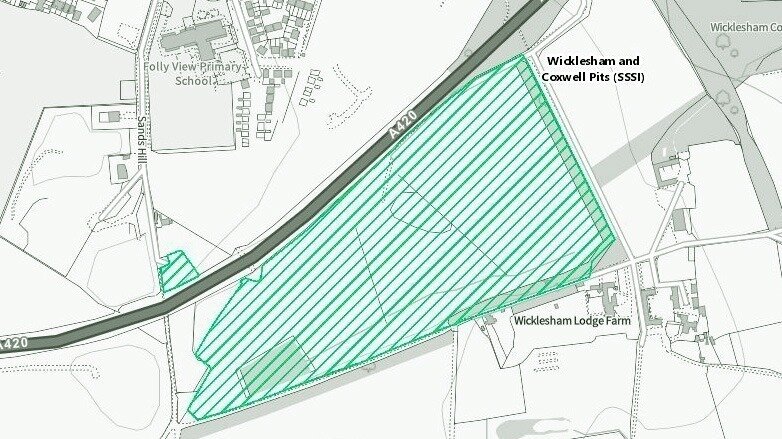
The report by Oxfordshire Geology Trust states: ‘The SSSI designation and this report does not apply to any aspect of the area that has been restored to agricultural land which forms the quarry void.’ WE WILL CONTEST THIS STATEMENT: the SSSI designation applies to the WHOLE quarry- as shown above and stated in Natural England’s listing.
The authors of the report by Oxfordshire Geology Trust, who say they have had a relationship with the landowners for over twenty-five years, further state: ‘The quarry void (floor) of the quarry however has minimal geological interest.’
They do not cite any authority for this statement, which conflicts with the 2008 British Geological Survey Report RR/08/03 ISBN 0 85272 623 5: the Faringdon Sponge Gravels are 50 METRES DEEP at this location (p.59). (The quarry is up to 8 METRES DEEP.)
The cover of the OGT report shows a photograph said to date from 2015, which must have been taken at least ten years earlier. By 2015 active quarrying had been finished for about seven years. In 2015 the walls were green, mature ponds had formed, and small trees were growing. Two permanent ponds, the breeding habitat of Great Crested Newts and other species, were included in the 2014 Restoration Plan.* By 2015, the applicant had already been pressuring the Vale of White Horse District Council for eight years- unsuccessfully- to have the quarry allocated as an industrial site in the Local Plan. The naturalisation of habitat and Protected Species that occurred long before 2015 was a result of many years of deliberately putting off the restoration, in the hope of being able to build on it instead.
Why did members of Oxfordshire Geology Trust use a photograph that they must have known was a lie? They had been visiting Wicklesham Quarry and collecting fossils there for many years. This deception undermines their credibility from the start.
Of even more concern than this dishonest photograph are statements by Oxfordshire Geology Trust that:
- are not backed up with evidence,
- conflict with authoritative scientific data,
- conveniently fit the landowners’ agenda.
1) WHAT IS THE AREA OF THE SITE OF SPECIAL SCIENTIFC INTEREST?
DEFRA’s definitive MAGIC* map (above) shows the 29 ACRE Site of Special Scientific Interest that is Wicklesham Quarry. It includes the BASE and the walls. The quarry is the largest part of WICKLESHAM AND COXWELL PITS SSSI, and you can read the full SSSI listing (which states the area) by Natural England HERE: chrome-extension://efaidnbmnnnibpcajpcglclefindmkaj/https://www.ecoweek.info/Find_Out_More-/SSSIs/Wicklesham_-_Coxwell_Pits_SSSI.pdf
As the MAGIC map demonstrates, the applicant’s claims that the ‘quarry walls are the qualifying feature’ of the SSSI listing are FICTION. This claim has also been made by Faringdon Council and Oxfordshire Geological Trust.
2) WHY IS WICKLESHAM QUARRY SSSI ‘UNIQUE’?
- It is one of the earliest and most historically important SSSIs in the country: first listed in 1950 under the 1949 National Parks and Access to the Countryside Act, & re-listed in 1986 under the 1981 Act.
- Natural England’s listing (link above) states: ‘This site is of great historical importance, and is one of Britain's richest palaeontological localities.’ Its ‘very rich and unusual assemblage’ includes ‘over 150 species’ of fossils, ‘many of these are known to occur only at Faringdon’.
- The earliest collection of ‘Faringdon fossils’ (before anyone knew what fossils were) – by Lhuyd in 1699- was sponsored by Sir Isaac Newton himself. Scientific credentials don’t get any better than that! This makes Wicklesham Quarry a landmark in the history of science.
- The name ‘Faringdon’ is known world-wide BECAUSE OF WICKLESHAM QUARRY: It is a 'TYPE SITE'- with fossils that are known to exist ONLY at this single location. Faringdon has therefore given its name to ‘Faringdon fossils’, ‘Faringdon Greensands’, and the famous ‘FARINGDON SPONGE GRAVELS’.
- It is a Conservation Review Site because of its international importance, and the reference location for all data on the scientific resources that exist here.
SO HERE ARE THE FACTS –
- The BASE of the Quarry is part of the SSSI.
- The Faringdon Sponge Gravels are around 50 METRES DEEP at Wicklesham Quarry. This is the recorded data of the British Geological Survey- the only recognized authority on such data.
Oxfordshire Geological Trust SUPPORTS the landowner’s application to fill the SSSI with vast, permanent structures. After the Trust's response to the consultation by the Vale of White Horse District Council in 2023, I contacted them to ask who had written it and what their qualifications were. No one replied to me.
The fact is that the Geological Trust depends on the landowner in order to gain access to the quarry. This compromises them. They perform a useful job for him by helping to keep the quarry walls clear of vegetation, and accompanying groups of visitors. In return they benefit from being able to freely collect extremely desirable fossils. Examples of ‘Faringdon fossils’ can often be seen for sale on EBay, sometimes fetching high prices. The Trust's report, starting with the highly misleading, wrongly dated photograph on the front, reflects their involvement with the applicant, and lacks scientific accuracy.
These may seem harsh criticisms, but in view of the seriousness of what is at stake here- the potential destruction of Faringdon’s world-famous Site of Special Scientific Interest - I think they are justified and necessary.
If the applicant wishes to claim this group as a local ‘authority’, as he seeks to suggest they are, then they should make it clear to the County Council and to the public what their scientific credentials are - if they have any. So far they have failed to do so.
3) ‘HARM TO THE SSSI’: BUILDINGS IN WICKLESHAM QUARRY WILL DESTROY THE VALUE OF THE SITE OF SPECIAL SCIENTIFIC INTEREST.
Neither Oxfordshire County Council nor the Vale of White Horse District Council will permit development that would ‘harm’ a Site of Special Scientific Interest. That is national policy. Any proposal involving permanent structures and preventing access to the base- would harm this very special SSSI irreparably. Here are key points for OBJECTIONS to the applicant’s geology report:
- The Faringdon Sponge Gravels which form the base of the quarry- which is part of the SSSI – are over 50 metres deep at this location, as stated in the British Geological Survey Report. They are a unique scientific resource, vital for future research on the palaeontology and geology of the SSSI.
- In order to understand HOW Wicklesham Quarry was formed, and its relationship to the ancient landscape - where a river once rushed through a coral reef out into the sea – it is necessary to have an unobstructed, simultaneous view of the sides of the quarry and their geological strata in relation to each other, and to the surrounding landscape. (To see it in 3 dimensions.)
- Spoil heaps of fossils are educational for fossil collectors including children, but they do not meet the needs of scientists, who need to relate rare fossils precisely to their geological contexts - in situ, in other words. Once removed, their scientific value is limited if not lost.
- The Joint Nature Conservation Council’s (JNCC: the parent body of Natural England) ‘Monitoring Guidelines for SSSIs’ (2004) state that the only acceptable interventions are ‘small alterations if they are reversible and short term and do not contaminate the site and do not affect critically important parts of the site.’ (P.36-7).
- There is no other location where this geology and palaeontology can be studied: Wicklesham Quarry SSSI is a ‘finite/ integrity’ site of limited extent, and therefore MUST have the best possible conservation for future generations.
For all these reasons, permanent structures on the base of the quarry are incompatible with visual interpretation, scientific research, and access to the resources of the base, and would destroy its value for future scientific research.
A further update will address the applicant's 'principle of development' - included in the revised documents and what it too FAILS TO TELL YOU.
Contact: protectwicklesham@gmail.com
- MAGIC stands for: Multi -Agency Geographic Information for the Countryside
*The photograph of Pond 1 currently on the main page of the online petition was taken in May 2016.