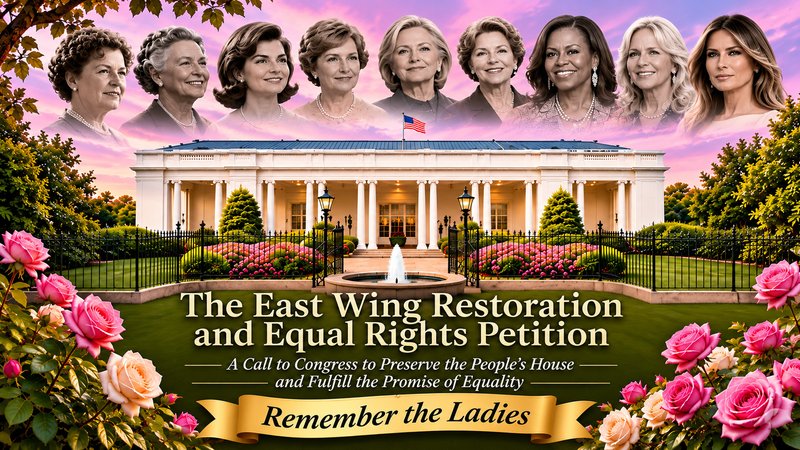
The East Wing Restoration and Equal Rights Petition
The Issue
To the Honorable Members of the United States Congress:
This country was founded upon a turbulent, racist, and misogynistic foundation, in which most of its population was denied the equality so boldly proclaimed in the Declaration of Independence. Nevertheless, generosity of soul may allow us to believe that at least some of the Founding Fathers held aspirations greater than the society they were willing to create. Yet we must measure the worth of these aspirations not merely by the words in which they were expressed, but by future generations' willingness to make them a reality.
The history of the East Wing of the White House offers one such measure of our nation's progress toward equality.
Its beginnings trace to the 1902 renovations shaped in part by First Lady Edith Roosevelt, who also established the tradition of displaying portraits of former First Ladies in the White House, recognizing that these women deserved a place of honor in the history of the American presidency.
In 1942, the East Wing was expanded during the presidency of Franklin D. Roosevelt, whose wife, Eleanor Roosevelt, had transformed the role of First Lady from one principally concerned with domestic and ceremonial obligations into one of significant public service, advocacy, and political influence.
In 1961, Jacqueline Kennedy undertook the restoration of the White House, believing that the People's House belonged to the American people and should reflect their shared history. Its character should not be subject to the fleeting whims of its occupants. She helped establish the White House Historical Association, secure congressional protections for its historic furnishings, and save historic buildings surrounding Lafayette Square from demolition.
She also helped shape the celebrated Rose Garden, redesigned in 1962 by Rachel Lambert Mellon, whose green lawn, roses, and flowering borders became a cherished part of the White House grounds.
In 1977, Rosalynn Carter established the First Lady's office in the East Wing, and in 1978, Congress formally recognized the duties of the President's spouse by authorizing the staff and services necessary to carry them out. Thus, a role once regarded as principally ceremonial had gained formal recognition as an institution of public service.
As women gained greater control over their own bodies and reproductive lives, they also gained greater freedom to pursue education, professional opportunities, and public office. These advances were not unrelated, for the freedom to determine whether and when to bear children has long been essential to women's ability to direct the course of their own lives. Those who became First Lady increasingly brought their own considerable qualifications and accomplishments to the position.
Hillary Rodham Clinton, a Yale-educated attorney, took an active role in shaping national health care policy as First Lady. She later became the first First Lady elected to the United States Senate, served as Secretary of State, and became the first woman nominated for president by a major American political party.
Laura Bush, a teacher and librarian, championed national literacy efforts, while Dr. Jill Biden, who earned a doctorate in education, continued teaching even while serving as First Lady.
In 2009, Michelle Obama, a Princeton and Harvard Law School graduate with an established career in law and public service, became the first Black First Lady of the United States. Her presence held particular significance for Black women and others from historically marginalized communities, whose accomplishments had so often been denied recognition in the nation's highest institutions.
In 2020, First Lady Melania Trump undertook a restoration of the Rose Garden, working with preservation officials and landscape architects to renew the historic 1962 design, improve accessibility, and safeguard its beauty for future generations. Yet in 2025, the President ordered the garden's central lawn replaced with paving, removing portions of the limestone border installed during his own wife's restoration. It is an abominable historical irony that a president should so readily alter not only the work of a former First Lady, but that of his own wife, undertaken during his previous administration. What greater illustration could there be of the fragility of women's contributions when their preservation rests upon the preferences of those who hold power?
The Rose Garden is but one example of how successive First Ladies have shaped the People's House, leaving contributions that extend far beyond the ceremonial duties once expected of them. Yet nowhere was their growing influence more evident than in the East Wing, which became the institutional home of the First Lady's office and a symbol of women's expanding role in American public life.
These women were more than presidents' wives. They were educated professionals, advocates, and leaders whose contributions to this nation did not begin with their husbands' election or necessarily end when they left the White House.
The struggle for women's equal rights, dignity, and opportunities is as old as the republic itself.
In 1776, the Declaration of Independence proclaimed:
"We hold these truths to be self-evident, that all men are created equal."
That same year, Abigail Adams, writing to her husband as he helped establish the new republic, implored him:
"I desire you would Remember the Ladies, and be more generous and favourable to them than your ancestors."
In 1848, the women assembled at Seneca Falls, unwilling to wait for equality to be granted to them, declared:
"We hold these truths to be self-evident: that all men and women are created equal."
These were not idle words, nor are they relics of another age. They represent an unfinished obligation, passed from one generation to the next, to fulfill the promise of equality so long denied to women.
Against this history, the present administration's conduct must be judged.
The profound and repeated ways in which the President, his administration, and the political movement known as MAGA have publicly degraded women demand a response equally public and unmistakable. That voices within the far right should now openly advocate the repeal of the Nineteenth Amendment, which protects women's right to vote, demonstrates how rights won through generations of struggle may once again be called into question.
Against this renewed challenge to women's equality, we must consider the destruction of the East Wing as more than an act of demolition. It is a desecration of women's history.
What greater insult to those generations of women could there be than for a president to tear down the very wing in which successive First Ladies carried out their work, only to replace it with a monument to himself? The proposed addition would encompass approximately 90,000 square feet, exceeding the size of the entire Executive Residence.
As though his stature could not stand without architectural assistance, the President who ordered the destruction of the East Wing has now proclaimed the Oval Office and Cabinet Room a national monument. Having swept aside the work of generations of women, he now seeks extraordinary protection for the presidential offices he has altered according to his own tastes.
And what of the day when a woman shall occupy the presidency, and her husband assume the duties so long entrusted to the wives of presidents?
Are we to believe that the office which generations of accomplished women transformed into an institution of public service should suddenly become unworthy of a man? That he should find it intolerable to occupy rooms once occupied by women, to work beneath the portraits of those who preceded him, or to exercise authority within an institution whose history was written principally by their accomplishments?
Perhaps herein lies the more troubling question: whether the very roles to which women have so long been confined are regarded as beneath the dignity of men, even when generations of women have demonstrated the importance of the work performed within them. A society cannot profess respect for women's contributions while regarding the institutions they have built as unworthy of men.
The White House belongs neither to the president who occupies it nor to the political party that placed him there. It belongs to the American people, and each president is entrusted with its care for only a brief period in our nation's history.
Surely the history of the American presidency belongs as much to the women who helped shape it as to the men who held its highest office. And surely no president should possess the unrestricted power to determine whose contributions are worthy of preservation and whose may be reduced to rubble.
The restoration of the East Wing is therefore more than a question of architecture or expense. It is an opportunity to declare that the equality of women and their independent place in American public life are not privileges to be granted or withdrawn at the pleasure of those who hold power.
It is therefore in the interest of preserving our history, protecting the authority of Congress, and restoring the bare minimum of respect and dignity that all women in this country deserve, that we the petitioners, call upon Congress to undertake the following acts:
1. Restore Congressional Authority Over the People's House
Immediately prohibit the use of federal funds for unauthorized alterations to the White House complex, and require congressional approval before any president or executive agency demolishes or substantially alters any building or structure within that complex.
Establish clear requirements for congressional authorization before demolishing or substantially altering other federal buildings and public monuments, without limiting such protections solely to properties already designated as historically significant.
Such protections shall extend to privately financed construction, for private wealth must not place public property beyond public accountability.
Require independent preservation review and meaningful public consultation before undertaking permanent structural changes, so the American people may be heard before their shared heritage is irreversibly altered.
These requirements shall not interfere with ordinary decoration, maintenance, or necessary repairs. Emergency actions required to protect life, safety, or national security may be permitted under narrowly defined circumstances, subject to congressional review.
2. Restore the East Wing in a Manner Befitting the Dignity of the White House
Pass a resolution calling for the reconstruction of the East Wing in keeping with the historic character and proportions of the White House.
The restored structure shall provide appropriate offices for the First Lady or First Gentleman and their staff, a reasonably sized space for state dinners and other ceremonial occasions, and whatever additional facilities Congress deems prudent, without unnecessary extravagance.
Let the size of these facilities be determined by their legitimate public purposes and independent architectural assessment, rather than the personal ambitions or tastes of any president.
The resulting structure should complement the People's House, not overwhelm it.
3. Dedicate the Restored East Wing to the Contributions of America's First Ladies and Women
Dedicate the restored East Wing and its ceremonial facilities as a permanent tribute to the First Ladies of the United States and, through them, to the generations of women whose labor, leadership, intellect, and sacrifice have built and sustained this nation.
Let this tribute honor women from every background, particularly those whose accomplishments were overlooked, diminished, appropriated, or erased because of their sex, race, or circumstances of birth.
Let the restored East Wing stand not merely as a monument to the wives of presidents, but as a testament to women's independent authority, judgment, accomplishments, and public service.
4. Name the New Ballroom in Honor of American Women
Give particular consideration to naming the new ceremonial ballroom The Michelle Obama Ballroom, honoring the first Black First Lady of the United States and recognizing the contributions of Black women and others whose achievements have too often been denied their rightful place in American history.
Or let the ballroom bear whatever it pleases the women of Congress to name it, for we have confidence that they will consult their female constituents and exercise the wisdom and judgment necessary to select a name befitting the dignity of the American people.
5. Establish the Equal Rights of Women Under the Constitution
Finally, let Congress take the necessary steps to secure the adoption of the Equal Rights Amendment to the Constitution of the United States, once and for all declaring that women possess rights equal to those of men, and leaving no presumption to the contrary for any generation yet to come.
Our Declaration
The restoration of the East Wing cannot undo its destruction, nor can brick, stone, or mortar alone restore the dignity of women whose contributions have too often been diminished or forgotten. But Congress may yet determine what shall rise in its place, and what principles that restoration shall represent.
Let the East Wing stand as a monument to the accomplishments of generations of American women, and let their equality be secured not merely in the monuments we erect, but in the Constitution by which we govern.
The women of this republic have waited 250 years for the promises of its founding to be fulfilled. Let this Congress leave no further generation to wait upon the generosity of those who hold power.
Remember the Ladies.
Respectfully submitted,
We, the undersigned petitioners

52
The Issue
To the Honorable Members of the United States Congress:
This country was founded upon a turbulent, racist, and misogynistic foundation, in which most of its population was denied the equality so boldly proclaimed in the Declaration of Independence. Nevertheless, generosity of soul may allow us to believe that at least some of the Founding Fathers held aspirations greater than the society they were willing to create. Yet we must measure the worth of these aspirations not merely by the words in which they were expressed, but by future generations' willingness to make them a reality.
The history of the East Wing of the White House offers one such measure of our nation's progress toward equality.
Its beginnings trace to the 1902 renovations shaped in part by First Lady Edith Roosevelt, who also established the tradition of displaying portraits of former First Ladies in the White House, recognizing that these women deserved a place of honor in the history of the American presidency.
In 1942, the East Wing was expanded during the presidency of Franklin D. Roosevelt, whose wife, Eleanor Roosevelt, had transformed the role of First Lady from one principally concerned with domestic and ceremonial obligations into one of significant public service, advocacy, and political influence.
In 1961, Jacqueline Kennedy undertook the restoration of the White House, believing that the People's House belonged to the American people and should reflect their shared history. Its character should not be subject to the fleeting whims of its occupants. She helped establish the White House Historical Association, secure congressional protections for its historic furnishings, and save historic buildings surrounding Lafayette Square from demolition.
She also helped shape the celebrated Rose Garden, redesigned in 1962 by Rachel Lambert Mellon, whose green lawn, roses, and flowering borders became a cherished part of the White House grounds.
In 1977, Rosalynn Carter established the First Lady's office in the East Wing, and in 1978, Congress formally recognized the duties of the President's spouse by authorizing the staff and services necessary to carry them out. Thus, a role once regarded as principally ceremonial had gained formal recognition as an institution of public service.
As women gained greater control over their own bodies and reproductive lives, they also gained greater freedom to pursue education, professional opportunities, and public office. These advances were not unrelated, for the freedom to determine whether and when to bear children has long been essential to women's ability to direct the course of their own lives. Those who became First Lady increasingly brought their own considerable qualifications and accomplishments to the position.
Hillary Rodham Clinton, a Yale-educated attorney, took an active role in shaping national health care policy as First Lady. She later became the first First Lady elected to the United States Senate, served as Secretary of State, and became the first woman nominated for president by a major American political party.
Laura Bush, a teacher and librarian, championed national literacy efforts, while Dr. Jill Biden, who earned a doctorate in education, continued teaching even while serving as First Lady.
In 2009, Michelle Obama, a Princeton and Harvard Law School graduate with an established career in law and public service, became the first Black First Lady of the United States. Her presence held particular significance for Black women and others from historically marginalized communities, whose accomplishments had so often been denied recognition in the nation's highest institutions.
In 2020, First Lady Melania Trump undertook a restoration of the Rose Garden, working with preservation officials and landscape architects to renew the historic 1962 design, improve accessibility, and safeguard its beauty for future generations. Yet in 2025, the President ordered the garden's central lawn replaced with paving, removing portions of the limestone border installed during his own wife's restoration. It is an abominable historical irony that a president should so readily alter not only the work of a former First Lady, but that of his own wife, undertaken during his previous administration. What greater illustration could there be of the fragility of women's contributions when their preservation rests upon the preferences of those who hold power?
The Rose Garden is but one example of how successive First Ladies have shaped the People's House, leaving contributions that extend far beyond the ceremonial duties once expected of them. Yet nowhere was their growing influence more evident than in the East Wing, which became the institutional home of the First Lady's office and a symbol of women's expanding role in American public life.
These women were more than presidents' wives. They were educated professionals, advocates, and leaders whose contributions to this nation did not begin with their husbands' election or necessarily end when they left the White House.
The struggle for women's equal rights, dignity, and opportunities is as old as the republic itself.
In 1776, the Declaration of Independence proclaimed:
"We hold these truths to be self-evident, that all men are created equal."
That same year, Abigail Adams, writing to her husband as he helped establish the new republic, implored him:
"I desire you would Remember the Ladies, and be more generous and favourable to them than your ancestors."
In 1848, the women assembled at Seneca Falls, unwilling to wait for equality to be granted to them, declared:
"We hold these truths to be self-evident: that all men and women are created equal."
These were not idle words, nor are they relics of another age. They represent an unfinished obligation, passed from one generation to the next, to fulfill the promise of equality so long denied to women.
Against this history, the present administration's conduct must be judged.
The profound and repeated ways in which the President, his administration, and the political movement known as MAGA have publicly degraded women demand a response equally public and unmistakable. That voices within the far right should now openly advocate the repeal of the Nineteenth Amendment, which protects women's right to vote, demonstrates how rights won through generations of struggle may once again be called into question.
Against this renewed challenge to women's equality, we must consider the destruction of the East Wing as more than an act of demolition. It is a desecration of women's history.
What greater insult to those generations of women could there be than for a president to tear down the very wing in which successive First Ladies carried out their work, only to replace it with a monument to himself? The proposed addition would encompass approximately 90,000 square feet, exceeding the size of the entire Executive Residence.
As though his stature could not stand without architectural assistance, the President who ordered the destruction of the East Wing has now proclaimed the Oval Office and Cabinet Room a national monument. Having swept aside the work of generations of women, he now seeks extraordinary protection for the presidential offices he has altered according to his own tastes.
And what of the day when a woman shall occupy the presidency, and her husband assume the duties so long entrusted to the wives of presidents?
Are we to believe that the office which generations of accomplished women transformed into an institution of public service should suddenly become unworthy of a man? That he should find it intolerable to occupy rooms once occupied by women, to work beneath the portraits of those who preceded him, or to exercise authority within an institution whose history was written principally by their accomplishments?
Perhaps herein lies the more troubling question: whether the very roles to which women have so long been confined are regarded as beneath the dignity of men, even when generations of women have demonstrated the importance of the work performed within them. A society cannot profess respect for women's contributions while regarding the institutions they have built as unworthy of men.
The White House belongs neither to the president who occupies it nor to the political party that placed him there. It belongs to the American people, and each president is entrusted with its care for only a brief period in our nation's history.
Surely the history of the American presidency belongs as much to the women who helped shape it as to the men who held its highest office. And surely no president should possess the unrestricted power to determine whose contributions are worthy of preservation and whose may be reduced to rubble.
The restoration of the East Wing is therefore more than a question of architecture or expense. It is an opportunity to declare that the equality of women and their independent place in American public life are not privileges to be granted or withdrawn at the pleasure of those who hold power.
It is therefore in the interest of preserving our history, protecting the authority of Congress, and restoring the bare minimum of respect and dignity that all women in this country deserve, that we the petitioners, call upon Congress to undertake the following acts:
1. Restore Congressional Authority Over the People's House
Immediately prohibit the use of federal funds for unauthorized alterations to the White House complex, and require congressional approval before any president or executive agency demolishes or substantially alters any building or structure within that complex.
Establish clear requirements for congressional authorization before demolishing or substantially altering other federal buildings and public monuments, without limiting such protections solely to properties already designated as historically significant.
Such protections shall extend to privately financed construction, for private wealth must not place public property beyond public accountability.
Require independent preservation review and meaningful public consultation before undertaking permanent structural changes, so the American people may be heard before their shared heritage is irreversibly altered.
These requirements shall not interfere with ordinary decoration, maintenance, or necessary repairs. Emergency actions required to protect life, safety, or national security may be permitted under narrowly defined circumstances, subject to congressional review.
2. Restore the East Wing in a Manner Befitting the Dignity of the White House
Pass a resolution calling for the reconstruction of the East Wing in keeping with the historic character and proportions of the White House.
The restored structure shall provide appropriate offices for the First Lady or First Gentleman and their staff, a reasonably sized space for state dinners and other ceremonial occasions, and whatever additional facilities Congress deems prudent, without unnecessary extravagance.
Let the size of these facilities be determined by their legitimate public purposes and independent architectural assessment, rather than the personal ambitions or tastes of any president.
The resulting structure should complement the People's House, not overwhelm it.
3. Dedicate the Restored East Wing to the Contributions of America's First Ladies and Women
Dedicate the restored East Wing and its ceremonial facilities as a permanent tribute to the First Ladies of the United States and, through them, to the generations of women whose labor, leadership, intellect, and sacrifice have built and sustained this nation.
Let this tribute honor women from every background, particularly those whose accomplishments were overlooked, diminished, appropriated, or erased because of their sex, race, or circumstances of birth.
Let the restored East Wing stand not merely as a monument to the wives of presidents, but as a testament to women's independent authority, judgment, accomplishments, and public service.
4. Name the New Ballroom in Honor of American Women
Give particular consideration to naming the new ceremonial ballroom The Michelle Obama Ballroom, honoring the first Black First Lady of the United States and recognizing the contributions of Black women and others whose achievements have too often been denied their rightful place in American history.
Or let the ballroom bear whatever it pleases the women of Congress to name it, for we have confidence that they will consult their female constituents and exercise the wisdom and judgment necessary to select a name befitting the dignity of the American people.
5. Establish the Equal Rights of Women Under the Constitution
Finally, let Congress take the necessary steps to secure the adoption of the Equal Rights Amendment to the Constitution of the United States, once and for all declaring that women possess rights equal to those of men, and leaving no presumption to the contrary for any generation yet to come.
Our Declaration
The restoration of the East Wing cannot undo its destruction, nor can brick, stone, or mortar alone restore the dignity of women whose contributions have too often been diminished or forgotten. But Congress may yet determine what shall rise in its place, and what principles that restoration shall represent.
Let the East Wing stand as a monument to the accomplishments of generations of American women, and let their equality be secured not merely in the monuments we erect, but in the Constitution by which we govern.
The women of this republic have waited 250 years for the promises of its founding to be fulfilled. Let this Congress leave no further generation to wait upon the generosity of those who hold power.
Remember the Ladies.
Respectfully submitted,
We, the undersigned petitioners


Supporter Voices
Petition Updates
Share this petition
Petition created on November 12, 2026