Support the ArtScience Interfaculty: joint statement from the ArtScience community
The Issue
After making its mark in arts education and culture for 35 years, the ArtScience Interfaculty has been discontinued by The Hague’s University of the Arts. During the past academic year, following an announcement in autumn 2025 that the ArtScience Bachelor would temporarily stop the intake of new students, there have been attempts from multiple stakeholders to enter into a dialogue with the University of the Arts in order to establish a process addressing the future of the Interfaculty. Contrary to all promises made and bypassing established institutional decision making processes, the KABK has suddenly announced that the ArtScience Bachelor will be merged with the Fine Arts department and furthermore that no new head with adequate competencies and background will be hired to lead the study program. Guest teachers who provided a substantial part of the teaching on a project basis have been cut, leading to a severe poverty in the diverse learning perspectives in the curriculum. Meanwhile students enrolled in the program have found themselves unable to follow courses, access facilities or receive clear information about the future of their studies.
This statement brings together voices from students, teachers, alumni and representatives of the professional field and members of the public, highlighting why we need the Interfaculty and demanding that the University of the Arts take responsibility for its stewardship.
The impact of the Interfaculty is evident within the rich and vibrant communities that it has been seeding for three and a half decades and which continue to thrive outside of the University of the Arts. We urge the University of the Arts to tap into the knowledge and resources of the ArtScience community to address the challenges it is facing.
Please sign the petition and help us make our voices heard!
Importance of the ArtScience Interfaculty
The ArtScience Interfaculty has a special history and offers a unique curriculum attracting students from all over the world. Born from the vision to bridge previously distinct domains in art, science and technology, for 35 years the interfaculty has operated on the forefront of innovating the educational domain, and enabling students to follow their curiosity and explore new connections between disciplines in response to the dreams and challenges of the 21st century. The Interfaculty has enabled students to create their own unique curricula combining classes from the Royal Academy of Art The Hague, Royal Conservatoire and Leiden University.
For three and a half decades the Interfaculty has continued to make an important mark in the cultural sector in The Netherlands and beyond. The output of teachers and alumni is widely recognised, positioning itself often at the highest international level, and it is enjoyed by all kinds of audiences. Alumni of the Interfaculty have also had an important role in shaping the cultural sector by founding, leading and participating in numerous organisations which play an important role in the cultural ecosystem both in The Hague, in The Netherlands and abroad. Next to this many Interfaculty alumni are also active as teachers, educators, policymakers and committee members.
The experience of current students: unfulfilled promises & refusal to be ignored
ArtScience students have been demanding the University of the Arts to deliver the education they were promised and to be included in the decision making process concerning the current reorganisation of the program. Following a decision made in the first semester of 2025/2026 to cut the number of courses led by guest teachers, many students report having been unable to enroll in any courses at all, and therefore have not been able to obtain the credits required to fulfil academic requirements. Students are concerned about the cancellation of the classes by guest teachers which formed an important part of the program until recently. Furthermore the decision to dissolve the Interfaculty leaves unanswered questions about access of facilities and courses across the formerly participating institutions. Students report attempting to establish a constructive dialogue since October 2025 with the management of the University of the Arts but that this process has led to unfulfilled promises, including unmet promises concerning the hiring of a new head for the ArtScience Bachelor at KABK and unmet promises of maintaining a constructive dialogue with students over their needs and concerns. Students are deeply concerned that the current announced merger of the ArtScience Bachelor with Fine Arts will fundamentally compromise the program they enrolled in. As a consequence, students started leaving the department.
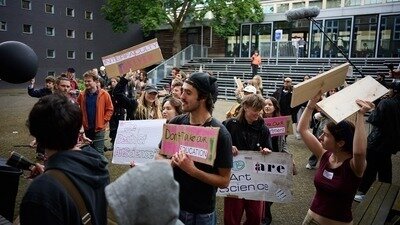
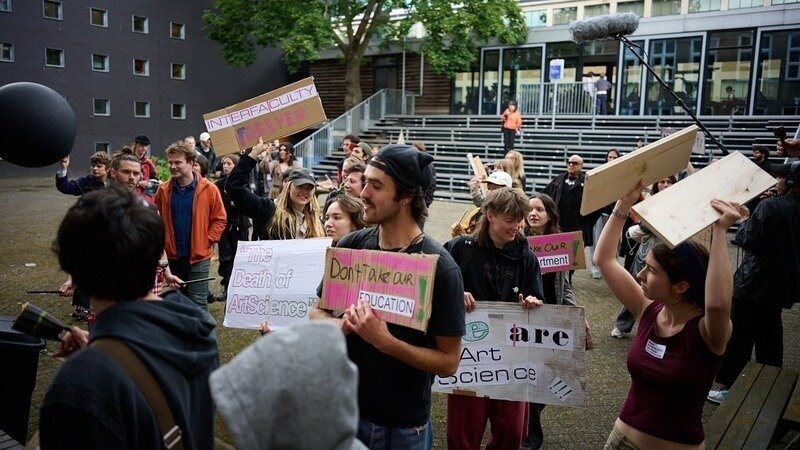
In reaction to these developments ArtScience students have initiated a week long festival protest The Death of ArtScience which is taking place at KABK and other venues between June 1st and 9th, and in the context of which this petition originates.
Alumni: testimonials, solidarity, challenges
From an alumni survey initiated by iii a few threads emerge: there is a broad consensus that the Interfaculty is unique in the world, it offers something to students that no other program does, and it continues to bring together and foster a community of students and alumni that is greatly valued. Aspects that are highlighted as fundamental to the Interfaculty are: the interdisciplinary nature based on the institutional collaboration between the Royal Academy of Art, Royal Conservatoire and Leiden University; the link between visual art and music; the focus on sensory experience; a critical method linking art, science and technology; the focus on collaborative hands-on projects; the (international) diversity of the student body; the freedom and student- centered educational approach, and the culture of mutual care in the community.
Students have historically found multidisciplinary study both rewarding and challenging. When successful, independent study with guidance at key developmental milestones fosters an intellectual and artistic autodidacticism that uniquely positions ArtScience students to excel both independently and collaboratively after graduation. Challenges have equally been recognized in organizing such an experimental program, which requires a reliable and stable administrative infrastructure provided by the leadership of the University of the Arts. The alumni survey highlights both the unique qualities of the Interfaculty that need to be protected as well as organizational challenges that need to be addressed in the reorganization of the department
Professional field: there is only one Interfaculty ArtScience and we need it
The representatives of the professional field are concerned about the consequences for the cultural ecosystem of the decision made by the University of the Arts. This will not only deny prospective students the opportunity to develop a practice in this unique context, it will also stop a flow of talent which has been essential to building the very foundations of the cutting-edge field of Art, Science & Technology and Digital Culture, and which year after year contributes to renewing its programs and actualising its potential.
Today, the vision on which the Interfaculty was founded is more relevant than ever. Across Europe and the Netherlands, governments, funding bodies and knowledge institutions increasingly recognize the importance of connecting artistic, scientific and technological forms of inquiry. Recent initiatives by Regieorgaan SIA, NWO, the KNAW and European programmes supporting artistic research and ArtScience practices demonstrate a growing recognition of the contribution such approaches can make to knowledge production, innovation and addressing complex societal challenges.
The distinctive value of ArtScience lies in its ability to operate beyond traditional disciplinary boundaries. Students are encouraged to develop practices that connect artistic, scientific, technological and social perspectives according to the demands of the questions they seek to address. This flexibility requires an educational environment that can actively connect with different faculties, laboratories, institutions and societal partners. Such an environment can only be sustained through the autonomy and openness that the Interfaculty model was designed to provide.
Our demands
Our request to the directors of the Royal Academy of Art and Conservatoire, Edwin Jacobs and Lies Colman, and to the head of ArtScience Interfaculty, Catelijne van Middelkoop, is to hear our voices and to work together with us to set firm grounds for the future of the Interfaculty, so that it may continue to realise its unique ambitions and carry out its vital role.
As representatives of the stakeholders of the ArtScience Interfaculty, we ask you to:
- Establish a decision making process addressing the future of the Interfaculty in consultation with all stakeholders
- Reconsider the decision to dissolve the Interfaculty
- Reconsider the decision to merge ArtScience Bachelor with Fine Arts
- Hire a head for the ArtScience Bachelor with appropriate competencies and experience
- Reinstate guest teachers
- Provide to current students a curriculum for the upcoming academic year before the summer break
- Guarantee student access to facilities at both the KABK and KC
- Refund tuition for the academic year 2025/2026 to students who were unable to fulfil academic requirements
Initial signatories 05.06.2026
Laura A Dima, multidisciplinary artist, independent, MA alumnus
Ossip Blits, Artist and teacher, MA alumnus
Omer van Soldt, Artist//Theater maker, BA alumnus
Lila Maria de Coninck, ArtScience bachelor student
Nereus Pfafrode, ArtScience bachelor student
Tara Momeni, ArtScience bachelor student
Oskar Kavarskas, ArtScience bachelor student
Kata Sápi, ArtScience bachelor student
Halldór Ólafsson, ArtScience bachelor student
Ilva Nieuwstraten, ArtScience master student
Lea Yordanov, ArtScience bachelor student
Levi Kramer, ArtScience bachelor student
Fru Vajda Bodnar, ArtScience master student
Giulia Favero, ArtScience bachelor student
Connor Croasdell, ArtScience master student
Domenika Georgiou, ArtScience master student
Arnas Petrauskas, ArtScience bachelor student
Esmée Witsel, ArtScience bachelor student
Hunter Nassar, ArtScience bachelor student
Ilja Kolosovs, ArtScience master student
Olivia van Leest, ArtScience bachelor student
Ioannis Michos, ArtScience bachelor student
Cori Jeoung, ArtScience bachelor student
Bing Zhang, ArtScience bachelor student
Guillermo Martin Viana, ArtScience master student
Anna Lora, ArtScience bachelor student
Xandri Driscoll, ArtScience bachelor student
Jinglei Zhang, ArtScience bachelor student
Roos van Asdonck, ArtScience bachelor student
Cocky Eek, Artist, ArtScience teacher
Matteo Marangoni, artist, founding member of iii, ArtScience master alumnus
Ezequiel Menalled, artist, managing director of iii
Dieter Vandoren, artist, founding member of iii, ArtScience master alumnus
Coralie Vogelaar, Artist, ArtScience teacher
Jasper van den Berg, Agency Coordinator iii
Lucas van der Velden, director of Sonic Acts, BA alumnus
Lauren Jetty Howells-Green, ArtScience MA alumnus, iii artist and team member, guest teacher
Leon Lapa Pereira, MA Alumnus, Patch Member, part of iii and Co-founder collective.Wasteland
Maria Oosterveen, ArtScience BA Alumnus, Curator Not to be Senseless, Artist
Vidya Chagan, ArtScience master student
Anaïs Lossouarn, artist, MA alumnus
Tom de Kok, Artist, BA alumnus
Maj Racher, ArtScience bachelor student
Tadas Vinskevičius, ArtScience bachelor student
Lola Brancovich, artist, ArtScience BA alumnus
Giulio Palma, ArtScience master student
Toke Nielsen, ArtScience bachelor student
Robin Bollé, ArtScience bachelor student
Viliam Solovic, ArtScience bachelor student
Milu Chen, Artist, BA alumnus
Mariska de Groot, artist, ArtScience MA alumnus, iii founding member.
Alwin de Rooij, scientist, ArtScience BA alumnus
Raaf Fennis, Director of Unbinare, BA alumnus
Lewis Beal, ArtScience master student
Greta Berge, ArtScience bachelor student
Maurice Huyghe, ArtScience bachelor student
Charlotte Roschkach, Artist, Master ArtScience alumnus
Ecaterina Grigoriev, Artist, ArtScience BA alumnus
Ruben Dijkstal, ArtScience bachelor student
Dominika Badyla, artist, curator, KABK graduate
Grzegorz Gębski, ArtScience bachelor student
Tom van den Berg, Artscience master student
Bo Shin, ArtScience bachelor student
Miche Ohiggins, artist, ArtScience graduate
Gabey Tjon a Tham, artist, member and board member of iii, ArtScience Master alumnus
Hilda Moucharrafieh & Arthur Kneepkens, co-directors Platform Beeldende Kunst (PBK)
Bronne Keesmaat, director of Rewire festival
Ludmila Rodrigues, artist, ArtScience graduate and teacher at KABK
Elena Apostolovski, program coordinator and internship coordinator at iii
Anton Kondratov, ArtScience bachelor student
Stelios Manousakis, artist, co-director Stichting Modulus
Marije Baalman, artist/researcher/developer, iii member, chairperson of the board of iii
Kay Churcher, artist, iii workspace member, ArtScience bachelor alumnus
Philip Vermeulen, Artist, ArtScience bachelor alumnus
Barbara Miše, ArtScience bachelor student
1,250
The Issue
After making its mark in arts education and culture for 35 years, the ArtScience Interfaculty has been discontinued by The Hague’s University of the Arts. During the past academic year, following an announcement in autumn 2025 that the ArtScience Bachelor would temporarily stop the intake of new students, there have been attempts from multiple stakeholders to enter into a dialogue with the University of the Arts in order to establish a process addressing the future of the Interfaculty. Contrary to all promises made and bypassing established institutional decision making processes, the KABK has suddenly announced that the ArtScience Bachelor will be merged with the Fine Arts department and furthermore that no new head with adequate competencies and background will be hired to lead the study program. Guest teachers who provided a substantial part of the teaching on a project basis have been cut, leading to a severe poverty in the diverse learning perspectives in the curriculum. Meanwhile students enrolled in the program have found themselves unable to follow courses, access facilities or receive clear information about the future of their studies.
This statement brings together voices from students, teachers, alumni and representatives of the professional field and members of the public, highlighting why we need the Interfaculty and demanding that the University of the Arts take responsibility for its stewardship.
The impact of the Interfaculty is evident within the rich and vibrant communities that it has been seeding for three and a half decades and which continue to thrive outside of the University of the Arts. We urge the University of the Arts to tap into the knowledge and resources of the ArtScience community to address the challenges it is facing.
Please sign the petition and help us make our voices heard!
Importance of the ArtScience Interfaculty
The ArtScience Interfaculty has a special history and offers a unique curriculum attracting students from all over the world. Born from the vision to bridge previously distinct domains in art, science and technology, for 35 years the interfaculty has operated on the forefront of innovating the educational domain, and enabling students to follow their curiosity and explore new connections between disciplines in response to the dreams and challenges of the 21st century. The Interfaculty has enabled students to create their own unique curricula combining classes from the Royal Academy of Art The Hague, Royal Conservatoire and Leiden University.
For three and a half decades the Interfaculty has continued to make an important mark in the cultural sector in The Netherlands and beyond. The output of teachers and alumni is widely recognised, positioning itself often at the highest international level, and it is enjoyed by all kinds of audiences. Alumni of the Interfaculty have also had an important role in shaping the cultural sector by founding, leading and participating in numerous organisations which play an important role in the cultural ecosystem both in The Hague, in The Netherlands and abroad. Next to this many Interfaculty alumni are also active as teachers, educators, policymakers and committee members.
The experience of current students: unfulfilled promises & refusal to be ignored
ArtScience students have been demanding the University of the Arts to deliver the education they were promised and to be included in the decision making process concerning the current reorganisation of the program. Following a decision made in the first semester of 2025/2026 to cut the number of courses led by guest teachers, many students report having been unable to enroll in any courses at all, and therefore have not been able to obtain the credits required to fulfil academic requirements. Students are concerned about the cancellation of the classes by guest teachers which formed an important part of the program until recently. Furthermore the decision to dissolve the Interfaculty leaves unanswered questions about access of facilities and courses across the formerly participating institutions. Students report attempting to establish a constructive dialogue since October 2025 with the management of the University of the Arts but that this process has led to unfulfilled promises, including unmet promises concerning the hiring of a new head for the ArtScience Bachelor at KABK and unmet promises of maintaining a constructive dialogue with students over their needs and concerns. Students are deeply concerned that the current announced merger of the ArtScience Bachelor with Fine Arts will fundamentally compromise the program they enrolled in. As a consequence, students started leaving the department.
In reaction to these developments ArtScience students have initiated a week long festival protest The Death of ArtScience which is taking place at KABK and other venues between June 1st and 9th, and in the context of which this petition originates.
Alumni: testimonials, solidarity, challenges
From an alumni survey initiated by iii a few threads emerge: there is a broad consensus that the Interfaculty is unique in the world, it offers something to students that no other program does, and it continues to bring together and foster a community of students and alumni that is greatly valued. Aspects that are highlighted as fundamental to the Interfaculty are: the interdisciplinary nature based on the institutional collaboration between the Royal Academy of Art, Royal Conservatoire and Leiden University; the link between visual art and music; the focus on sensory experience; a critical method linking art, science and technology; the focus on collaborative hands-on projects; the (international) diversity of the student body; the freedom and student- centered educational approach, and the culture of mutual care in the community.
Students have historically found multidisciplinary study both rewarding and challenging. When successful, independent study with guidance at key developmental milestones fosters an intellectual and artistic autodidacticism that uniquely positions ArtScience students to excel both independently and collaboratively after graduation. Challenges have equally been recognized in organizing such an experimental program, which requires a reliable and stable administrative infrastructure provided by the leadership of the University of the Arts. The alumni survey highlights both the unique qualities of the Interfaculty that need to be protected as well as organizational challenges that need to be addressed in the reorganization of the department
Professional field: there is only one Interfaculty ArtScience and we need it
The representatives of the professional field are concerned about the consequences for the cultural ecosystem of the decision made by the University of the Arts. This will not only deny prospective students the opportunity to develop a practice in this unique context, it will also stop a flow of talent which has been essential to building the very foundations of the cutting-edge field of Art, Science & Technology and Digital Culture, and which year after year contributes to renewing its programs and actualising its potential.
Today, the vision on which the Interfaculty was founded is more relevant than ever. Across Europe and the Netherlands, governments, funding bodies and knowledge institutions increasingly recognize the importance of connecting artistic, scientific and technological forms of inquiry. Recent initiatives by Regieorgaan SIA, NWO, the KNAW and European programmes supporting artistic research and ArtScience practices demonstrate a growing recognition of the contribution such approaches can make to knowledge production, innovation and addressing complex societal challenges.
The distinctive value of ArtScience lies in its ability to operate beyond traditional disciplinary boundaries. Students are encouraged to develop practices that connect artistic, scientific, technological and social perspectives according to the demands of the questions they seek to address. This flexibility requires an educational environment that can actively connect with different faculties, laboratories, institutions and societal partners. Such an environment can only be sustained through the autonomy and openness that the Interfaculty model was designed to provide.
Our demands
Our request to the directors of the Royal Academy of Art and Conservatoire, Edwin Jacobs and Lies Colman, and to the head of ArtScience Interfaculty, Catelijne van Middelkoop, is to hear our voices and to work together with us to set firm grounds for the future of the Interfaculty, so that it may continue to realise its unique ambitions and carry out its vital role.
As representatives of the stakeholders of the ArtScience Interfaculty, we ask you to:
- Establish a decision making process addressing the future of the Interfaculty in consultation with all stakeholders
- Reconsider the decision to dissolve the Interfaculty
- Reconsider the decision to merge ArtScience Bachelor with Fine Arts
- Hire a head for the ArtScience Bachelor with appropriate competencies and experience
- Reinstate guest teachers
- Provide to current students a curriculum for the upcoming academic year before the summer break
- Guarantee student access to facilities at both the KABK and KC
- Refund tuition for the academic year 2025/2026 to students who were unable to fulfil academic requirements
Initial signatories 05.06.2026
Laura A Dima, multidisciplinary artist, independent, MA alumnus
Ossip Blits, Artist and teacher, MA alumnus
Omer van Soldt, Artist//Theater maker, BA alumnus
Lila Maria de Coninck, ArtScience bachelor student
Nereus Pfafrode, ArtScience bachelor student
Tara Momeni, ArtScience bachelor student
Oskar Kavarskas, ArtScience bachelor student
Kata Sápi, ArtScience bachelor student
Halldór Ólafsson, ArtScience bachelor student
Ilva Nieuwstraten, ArtScience master student
Lea Yordanov, ArtScience bachelor student
Levi Kramer, ArtScience bachelor student
Fru Vajda Bodnar, ArtScience master student
Giulia Favero, ArtScience bachelor student
Connor Croasdell, ArtScience master student
Domenika Georgiou, ArtScience master student
Arnas Petrauskas, ArtScience bachelor student
Esmée Witsel, ArtScience bachelor student
Hunter Nassar, ArtScience bachelor student
Ilja Kolosovs, ArtScience master student
Olivia van Leest, ArtScience bachelor student
Ioannis Michos, ArtScience bachelor student
Cori Jeoung, ArtScience bachelor student
Bing Zhang, ArtScience bachelor student
Guillermo Martin Viana, ArtScience master student
Anna Lora, ArtScience bachelor student
Xandri Driscoll, ArtScience bachelor student
Jinglei Zhang, ArtScience bachelor student
Roos van Asdonck, ArtScience bachelor student
Cocky Eek, Artist, ArtScience teacher
Matteo Marangoni, artist, founding member of iii, ArtScience master alumnus
Ezequiel Menalled, artist, managing director of iii
Dieter Vandoren, artist, founding member of iii, ArtScience master alumnus
Coralie Vogelaar, Artist, ArtScience teacher
Jasper van den Berg, Agency Coordinator iii
Lucas van der Velden, director of Sonic Acts, BA alumnus
Lauren Jetty Howells-Green, ArtScience MA alumnus, iii artist and team member, guest teacher
Leon Lapa Pereira, MA Alumnus, Patch Member, part of iii and Co-founder collective.Wasteland
Maria Oosterveen, ArtScience BA Alumnus, Curator Not to be Senseless, Artist
Vidya Chagan, ArtScience master student
Anaïs Lossouarn, artist, MA alumnus
Tom de Kok, Artist, BA alumnus
Maj Racher, ArtScience bachelor student
Tadas Vinskevičius, ArtScience bachelor student
Lola Brancovich, artist, ArtScience BA alumnus
Giulio Palma, ArtScience master student
Toke Nielsen, ArtScience bachelor student
Robin Bollé, ArtScience bachelor student
Viliam Solovic, ArtScience bachelor student
Milu Chen, Artist, BA alumnus
Mariska de Groot, artist, ArtScience MA alumnus, iii founding member.
Alwin de Rooij, scientist, ArtScience BA alumnus
Raaf Fennis, Director of Unbinare, BA alumnus
Lewis Beal, ArtScience master student
Greta Berge, ArtScience bachelor student
Maurice Huyghe, ArtScience bachelor student
Charlotte Roschkach, Artist, Master ArtScience alumnus
Ecaterina Grigoriev, Artist, ArtScience BA alumnus
Ruben Dijkstal, ArtScience bachelor student
Dominika Badyla, artist, curator, KABK graduate
Grzegorz Gębski, ArtScience bachelor student
Tom van den Berg, Artscience master student
Bo Shin, ArtScience bachelor student
Miche Ohiggins, artist, ArtScience graduate
Gabey Tjon a Tham, artist, member and board member of iii, ArtScience Master alumnus
Hilda Moucharrafieh & Arthur Kneepkens, co-directors Platform Beeldende Kunst (PBK)
Bronne Keesmaat, director of Rewire festival
Ludmila Rodrigues, artist, ArtScience graduate and teacher at KABK
Elena Apostolovski, program coordinator and internship coordinator at iii
Anton Kondratov, ArtScience bachelor student
Stelios Manousakis, artist, co-director Stichting Modulus
Marije Baalman, artist/researcher/developer, iii member, chairperson of the board of iii
Kay Churcher, artist, iii workspace member, ArtScience bachelor alumnus
Philip Vermeulen, Artist, ArtScience bachelor alumnus
Barbara Miše, ArtScience bachelor student
Petition Updates
Share this petition
Petition created on June 5, 2026