What Happened in Court and Why We Aren’t Backing Down

Yesterday, we went to court asking Judge Curtis Kin to stop the killing of Catalina’s deer while the legality of the eradication program is decided.
Sadly, we did not walk away with an injunction. Earlier in the day the Court had issued a tentative ruling indicating that it intended to deny our request. After hearing argument from the parties, however, Judge Kin took the matter under submission. No final order granting or denying our motion for a preliminary injunction has been issued. At the same time, there is currently no injunction preventing the Catalina Island Conservancy from proceeding with its removal operation.
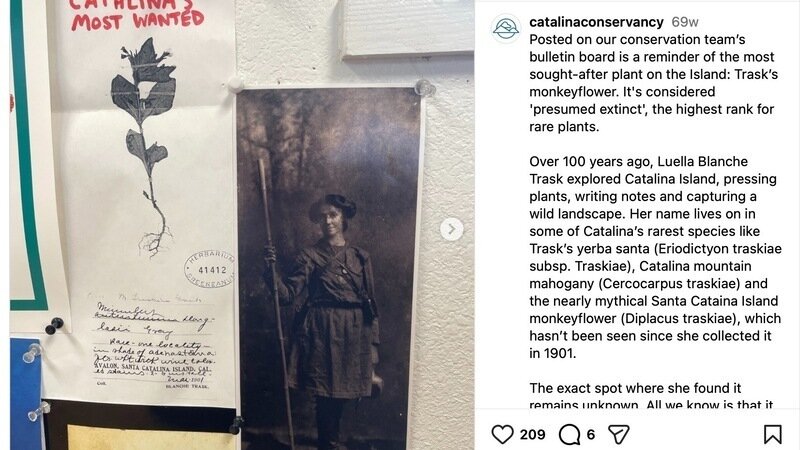
Perhaps we should send them a congratulatory bouquet of Trask’s monkeyflowers.
Oh, wait.
The Conservancy itself says the plant hasn’t been seen since Blanche Trask collected it in 1901. That is 27 years before the first mule deer hoof landed on the Island.
The joke would be funnier if Trask’s monkeyflower had not actually been invoked in the Conservancy’s sworn court evidence.
Lauren Dennhardt told the Court that Island species face extinction from “exposure to deer,” then added:
“This already occurred with the Trask’s monkey flower.”
Dennhardt is not a casual spokesperson for this project. She is the Conservancy’s Senior Director of Conservation, the project’s Principal Investigator, and, in her sworn declaration, identifies herself as “the project lead” responsible for “overseeing all aspects” of the Catalina Island Restoration Project.
Yet her own organization says Trask’s monkeyflower hasn’t been seen since 1901.
That is a remarkable chronology for the project’s own lead to omit when offering Trask’s monkeyflower as a sworn example of extinction from “exposure to deer.”
It also gets at why the tentative ruling troubles us so deeply. In it, Judge Kin accepted many of the Conservancy’s claims despite disputed evidence contained in the record before him, and he misunderstood the harm we asked him to prevent until the full case could be heard.
Balance of Harms
When deciding whether to grant a preliminary injunction, a court weighs the harm each side will suffer depending on whether the injunction is granted. We told the Court our harm is irreversible: every deer killed is a life no later ruling can restore.
The tentative framed the harm differently. It focused instead on whether enough deer would be killed before the case is decided to threaten the herd as a whole. Because some deer would remain, the tentative concluded that our harm was not irreparable. Under that reasoning, the size of the herd suddenly matters a great deal.
Herd Size
The Conservancy told the court that “[a]bout 2,000 deer are estimated to be on Catalina Island currently” without identifying a 2026 survey, survey date, calculation, or source for that present-tense assertion.
The tentative accepted that number as the present population.
There is no disclosed 2026 population estimate. The latest estimate the Conservancy has actually produced is 2,040 from July 2025. The last peer-reviewed Catalina population analysis used data only through 2021. The Conservancy’s own monitoring record also contains entire years with no population estimate: 2017, 2020, 2022 and 2023. In 2022, CIC completed only two of five spotlight routes because of “lack of resources” and acknowledged that it could not produce a population estimate. In 2023, it skipped the survey altogether, explaining that, given its “overarching objective of achieving a deer-free environment,” it did not consider reconfirming the estimate necessary.
Even when it does count deer, the Conservancy relies on spotlight surveys conducted along existing roads rather than an Island-wide census. Meanwhile, its own Workplan identifies thermal drones as a superior tool for assessing deer population status and describes them as highly effective at finding deer in thick vegetation at night. HOWL for Wildlife even offered to pay for a thermal-drone population survey before the project was approved. The Conservancy declined. Apparently drones are good enough to find deer once it is time to kill them, but not worth using to find out how many deer are actually there first.
Our expert believes the number may be much lower. He spent 23 years managing guided deer hunts for the Catalina Island Conservancy, and there is arguably nobody on earth more familiar with this particular herd. Based on that experience, he estimates that, if even 50 deer were harvested during the 2025 season, no more than about 1,200 mule deer remain on Catalina today.
“About 2,000” should not become an established present-day count simply because the project lead repeats it often enough. There is no disclosed 2026 survey, calculation, or population estimate in the record supporting its treatment as the current population. Then again, on the very day CDFW issued the permit, Dennhardt was teaching a workshop on how to “strategically position” controversial conservation projects and turn technical information into “compelling narratives,” so…
200 Deer
In assessing the harm we stand to face without an injunction, the tentative assessed it to be minimal given that “the initial phase will only impact an estimated 200 deer, which only reflects 10% of the current population.”
Two problems. First, 200 is 10 percent only if there really are 2,000 deer. If no more than approximately 1,200 remain, killing 200 means removing at least one-sixth of the entire herd.
Second is the problem the tentative itself acknowledges just a few lines later: “200 is not the enforceable limit under the RMP.” Exactly. There is no 200-deer limit. Not in the permit. Not in a court order. The permit authorizes the killing of “all individuals encountered.” “Roughly 200” is the Conservancy’s prediction. It is not an enforceable ceiling, and nobody is required to stop the operation when the number reaches 200. We’re supposed to trust them, ok?
The tentative also considered the 200 tags authorized for the October hunting season and the possibility that those deaths could be added to the removal operation. Its conclusion: “even the eradication of roughly 400 deer would not irreparably harm the deer population.”
Again, the significance of that statement depends enormously on whether the herd numbers 2,000 — or something closer to 1,200.
Plants
Maybe the most troubling is how much deference the court gave to the Conservancy’s claims about Island species “at risk of extinction,” including Catalina Island mountain-mahogany, Catalina Hutton’s vireo and island scrub oak despite substantial contrary evidence already in the record before him, much of it from the Conservancy itself.
The remaining wild Catalina Island mountain-mahogany have been protected from deer behind fencing since 1999 and nevertheless have failed to recover. CIC’s own materials identify other serious constraints, including extremely low genetic diversity, inbreeding, hybridization, reproductive and propagation difficulties, and highly specialized habitat requirements.
The island scrub oak tells a similar story. CIC’s own Catalina research described the effect of deer and bison on acorn germination and seedlings as “minimal.” Its own materials identify numerous other barriers to oak recovery, including the absence of scrub jays, invasive annual grasses, depleted native seedbanks, weed seedbanks, historical topsoil loss, gophers and ground squirrels, Armillaria root disease, and environmental and moisture stress.
The Catalina Hutton’s vireo depends heavily on island scrub-oak habitat. The Conservancy’s claimed threat to the vireo therefore rests substantially on its claim that deer are driving failed oak recruitment and degradation of that habitat.
And then, of course, there is the monkeyflower.
Nobody is claiming that deer don’t eat plants. The question is whether this complicated record supports the much larger proposition that every deer on Catalina must be killed now to save these species from extinction.
The Bottom Line
We were troubled by the court’s tentative ruling, but grateful that it was not adopted from the bench. Our counsel argued persuasively and raised many of the issues that we have shared with you here. We remain hopeful that Judge Kin will reconsider and grant the temporary and narrow pause we have asked for until the matter is resolved.
What Happens Now
- The Court has not decided that this eradication program is lawful.
- It has not decided that the Conservancy’s scientific claims are correct.
- It has not decided whether CDFW lawfully approved the project.
- It has not decided that we are unlikely to prevail on the merits.
All of those issues are still pending before the court and that is why we are not backing down.
Thank you for standing with us. It is not easy being David against the Goliath that is the Catalina Island Conservancy — with its staff, contractors, consultants, lawyers and resources. We could not do this without you.
If you can, please donate to the legal fight, buy a T-shirt, and share this update.
And if the Conservancy ultimately succeeds in eliminating Catalina’s deer, Trask’s monkeyflower will still have disappeared 27 years before the deer arrived.