Some important things to consider

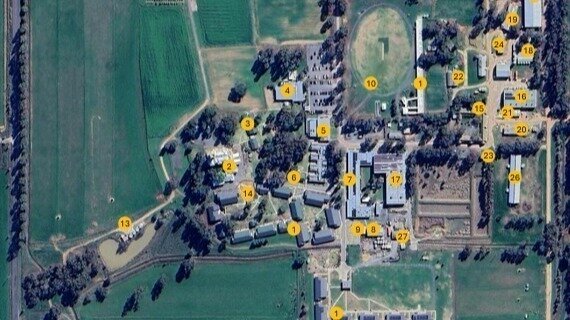
The subject site is located in Dhurringile, a small locality within the Greater Shepparton City Council area, approximately 10 minutes north of Murchison and 10 minutes south of Tatura. The subject site is located a 2.5 hours’ drive from Melbourne, 25 minutes from Shepparton and 45 minutes from Seymour, making it a highly accessible location to Melbourne’s metropolitan market and two regional cities. Its proximity to Shepparton affords the subject site with favourable access to infrastructure, including road, air and rail transport. This includes Shepparton Aerodrome and Shepparton Railway Station.
The site occupies an area of approximately 259 hectares and is bordered by Murchison-Tatura Road to the west, Baulch Road to the south, Kiota Road to the north and Dhurringile Road to the East. Primary access to the site is via Murchison-Tatura Road.
Around 70% of the site is used for farmland, with the remaining 30% having a significant number of built assets that were used for prison purposes. The site is serviced by reticulated water, sewer and power suitable for high-capacity use. The farmland has a modern irrigation system with water rights.
Which if was re-opened could service a lot of agricultural programs for not just minimum security prisoners but also introduce medium security prisoners with low scale crimes.
The built assets have been maintained well. All but the historic mansion, stables and farm administration have been built after 1990. Many of the built assets are in good condition and adaptable to other uses.
Site Features
The main facilities are located in the western central area of
the site, in close proximity to Murchison-Tatura Road. The
remaining area is farmland.
Figure 3 shows an aerial image of the main facilities on site,
including:
1. Self-contained Units (Former Prisoner
Accommodation)
2. Dhurringile Mansion
3. Multipurpose building
4. Visits Centre
5. Gatehouse
6. Myumila Centre (PIU & Supervisors)
7. Administration Building (Laundry, Kitchen,
Education/Library, Programs, Medical Centre,
Reception)
8. Gymnasium
9. Music Room
10. Recreation/Oval
11. Old Dog Squad House
12. Dairy Supervisor’s Residence
13. Fire Pump Shed & Storage Tanks
14. Generator/Services Area
15. Farm Administration
16. Wooden Products
17. Metal Fabrication
18. Dairy
19. Calving Shed
20. Farm Agriculture Workshop
21. Kindling Shed
22. Horticulture
23. Fuel Depot
24. Tractor Shed
25. Hay Storage Shed
26. Main Cattle Feed Lot
27. Maintenance Shed
Strategic Considerations
• There is substantial water supply on the property – 640 megalitres which can support future agricultural production.
• Dhurringile recently supported a small dairy production which was operated by inmates of the property. The dairy has been sold off however there remains opportunity to reinstate this in the future.
• Many of the surrounding farms are cropping or raising cattle, there is however opportunity in the district for horticulture with some surrounding properties growing peaches, apples and nectarines, flowers.
• Given the level of infrastructure that exists on the site, there is opportunity to undertake downstream processing of agricultural products in the sheds on site.
• Dhurringile has access to reticulated water and sewer and has the capacity to support enterprises without needing significant investment in services.
Victoria currently has only one true prison farm left:
HM Prison Langi Kal Kal – a large minimum-security working farm where prisoners are engaged in agriculture, livestock work, horticulture, and other structured outdoor labour programs.
This makes Dhurringile especially important because:
1. Only one remaining prison farm model
Victoria has effectively reduced its dedicated prison farm system to a single operational site. Dhurringile was the only comparable second large-scale farm-style correctional centre, and its closure removed a proven rehabilitation pathway.
2. High-demand rehabilitation model is shrinking
Minimum-security prisons are increasingly being used as:
pre-release transition hubs
short-term holding before release
mixed vocational program sites
But true agricultural rehabilitation environments are now rare, despite strong evidence they support routine, responsibility, and reduced reoffending.
3. Proven “work-based rehabilitation” model
Dhurringile provided:
dairy farming
horticulture and orchards
livestock work
maintenance and property operations
structured daily employment for prisoners
This type of environment builds:
discipline
job skills
accountability
employability after release
4. Strong safety record despite open-farm style environment
Even with its open, rural design over decades of operation, Dhurringile had:
only a small number of documented escapes over many years
thousands of successful completions through the system
a strong record relative to its size and security classification
This supports the argument that structured freedom + work responsibility can be both safe and effective.
5. Regional and economic value
Dhurringile also functioned as:
a regional employer
a local service hub
a contributor to agricultural production and training pathways
Its closure removed both jobs and a long-standing community institution.
6. Capacity pressure on the prison system
With rising demand across Victorian corrections, reopening existing infrastructure like Dhurringile would:
reduce pressure on other facilities
avoid costly new builds
restore a proven correctional model immediately
Please support my petition
https://www.change.org/p/stop-the-sale-and-reopen-dhurringile-prison-for-rehabilitation-farming-skills-training
Thankyou very much for reading 😊