Courts give Species at Risk Act some bite

Courts give Species at Risk Act some bite
Monique Keiran/ Times Colonist
August 26, 2018
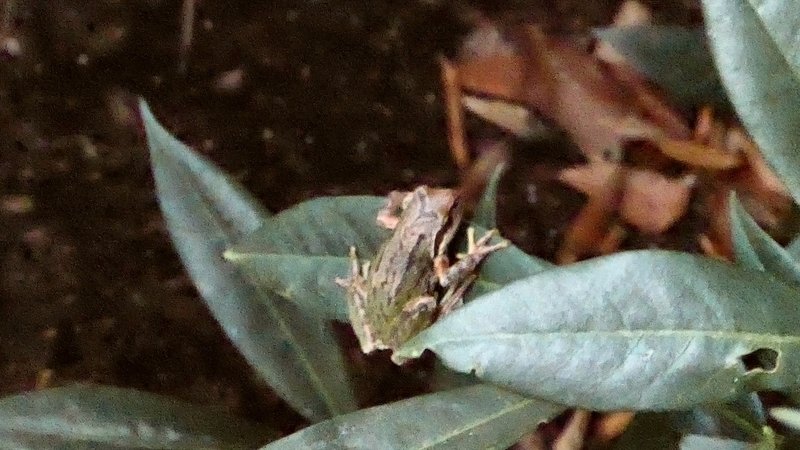
A recent Federal Court judgment to protect the western chorus frog means that Ottawa has the power to criminalize threats posed to the frog ” and by extension to other species deemed to be at risk ” anywhere in Canada.
Sara was born without teeth. Most mammals come into the world with teeth under their gums, and baby birds and reptiles use their single egg teeth or similar structure to hammer their way of their shells when they hatch.
Sara had none of that. She also lacked much of a backbone.
The promise of these structures was there at her conception, but somehow in the negotiations between that potential and the environment she developed in, the promise remained latent at best and was quashed at worst.
So Sara has spent most of her existence gumming and flopping through life.
The irony is that Sara’s — SARA’s — purpose is to protect species at risk in Canada, whether toothed or toothless, beaked or billed, with backbones, skeletons, exoskeletons, trunks or no hard body structures at all, with or without spines, hooks, prickles or hard bits, and of any texture.
For much of the past 16 years, Canada’s Species at Risk Act has been limited in her ability to safeguard the more than 520 species in Canada at risk from dwindling habitat, encroaching development, poisoned waters, rising temperatures and other effects of living alongside so many humans. Her effectiveness has been constrained by a lack of resources, basic species and habitat information, transparency and political will.
But efforts to make SARA stronger might be bearing fruit. The federal government is now supporting research, management, implementation and enforcement — giving her a bit of a backbone. In addition, the courts have given her dentures.
In a recent landmark judgment regarding an emergency order to protect the western chorus frog in La Prairie, Quebec, Canada’s Federal Court concluded that SARA’s emergency-order provision to protect a species and its habitat on private lands is constitutional and not disguised expropriation.
The judgment also confirms that the order’s specific prohibitions, and consequently the associated offences and penalties, are valid in criminal law. This means Ottawa has the power to criminalize threats posed to the frog — and by extension to other species deemed to be at risk — anywhere in Canada, and even when provincial or municipal governments disagree or have already authorized development or destruction of habitat critical to the continued survival of an at-risk species.
This has implications for landowners who want to develop property, for the provinces that want to protect their political and legislative jurisdictions, and for municipalities that rely on development for tax and permit revenue. It also has interesting implications for the federal government. As we have seen in past years, party priorities affect the ability of government administrators to enact and enforce legislation and can rewrite legislation to suit them.
When the western chorus frog was listed as threatened under SARA in 2010, its last remaining viable habitat in southern Ontario and southwestern Quebec included a stretch of private land in La Prairie, a Montreal suburb.
A few years later, a 1,200-unit housing project was approved for part of the land.
The 2016 federal emergency-protection order, which covers two square kilometres of the larger property, makes it illegal to develop there, and forced the housing project to be scaled back by 171 units. The government also said no compensation would be paid to the land’s owners.
It was the first time SARA had been used to halt development on private property. The only other emergency-protection order issued under the act — in 2014, to protect the sage grouse — applied to Crown lands.
With an appeal of the court decision expected, it’s not certain if SARA’s dentures will become permanent.
However, the SARA judgment refers to several other recent court decisions that demonstrate that biodiversity protection is now a fundamental societal value and states that the way environmental law is applied in Canada must evolve accordingly.
And while the appeal makes its way through the courts, Environment Canada, the agency responsible for SARA, will be tracking and reporting on unprotected critical habitat for species at risk on non-federal lands 180 days after such habitat has been identified. This bit of backbone, too, is courtesy of the courts — a judicial review filed in federal court dealing with SARA’s critical habitat-reporting requirements.