
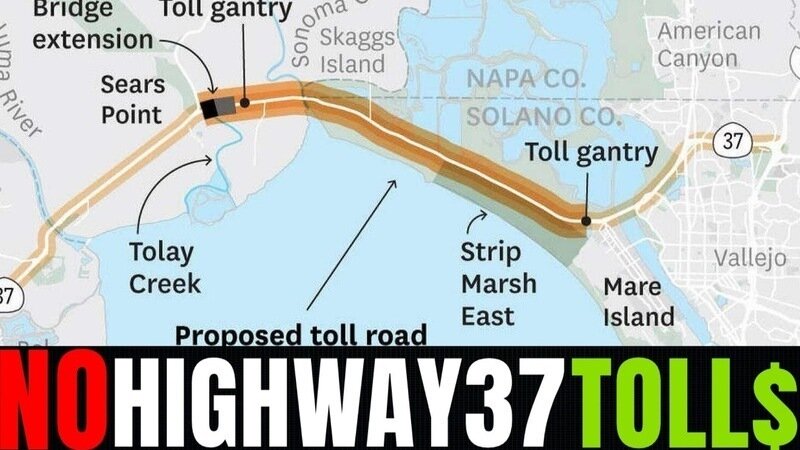
Stop the proposed Highway 37 tolls
The Issue
PAGE 1 — WHAT IS ACTUALLY BEING PROPOSED?
1. The Highway 37 improvement plan
Source: MTC and Caltrans project descriptions, updated 2025–2026
sfchronicle.com
The project covers the approximately 10-mile bottleneck between Sears Point in Sonoma County and Mare Island inVallejo.
$500 MILLION
MTC estimated project cost
Two lanes in each direction
Free for eligible usersOne carpool lane
Eligible carpools can use this lane without a toll.
Toll proposedOne regular lane
Other drivers would pay electronically through FasTrak.
Other proposed improvements:
Replace the Tolay Creek Bridge.
Improve the Sonoma Creek Bridge.
Improve the Highway 37 and Highway 121 interchange.
Improve traffic flow and restore nearby wetlands.
Provide bus service between Vallejo and Marin County.
Expected public opening: 2030.
Metropolitan Transportation Commission
+2
2. Benefits and costs of the proposed plan
Potential benefits
Financial and practical concerns
Adds a lane in each direction
Regular drivers pay a toll to use one lane
Free lane for eligible carpools
Toll rates have not been finalized
Bus service is part of the plan
Low-income discount amounts are not published
Bridge and road improvements
Construction cost is estimated at $500 million
Improved traffic flow
Near-term widening does not solve long-term sea-level rise
Important protections in the CTC's 2023 approval:
Toll collection cannot begin until the improvements are open.
Bus service between Vallejo and Marin must be established.
A toll discount program for lower-income drivers must be in place.
MTC must consider regional income levels when considering discounts.
Metropolitan Transportation Commission
+1
3. California laws that control tolling
AB 194 — Chapter 687, Statutes of 2015
This is an existing California law governing toll facilities.
Under Streets and Highways Code Section 149.7:
A complete funding plan must be prepared for a proposed toll facility.
The California Transportation Commission must review and approve the toll application.
Toll revenue may pay construction debt, maintenance, repairs, toll collection and required reserves.
Remaining revenue must be spent in the corridor where it was collected under an approved expenditure plan.
Administrative expenses cannot exceed 3% of toll revenue.
Toll-backed bonds may be issued, but the state's full faith, credit and taxing power are not pledged to repay them.
LegInfo California
+2
IMPORTANT: SB 1050 FAILED IN 2022
SB 1050 (Dodd, 2021–2022) never became law.
It was held in the Assembly Appropriations Committee's suspense file.
The proposed bill included:
Annual independent toll-revenue audits.
Spending plans updated every three years.
Public comment before toll schedules.
Removal of tolls after bonds were repaid, with a limited two-thirds-vote exception.
These were proposed protections, not existing legal requirements under SB 1050.
This is important history when considering new protections for Highway 37.
Source: California State Assembly 2021–2022 Legislative Bill Summary.
AB 697 — signed October 2025
This law addressed environmental permits for construction involving protected wildlife, provided required impacts arefully mitigated. It helped clear the way for the Highway 37 improvement work. It did not create the toll or establish itsfinancing terms.
Metropolitan Transportation Commission
PAGE 2 — HOW COULD HIGHWAY 37 BE FUNDED?
4. A proven California example: I-80
kcra.com
$49.5 MILLION
I-80 Roseville/Rocklin improvement project
Construction: 2023–2025
$11.5 million from SB 1.
Additional state and federal grants.
Local development traffic impact fees.
Caltrans and PCTPA confirm the use of these different funding sources. The public records cited here do not provide averified dollar-by-dollar breakdown of the remaining funding.
Completed June 2025
Caltrans
+2
This project added an eastbound auxiliary lane, a westbound fifth lane and an improved off-ramp. It is a smaller projectthan Highway 37, but it demonstrates how multiple public funding sources can be combined without introducing a newtoll for the improvement.
5. Existing funding programs available for review
These are real programs. Funding is competitive or restricted and is not automatically available to Highway 37.
Funding source
Public funding details
SB 1 — 2017
$250 million annually for the Solutions for Congested Corridors Program
SB 1 — 2017
Approximately $300 million annually for the Trade Corridor Enhancement Program
Federal grants
Highway, freight, bridge and infrastructure funding, subject to eligibility
STIP
State Transportation Improvement Program for eligible highway and regional projects
Local Partnership Program
$200 million annually under SB 1 for qualifying local and regional agencies
Developer fees
Can help pay for transportation impacts where a legal connection to development exists
CTC
+3
CURRENT FUNDING OPPORTUNITIES — NOVEMBER 2026
November 19, 2026: CTC deadline for 2026 Solutions for Congested Corridors Program project nominations.
November 20, 2026: CTC deadline for 2026 Trade Corridor Enhancement Program nominations.
These are active funding cycles. Whether Highway 37 qualifies and whether an agency has submitted a nomination mustbe confirmed.
Source: California Transportation Commission, 2026 program schedules.
SCCP official program · TCEP official program
An important restriction: The SHOPP program is generally limited to maintenance, safety, operations and rehabilitation. Itcannot be used to add new highway capacity. Therefore, it is not a general funding source for the new lanes, although itcan fund eligible bridge and highway repairs.
CTC
6. More than $300 million in state funding has already been approved for other Highway 37improvements
$329.1 MILLION
Reported CTC-approved awards for separate Highway 37 corridor improvements in 2026, not the full $500 million toll-funded project.
Funding
Amount
Novato Creek Bridge and related mitigation
$234.1M
STIP and climate adaptation improvements
$62.7M
Sears Point–Mare Island Phase 1
$32.3M
Total
$329.1M
The $32.3 million Phase 1 award is directly identified for the Sears Point–Mare Island improvement project. The otherawards cover separate corridor improvements. These amounts must not be counted as money already committed to theentire $500 million widening project.
Metropolitan Transportation Commission
7. Federal TIFIA financing — established in 1998
Existing federal programThe Transportation Infrastructure Finance and Innovation Act (TIFIA) provides federal loans and loan guarantees foreligible transportation projects.
Direct loans can cover up to 49% of eligible project costs.
Interest is tied to U.S. Treasury rates.
Repayment generally begins within five years after substantial completion.
The repayment term cannot exceed 35 years or the project's useful life, whichever is shorter.
California restriction: Caltrans currently reports that it has no state legislative authority to use TIFIA. An eligible regionalor special authority would need to establish that it can legally sponsor and repay such financing. TIFIA is an option toinvestigate, not an approved Highway 37 funding source.
Caltrans
8. California's existing carbon funding
California already has a Cap-and-Invest program, formerly called Cap-and-Trade.
Auction proceeds go into the Greenhouse Gas Reduction Fund.
The Legislature controls the use of remaining funds through state budget and statutory allocations.
Existing allocations support eligible clean transportation and transit programs.
At least 35% of California Climate Investments must benefit priority populations.
These funds could be explored for eligible transit or low-carbon transportation parts of the Highway 37 program. Theycannot simply be assumed available for general freeway widening.
No verified new carbon-tax proposal by the incoming governor is included here. Cap-and-Invest is an existing program,not a newly proposed carbon tax.
California Air Resources Board
+3
9. What does a $500 million project actually cost to finance?
The distinction between a grant and a loan is important.
Funding type
Does the public repay it?
State grant
No loan repayment
Federal grant
No loan repayment
SB 1 grant
No loan repayment
Eligible local contribution
Depends on funding agreement
TIFIA loan
Yes, with interest
Toll-backed bonds
Yes, using pledged toll revenue
No official $500 million loan repayment schedule has been published in the MTC project summary.
It would be misleading to state that $500 million is being borrowed or to promise that gas-tax revenue can repay it over acertain number of years.
Before toll collection, the financing documents should disclose:
Actual amount borrowed.
Interest rate and total interest.
Repayment period.
Revenue pledged to repay debt.
Expected toll collections.
Maintenance and operating costs.
What happens after the debt is repaid.
Under AB 194, toll-backed bonds can be issued against toll revenue. California's taxing power is not pledged to repaythose bonds.
LegInfo California
10. Important difference: the future Highway 37 project
Caltrans states that the near-term widening project does not solve the long-term sea-level-rise problem.
A separate future project is planned for a new four-lane elevated facility, partly on fill or a causeway.
The current widening and the future elevated highway are separate projects with different scopes and timelines.
Caltrans
OFFICIAL GOVERNMENT RECORDS
These are the primary sources used for this review.
MTC — Highway 37 proposed toll and project description
Caltrans — Sears Point to Mare Island project plan
California AB 194 — toll facility law
California Assembly — SB 1050 legislative status
California SB 1 funding allocations
Solutions for Congested Corridors Program
Trade Corridor Enhancement Program
Caltrans — TIFIA federal financing
CARB — California Climate Investments
MTC — 2026 Highway 37 state funding awards
Caltrans — I-80 project completion and funding
MTC — AB 697 and Highway 37 environmental improvements
Final financial findings
What the public records establish
Highway 37's near-term widening is estimated at $500 million.
State and federal funding programs already exist.
More than $300 million has been approved for other Highway 37 corridor improvements.
I-80 demonstrates that several public funding sources can be combined.
SB 1 competitive grant programs have current November 2026 nomination deadlines.
TIFIA is a federal financing option, but Caltrans lacks current state authority to use it.
SB 1050 failed and its proposed protections are not law.
Current law allows toll-backed debt but does not guarantee automatic toll removal after repayment.
The central distinction for the public: Grants, transportation taxes and local contributions can pay for eligible constructionwithout creating a loan. Loans and bonds must be repaid. Tolls are one possible repayment source, but the public shouldbe able to see the complete financing plan, legal restrictions, and available grant opportunities before accepting thatarrangement.
590
The Issue
PAGE 1 — WHAT IS ACTUALLY BEING PROPOSED?
1. The Highway 37 improvement plan
Source: MTC and Caltrans project descriptions, updated 2025–2026
sfchronicle.com
The project covers the approximately 10-mile bottleneck between Sears Point in Sonoma County and Mare Island inVallejo.
$500 MILLION
MTC estimated project cost
Two lanes in each direction
Free for eligible usersOne carpool lane
Eligible carpools can use this lane without a toll.
Toll proposedOne regular lane
Other drivers would pay electronically through FasTrak.
Other proposed improvements:
Replace the Tolay Creek Bridge.
Improve the Sonoma Creek Bridge.
Improve the Highway 37 and Highway 121 interchange.
Improve traffic flow and restore nearby wetlands.
Provide bus service between Vallejo and Marin County.
Expected public opening: 2030.
Metropolitan Transportation Commission
+2
2. Benefits and costs of the proposed plan
Potential benefits
Financial and practical concerns
Adds a lane in each direction
Regular drivers pay a toll to use one lane
Free lane for eligible carpools
Toll rates have not been finalized
Bus service is part of the plan
Low-income discount amounts are not published
Bridge and road improvements
Construction cost is estimated at $500 million
Improved traffic flow
Near-term widening does not solve long-term sea-level rise
Important protections in the CTC's 2023 approval:
Toll collection cannot begin until the improvements are open.
Bus service between Vallejo and Marin must be established.
A toll discount program for lower-income drivers must be in place.
MTC must consider regional income levels when considering discounts.
Metropolitan Transportation Commission
+1
3. California laws that control tolling
AB 194 — Chapter 687, Statutes of 2015
This is an existing California law governing toll facilities.
Under Streets and Highways Code Section 149.7:
A complete funding plan must be prepared for a proposed toll facility.
The California Transportation Commission must review and approve the toll application.
Toll revenue may pay construction debt, maintenance, repairs, toll collection and required reserves.
Remaining revenue must be spent in the corridor where it was collected under an approved expenditure plan.
Administrative expenses cannot exceed 3% of toll revenue.
Toll-backed bonds may be issued, but the state's full faith, credit and taxing power are not pledged to repay them.
LegInfo California
+2
IMPORTANT: SB 1050 FAILED IN 2022
SB 1050 (Dodd, 2021–2022) never became law.
It was held in the Assembly Appropriations Committee's suspense file.
The proposed bill included:
Annual independent toll-revenue audits.
Spending plans updated every three years.
Public comment before toll schedules.
Removal of tolls after bonds were repaid, with a limited two-thirds-vote exception.
These were proposed protections, not existing legal requirements under SB 1050.
This is important history when considering new protections for Highway 37.
Source: California State Assembly 2021–2022 Legislative Bill Summary.
AB 697 — signed October 2025
This law addressed environmental permits for construction involving protected wildlife, provided required impacts arefully mitigated. It helped clear the way for the Highway 37 improvement work. It did not create the toll or establish itsfinancing terms.
Metropolitan Transportation Commission
PAGE 2 — HOW COULD HIGHWAY 37 BE FUNDED?
4. A proven California example: I-80
kcra.com
$49.5 MILLION
I-80 Roseville/Rocklin improvement project
Construction: 2023–2025
$11.5 million from SB 1.
Additional state and federal grants.
Local development traffic impact fees.
Caltrans and PCTPA confirm the use of these different funding sources. The public records cited here do not provide averified dollar-by-dollar breakdown of the remaining funding.
Completed June 2025
Caltrans
+2
This project added an eastbound auxiliary lane, a westbound fifth lane and an improved off-ramp. It is a smaller projectthan Highway 37, but it demonstrates how multiple public funding sources can be combined without introducing a newtoll for the improvement.
5. Existing funding programs available for review
These are real programs. Funding is competitive or restricted and is not automatically available to Highway 37.
Funding source
Public funding details
SB 1 — 2017
$250 million annually for the Solutions for Congested Corridors Program
SB 1 — 2017
Approximately $300 million annually for the Trade Corridor Enhancement Program
Federal grants
Highway, freight, bridge and infrastructure funding, subject to eligibility
STIP
State Transportation Improvement Program for eligible highway and regional projects
Local Partnership Program
$200 million annually under SB 1 for qualifying local and regional agencies
Developer fees
Can help pay for transportation impacts where a legal connection to development exists
CTC
+3
CURRENT FUNDING OPPORTUNITIES — NOVEMBER 2026
November 19, 2026: CTC deadline for 2026 Solutions for Congested Corridors Program project nominations.
November 20, 2026: CTC deadline for 2026 Trade Corridor Enhancement Program nominations.
These are active funding cycles. Whether Highway 37 qualifies and whether an agency has submitted a nomination mustbe confirmed.
Source: California Transportation Commission, 2026 program schedules.
SCCP official program · TCEP official program
An important restriction: The SHOPP program is generally limited to maintenance, safety, operations and rehabilitation. Itcannot be used to add new highway capacity. Therefore, it is not a general funding source for the new lanes, although itcan fund eligible bridge and highway repairs.
CTC
6. More than $300 million in state funding has already been approved for other Highway 37improvements
$329.1 MILLION
Reported CTC-approved awards for separate Highway 37 corridor improvements in 2026, not the full $500 million toll-funded project.
Funding
Amount
Novato Creek Bridge and related mitigation
$234.1M
STIP and climate adaptation improvements
$62.7M
Sears Point–Mare Island Phase 1
$32.3M
Total
$329.1M
The $32.3 million Phase 1 award is directly identified for the Sears Point–Mare Island improvement project. The otherawards cover separate corridor improvements. These amounts must not be counted as money already committed to theentire $500 million widening project.
Metropolitan Transportation Commission
7. Federal TIFIA financing — established in 1998
Existing federal programThe Transportation Infrastructure Finance and Innovation Act (TIFIA) provides federal loans and loan guarantees foreligible transportation projects.
Direct loans can cover up to 49% of eligible project costs.
Interest is tied to U.S. Treasury rates.
Repayment generally begins within five years after substantial completion.
The repayment term cannot exceed 35 years or the project's useful life, whichever is shorter.
California restriction: Caltrans currently reports that it has no state legislative authority to use TIFIA. An eligible regionalor special authority would need to establish that it can legally sponsor and repay such financing. TIFIA is an option toinvestigate, not an approved Highway 37 funding source.
Caltrans
8. California's existing carbon funding
California already has a Cap-and-Invest program, formerly called Cap-and-Trade.
Auction proceeds go into the Greenhouse Gas Reduction Fund.
The Legislature controls the use of remaining funds through state budget and statutory allocations.
Existing allocations support eligible clean transportation and transit programs.
At least 35% of California Climate Investments must benefit priority populations.
These funds could be explored for eligible transit or low-carbon transportation parts of the Highway 37 program. Theycannot simply be assumed available for general freeway widening.
No verified new carbon-tax proposal by the incoming governor is included here. Cap-and-Invest is an existing program,not a newly proposed carbon tax.
California Air Resources Board
+3
9. What does a $500 million project actually cost to finance?
The distinction between a grant and a loan is important.
Funding type
Does the public repay it?
State grant
No loan repayment
Federal grant
No loan repayment
SB 1 grant
No loan repayment
Eligible local contribution
Depends on funding agreement
TIFIA loan
Yes, with interest
Toll-backed bonds
Yes, using pledged toll revenue
No official $500 million loan repayment schedule has been published in the MTC project summary.
It would be misleading to state that $500 million is being borrowed or to promise that gas-tax revenue can repay it over acertain number of years.
Before toll collection, the financing documents should disclose:
Actual amount borrowed.
Interest rate and total interest.
Repayment period.
Revenue pledged to repay debt.
Expected toll collections.
Maintenance and operating costs.
What happens after the debt is repaid.
Under AB 194, toll-backed bonds can be issued against toll revenue. California's taxing power is not pledged to repaythose bonds.
LegInfo California
10. Important difference: the future Highway 37 project
Caltrans states that the near-term widening project does not solve the long-term sea-level-rise problem.
A separate future project is planned for a new four-lane elevated facility, partly on fill or a causeway.
The current widening and the future elevated highway are separate projects with different scopes and timelines.
Caltrans
OFFICIAL GOVERNMENT RECORDS
These are the primary sources used for this review.
MTC — Highway 37 proposed toll and project description
Caltrans — Sears Point to Mare Island project plan
California AB 194 — toll facility law
California Assembly — SB 1050 legislative status
California SB 1 funding allocations
Solutions for Congested Corridors Program
Trade Corridor Enhancement Program
Caltrans — TIFIA federal financing
CARB — California Climate Investments
MTC — 2026 Highway 37 state funding awards
Caltrans — I-80 project completion and funding
MTC — AB 697 and Highway 37 environmental improvements
Final financial findings
What the public records establish
Highway 37's near-term widening is estimated at $500 million.
State and federal funding programs already exist.
More than $300 million has been approved for other Highway 37 corridor improvements.
I-80 demonstrates that several public funding sources can be combined.
SB 1 competitive grant programs have current November 2026 nomination deadlines.
TIFIA is a federal financing option, but Caltrans lacks current state authority to use it.
SB 1050 failed and its proposed protections are not law.
Current law allows toll-backed debt but does not guarantee automatic toll removal after repayment.
The central distinction for the public: Grants, transportation taxes and local contributions can pay for eligible constructionwithout creating a loan. Loans and bonds must be repaid. Tolls are one possible repayment source, but the public shouldbe able to see the complete financing plan, legal restrictions, and available grant opportunities before accepting thatarrangement.
The Decision Makers


Supporter Voices
Petition Updates
Share this petition
Petition created on October 21, 2026