
Stop the Proposed 150-Home Housing Commission Development at Sydney Olympic Park
The issue
Stop the Proposed 150-Home Housing Commission Development at Sydney Olympic Park
Protect our community, infrastructure, businesses and quality of life
150 homes. Potentially 400-500 residents. Four connected tower forms. One relatively small site.
We, the residents, owners and businesses of Sydney Olympic Park and the surrounding Carter Street precinct, strongly oppose the proposed development of approximately 150 social housing homes at 2A-4 Edwin Flack Avenue.
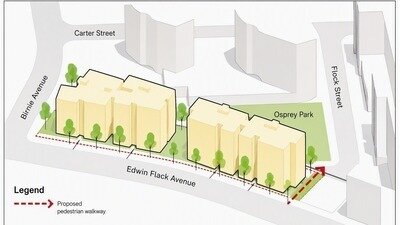
The proposal comprises two adjoining 8-storey building forms, creating a substantial four-tower appearance across the site, potentially accommodating around 400-500 residents.
We do not believe this is the right location, scale or timing for this development.
The proposal would place approximately 150 social housing households on a relatively small site in a precinct where transport, schools, healthcare, shopping, parking and other essential infrastructure are still developing.
The development is expected to be occupied around 2029.
The question isn't what Sydney Olympic Park might look like under Master Plan 2050. The question is whether the infrastructure and services required to support this development will actually be available when residents move in.
What will actually be ready in 2029?
Sydney Olympic Park is a rapidly growing precinct. Master Plan 2050 provides for substantial future growth, including new schools, community facilities, transport and other infrastructure. Just a few months after the Master Plan 2050 was announced, there are already serious concerns about whether the essential services and infrastructure promised under the Plan will actually be delivered. For example, the proposed public school has already encountered a major hurdle, creating uncertainty about whether it will proceed at all. The proposed light rail connection to Sydney Olympic Park has also been shelved.
We support properly planned growth.
But a long-term master plan is not the same as infrastructure actually being available when residents move in.
We are not asking for every part of Master Plan 2050 to be completed today.
We are asking a much more immediate question:
What infrastructure and services will actually be available when these 150 households move in around 2029?
Homes NSW should demonstrate that the infrastructure and services necessary to support this development will be funded, committed and capable of being operational when residents arrive.
Until that can be demonstrated, we do not believe this development should proceed.
Services and healthcare
Sydney Olympic Park is still developing the everyday services needed to support a growing residential population.
There is currently no public school within Sydney Olympic Park itself, affordable and bulk-billed primary healthcare is limited, and there is no full-service supermarket suitable for substantial weekly grocery shopping. Residents can also need to travel outside the precinct for important everyday services.
The proposed public school for Sydney Olympic Park may not even go ahead. The Department of Education has advised that the proposed school site, understood to be the only suitable site within the precinct, is subject to a Voluntary Planning Agreement, with delays and difficulties affecting the transfer of the land to the Department. This has created genuine uncertainty about whether the school will ultimately be delivered.
Social housing is intended to support people experiencing greater housing need. Government data cited in our formal submission indicates that approximately 38% of social housing households include at least one person with disability, while significant proportions of tenants report anxiety, financial pressure and social isolation.
This does not mean every future resident will require additional support.
It does mean that healthcare, disability, mental-health, community and other essential services need sufficient capacity and accessibility when residents move in.
These requirements must be properly considered before adding approximately 400-500 residents to this site.
Public transport is already under pressure
The existing public transport network is already carrying significant demand.
The 526 bus is a critical connection between Sydney Olympic Park, Newington, Rhodes and Strathfield, and capacity concerns have already been identified during peak periods.
Adding potentially another 400-500 residents will create additional demand for transport to work, education, healthcare, shopping and other essential services.
Sydney Metro West is currently targeted for 2032, while the Sydney Olympic Park light-rail extension does not yet have a confirmed operating date.
Future infrastructure is welcome.
But residents will be living here in 2029. Homes NSW need to show what transport network will actually be available at that time. Will it have sufficient capacity to serve the additional population? We say it won't!
We should not be expected to accept the development now on the assumption that future transport infrastructure will eventually catch up.
Schools and growing population pressure
Sydney Olympic Park currently has no public school within the precinct, while surrounding schools are already expanding to accommodate population growth. With the NSW Government already encountering difficulties securing the only suitable site within Sydney Olympic Park for a proposed public school, there is increasing uncertainty as to whether a school will ever be delivered.
Newington Public School has experienced capacity pressure, while Wentworth Point Public School has undergone a major expansion to provide additional permanent teaching spaces.
The question is not whether a school exists somewhere nearby.
Will there be sufficient permanent school capacity for children from these 150 households in 2029, alongside the many other developments occurring across the surrounding precinct?
That should be demonstrated before this development is approved.
Major construction, events and emergency access
The development may overlap with major construction associated with Parramatta Light Rail Stage 2B (if this light rail is actually delivered to Sydney Olympic Park).
The light-rail alignment passes through the Carter Street precinct, crosses Edwin Flack Avenue and runs along Uhrig Road.
Sydney Olympic Park is also a major events precinct, with substantial surges in traffic and pedestrian movements during concerts, sporting events and other major events.
The cumulative impact of this development alongside major construction and event activity must be properly assessed.
That includes:
construction traffic and road closures;
pedestrian diversions;
noise, dust and vibration;
event-day congestion;
parking pressure; and
emergency access and evacuation.
These are not ordinary suburban conditions.
Parking and Grazier Street
The proposal will remove existing parking capacity in a precinct where parking demand can increase dramatically during major events.
Homes NSW should explain how parking demand from residents, businesses, visitors and event patrons will be accommodated.
The proposed pedestrian connection towards Grazier Street also raises concerns because it directs additional pedestrian movements towards a constrained one-way street environment with limited pedestrian infrastructure.
A development potentially accommodating 400-500 additional residents requires pedestrian access that is safe, accessible and properly integrated into the surrounding network.
There is a better comparison
There is an important comparison that should not be overlooked.
Homes NSW is also delivering 145 social housing homes at Kamira Avenue, Villawood - just less than the number of homes proposed for Sydney Olympic Park.
But the surrounding environment is very different.
The Villawood development is close to an established town centre, with Villawood railway station, shops, schools and bus services already operating nearby.
Importantly, the Villawood project is not simply relying on a long-term plan for infrastructure to be delivered over the next 25 years. The broader town-centre renewal is already being actively delivered, with housing construction underway and supporting retail, childcare, medical, community and open-space infrastructure being progressed as part of the project.
This means the supporting infrastructure is being delivered alongside the housing, rather than being left as a future possibility with no certainty that it will be completed when residents move in.
The point is not that Sydney Olympic Park and Villawood are almost identical.
The point is that 150 social housing homes can be delivered in a location where essential services and transport are already established and where further supporting infrastructure is actively being delivered alongside the housing.
So the question for Sydney Olympic Park is:
Why concentrate 150 social housing households on this particular site when many of the services and infrastructure they will rely upon are still being progressively delivered, with no certainty that they will be ready when residents move in?
The issue is planning, infrastructure and location
This proposal needs to be considered in the context of the existing Sydney Olympic Park community, surrounding businesses, infrastructure constraints and the significant growth already occurring across the precinct.
The answer should not be that the homes can physically fit on the site. The question is whether this is the right location, scale and timing for 150 social housing households.
We believe it is not.
Our request
We are calling on the NSW Government and Homes NSW to:
Withdraw the proposed development at 2A–4 Edwin Flack Avenue and do not proceed with this 145-home social housing project in its current location and form.
Before any proposal of this scale is considered further, Homes NSW must show:
✔ What infrastructure and services will actually be operational in 2029
✔ That healthcare, mental-health and community services will have sufficient capacity
✔ That permanent school capacity will be sufficient
✔ That public transport will have capacity for the additional population
✔ How Parramatta Light Rail construction and other major projects will affect the development
✔ How event-day traffic, parking, pedestrian safety and emergency access will be managed
✔ That the proposed Grazier Street connection is necessary and safe
✔ That appropriate long-term building management and support arrangements will be in place
Sydney Olympic Park deserves infrastructure-led growth
We are not asking for every part of Master Plan 2050 to be completed today.
We are asking for the infrastructure and services necessary to support this development to be ready when residents move in.
Housing and the infrastructure needed to support it should arrive together, not housing first and services later.
We say NO to this proposal.
Sign the petition
Stand with the residents, owners and businesses of Sydney Olympic Park and Carter Street.
Tell the NSW Government and Homes NSW:
Stop the proposed 150-home social housing development at 2A–4 Edwin Flack Avenue.
Protect our community, businesses, infrastructure, safety and quality of life.
1,821
The issue
Stop the Proposed 150-Home Housing Commission Development at Sydney Olympic Park
Protect our community, infrastructure, businesses and quality of life
150 homes. Potentially 400-500 residents. Four connected tower forms. One relatively small site.
We, the residents, owners and businesses of Sydney Olympic Park and the surrounding Carter Street precinct, strongly oppose the proposed development of approximately 150 social housing homes at 2A-4 Edwin Flack Avenue.
The proposal comprises two adjoining 8-storey building forms, creating a substantial four-tower appearance across the site, potentially accommodating around 400-500 residents.
We do not believe this is the right location, scale or timing for this development.
The proposal would place approximately 150 social housing households on a relatively small site in a precinct where transport, schools, healthcare, shopping, parking and other essential infrastructure are still developing.
The development is expected to be occupied around 2029.
The question isn't what Sydney Olympic Park might look like under Master Plan 2050. The question is whether the infrastructure and services required to support this development will actually be available when residents move in.
What will actually be ready in 2029?
Sydney Olympic Park is a rapidly growing precinct. Master Plan 2050 provides for substantial future growth, including new schools, community facilities, transport and other infrastructure. Just a few months after the Master Plan 2050 was announced, there are already serious concerns about whether the essential services and infrastructure promised under the Plan will actually be delivered. For example, the proposed public school has already encountered a major hurdle, creating uncertainty about whether it will proceed at all. The proposed light rail connection to Sydney Olympic Park has also been shelved.
We support properly planned growth.
But a long-term master plan is not the same as infrastructure actually being available when residents move in.
We are not asking for every part of Master Plan 2050 to be completed today.
We are asking a much more immediate question:
What infrastructure and services will actually be available when these 150 households move in around 2029?
Homes NSW should demonstrate that the infrastructure and services necessary to support this development will be funded, committed and capable of being operational when residents arrive.
Until that can be demonstrated, we do not believe this development should proceed.
Services and healthcare
Sydney Olympic Park is still developing the everyday services needed to support a growing residential population.
There is currently no public school within Sydney Olympic Park itself, affordable and bulk-billed primary healthcare is limited, and there is no full-service supermarket suitable for substantial weekly grocery shopping. Residents can also need to travel outside the precinct for important everyday services.
The proposed public school for Sydney Olympic Park may not even go ahead. The Department of Education has advised that the proposed school site, understood to be the only suitable site within the precinct, is subject to a Voluntary Planning Agreement, with delays and difficulties affecting the transfer of the land to the Department. This has created genuine uncertainty about whether the school will ultimately be delivered.
Social housing is intended to support people experiencing greater housing need. Government data cited in our formal submission indicates that approximately 38% of social housing households include at least one person with disability, while significant proportions of tenants report anxiety, financial pressure and social isolation.
This does not mean every future resident will require additional support.
It does mean that healthcare, disability, mental-health, community and other essential services need sufficient capacity and accessibility when residents move in.
These requirements must be properly considered before adding approximately 400-500 residents to this site.
Public transport is already under pressure
The existing public transport network is already carrying significant demand.
The 526 bus is a critical connection between Sydney Olympic Park, Newington, Rhodes and Strathfield, and capacity concerns have already been identified during peak periods.
Adding potentially another 400-500 residents will create additional demand for transport to work, education, healthcare, shopping and other essential services.
Sydney Metro West is currently targeted for 2032, while the Sydney Olympic Park light-rail extension does not yet have a confirmed operating date.
Future infrastructure is welcome.
But residents will be living here in 2029. Homes NSW need to show what transport network will actually be available at that time. Will it have sufficient capacity to serve the additional population? We say it won't!
We should not be expected to accept the development now on the assumption that future transport infrastructure will eventually catch up.
Schools and growing population pressure
Sydney Olympic Park currently has no public school within the precinct, while surrounding schools are already expanding to accommodate population growth. With the NSW Government already encountering difficulties securing the only suitable site within Sydney Olympic Park for a proposed public school, there is increasing uncertainty as to whether a school will ever be delivered.
Newington Public School has experienced capacity pressure, while Wentworth Point Public School has undergone a major expansion to provide additional permanent teaching spaces.
The question is not whether a school exists somewhere nearby.
Will there be sufficient permanent school capacity for children from these 150 households in 2029, alongside the many other developments occurring across the surrounding precinct?
That should be demonstrated before this development is approved.
Major construction, events and emergency access
The development may overlap with major construction associated with Parramatta Light Rail Stage 2B (if this light rail is actually delivered to Sydney Olympic Park).
The light-rail alignment passes through the Carter Street precinct, crosses Edwin Flack Avenue and runs along Uhrig Road.
Sydney Olympic Park is also a major events precinct, with substantial surges in traffic and pedestrian movements during concerts, sporting events and other major events.
The cumulative impact of this development alongside major construction and event activity must be properly assessed.
That includes:
construction traffic and road closures;
pedestrian diversions;
noise, dust and vibration;
event-day congestion;
parking pressure; and
emergency access and evacuation.
These are not ordinary suburban conditions.
Parking and Grazier Street
The proposal will remove existing parking capacity in a precinct where parking demand can increase dramatically during major events.
Homes NSW should explain how parking demand from residents, businesses, visitors and event patrons will be accommodated.
The proposed pedestrian connection towards Grazier Street also raises concerns because it directs additional pedestrian movements towards a constrained one-way street environment with limited pedestrian infrastructure.
A development potentially accommodating 400-500 additional residents requires pedestrian access that is safe, accessible and properly integrated into the surrounding network.
There is a better comparison
There is an important comparison that should not be overlooked.
Homes NSW is also delivering 145 social housing homes at Kamira Avenue, Villawood - just less than the number of homes proposed for Sydney Olympic Park.
But the surrounding environment is very different.
The Villawood development is close to an established town centre, with Villawood railway station, shops, schools and bus services already operating nearby.
Importantly, the Villawood project is not simply relying on a long-term plan for infrastructure to be delivered over the next 25 years. The broader town-centre renewal is already being actively delivered, with housing construction underway and supporting retail, childcare, medical, community and open-space infrastructure being progressed as part of the project.
This means the supporting infrastructure is being delivered alongside the housing, rather than being left as a future possibility with no certainty that it will be completed when residents move in.
The point is not that Sydney Olympic Park and Villawood are almost identical.
The point is that 150 social housing homes can be delivered in a location where essential services and transport are already established and where further supporting infrastructure is actively being delivered alongside the housing.
So the question for Sydney Olympic Park is:
Why concentrate 150 social housing households on this particular site when many of the services and infrastructure they will rely upon are still being progressively delivered, with no certainty that they will be ready when residents move in?
The issue is planning, infrastructure and location
This proposal needs to be considered in the context of the existing Sydney Olympic Park community, surrounding businesses, infrastructure constraints and the significant growth already occurring across the precinct.
The answer should not be that the homes can physically fit on the site. The question is whether this is the right location, scale and timing for 150 social housing households.
We believe it is not.
Our request
We are calling on the NSW Government and Homes NSW to:
Withdraw the proposed development at 2A–4 Edwin Flack Avenue and do not proceed with this 145-home social housing project in its current location and form.
Before any proposal of this scale is considered further, Homes NSW must show:
✔ What infrastructure and services will actually be operational in 2029
✔ That healthcare, mental-health and community services will have sufficient capacity
✔ That permanent school capacity will be sufficient
✔ That public transport will have capacity for the additional population
✔ How Parramatta Light Rail construction and other major projects will affect the development
✔ How event-day traffic, parking, pedestrian safety and emergency access will be managed
✔ That the proposed Grazier Street connection is necessary and safe
✔ That appropriate long-term building management and support arrangements will be in place
Sydney Olympic Park deserves infrastructure-led growth
We are not asking for every part of Master Plan 2050 to be completed today.
We are asking for the infrastructure and services necessary to support this development to be ready when residents move in.
Housing and the infrastructure needed to support it should arrive together, not housing first and services later.
We say NO to this proposal.
Sign the petition
Stand with the residents, owners and businesses of Sydney Olympic Park and Carter Street.
Tell the NSW Government and Homes NSW:
Stop the proposed 150-home social housing development at 2A–4 Edwin Flack Avenue.
Protect our community, businesses, infrastructure, safety and quality of life.
The Decision Makers
Supporter Voices
Petition Updates
Share this petition
Petition created on 19 August 2026