
Hello
When we last updated you in December 2025, the planning committee had just voted to approve the Wisborough Green solar farm. A lot has happened since then. We are still here, the case is still open, and the grounds on which we are challenging this decision have actually strengthened — not weakened — in the months since.
We want to be honest with you: we are in uncertain territory. We may be heading toward a judicial review — a formal High Court challenge — which would be costly and uncertain for everyone. But we also believe the legal case is genuine, and that the planning process in this instance fell short of the standards the law requires. Here is where things stand.
What has happened since December
The Secretary of State declined to call in the application
In February 2026, Whitehall returned the decision to Chichester District Council. This was a decision about who decides — not about whether the approval was lawful. The legal questions we raised were not answered. They were handed back.
No planning permission has yet been issued
The committee voted to approve, but the formal decision notice has not been issued. That window — the last opportunity for the Council to correct the decision internally — remains open. Once it closes, the only route left is the courts.
The Planning Committee Chair has commissioned a legal and an independent ecological review
The Chair of the Planning Committee — who himself voted against the application — has taken the concerns we raised seriously enough to commission a review by lawyers and an ecologist. That review is ongoing.
We are in the process of commissioning our own independent ecological review
We have identified specialist ecologists with direct experience of similar cases — including the neighbouring Runcton solar farm appeal — and are in the process of instructing them to review whether the ecology assessment in this case meets the required legal standard.
The core concern, in plain English
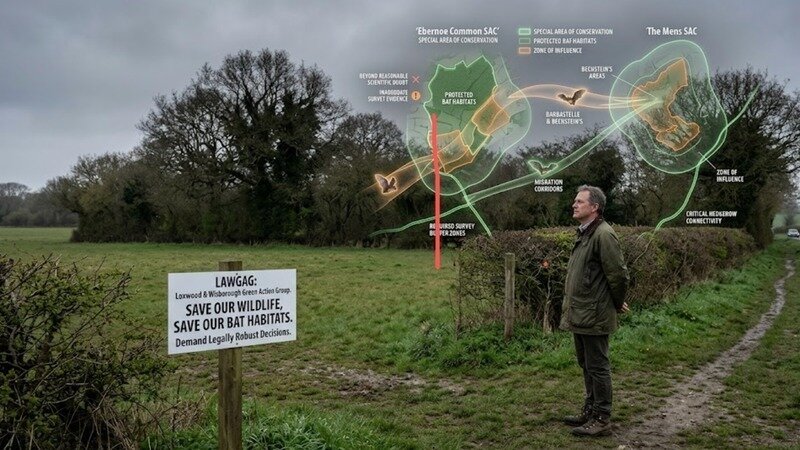
The site lies within the zone of influence of two Special Areas of Conservation — protected habitats designated for their internationally important bat populations. Before a council can approve development affecting one of these sites, the law requires it to be satisfied — beyond reasonable scientific doubt — that the development will cause no harm to the protected habitat. It is one of the highest legal thresholds in planning law.
The developer's own documents confirm that no bat activity surveys were carried out on the site. The Council's ecological assessment relies instead on assumed bat behaviour — not measured data — to conclude that protective buffer zones around hedgerows will be adequate. The assessment itself acknowledges that surveys are needed to determine those buffers. Yet it records that sufficient survey work has been done.
This week, the Planning Inspectorate dismissed a bat SAC appeal elsewhere in the country on almost identical grounds, stating plainly: "Where any uncertainty remains, permission must be refused." That is the standard we say has not been met here.
A word on the wider context
We are acutely aware that the world feels very different from when this campaign began. The conflict involving Iran, Israel and the United States has sent energy prices higher and made the case for domestic renewable energy feel more urgent than ever. We understand that. We are not anti-solar, and we never have been.
But energy insecurity and ecological protection are not opposites. The UK Government's own national security assessment — compiled with the involvement of intelligence agencies and published earlier this year — identifies biodiversity loss and ecosystem collapse as threats to national security in their own right. The legal protections for bat habitats like The Mens and Ebernoe Common SAC exist because these ecosystems matter — not as a bureaucratic obstacle to development, but as part of the national framework for long-term resilience.
A solar farm built on a lawful, properly evidenced basis is one we could accept. What we cannot accept is one approved on an inadequate evidence base that the law does not permit.
What happens next
We are waiting for the outcome of the Council's internal legal review. If it concludes that the concerns are valid, the application should be brought back to committee for reconsideration on a proper evidence base. If it does not — or if the Council proceeds to issue the decision notice without addressing them — we will have little choice but to pursue a legal challenge through the courts.
Judicial review is not something we undertake lightly. It is expensive, uncertain and slow. But a planning permission that is not lawfully made is not a permission worth having — for anyone, including the developer. The most efficient route to a durable outcome is a decision that is properly made in the first place.
We will update you as soon as there is meaningful news. Thank you — genuinely — for staying with us through what has become a much longer and more complex process than any of us anticipated.
LAWGAG — Loxwood & Wisborough Green Action Group · April 2026