
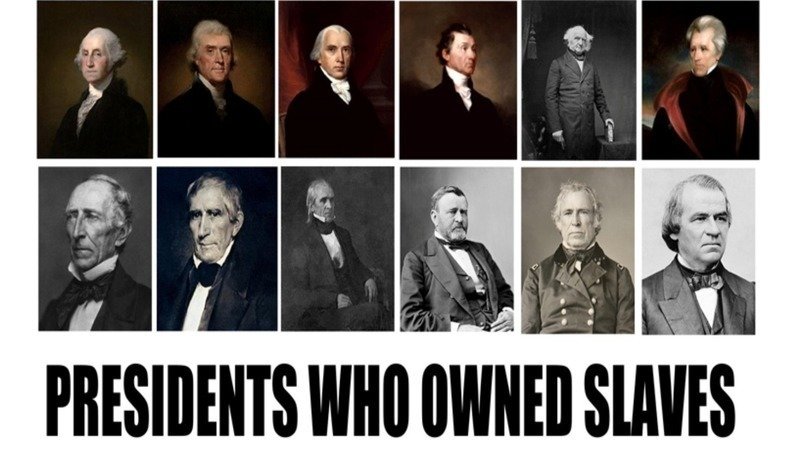
Presidential Slave Notes
We are nearing the nations President’s Day celebration. In this communication you will find the presidents positions on slavery and a very brief history of slavery during their presidency. It is interesting how these facts are omitted from the history books used in schools.
President George Washington 1789–1797
Washington was a major slaveholder before, during, and after his presidency. The majority of those sold into slavery were destined to work on plantations in the Caribbean and the Americas, where huge areas of the American continent had been colonized by European countries. These plantations produced products such as sugar or tobacco, meant for consumption back in Europe.
Presidential Slavery Notes:
During Washington’s presidency, the United States passed the Fugitive Slave Act of 1793. The Fugitive Slave Act of 1793 guaranteed a right for a slaveholder to recover an escaped slave. The Act, "An Act respecting fugitives from justice, and persons escaping from the service of their masters," created the legal mechanism by which that could be accomplished.
President Thomas Jefferson 1801–1809
Jefferson fathered multiple enslaved children with the enslaved woman Sally Hemings
Presidential Slavery Notes:
Although he believed that slavery was a gross violation of the principles celebrated in the Declaration of Independence, he also believed that people of African descent were biologically inferior to whites and could never live alongside whites in peace and harmony.
President James Madison 1809–1817
Madison did not free his slaves during his lifetime or in his will.
Presidential Slavery Notes:
The Missouri crisis of 1819-1821 put Madison's convictions on the slavery issue to a severe test. In letters to the President and several other correspondents, Madison denied that Congress had the power to attach an antislavery condition to the admission of a new state, or to control the migration of slaves within the several States.
President James Monroe 1817–1825
He owned many slaves throughout his entire adult life, freeing only one of them in his final days.
Presidential Slavery Notes:
Monroe’s presidency saw the rapid westward expansion of the nation after the War of 1812, including the westward expansion of slavery across the Mississippi River.
President Andrew Jackson 1829–1837
Jackson owned many slaves. One controversy during his presidency was his reaction to anti-slavery tracts. During his campaign for the presidency, he faced criticism for being a slave trader. He did not free his slaves in his will.
Presidential Slavery Notes:
Records show Jackson beat his enslaved workers, including doling out a brutal public whipping to a woman he felt had been “putting on airs.” And when any of them ran away, he pursued them and put them in chains when they were recovered. In an 1804 newspaper advertisement for a 30-year-old runaway named Tom, he offered an extra $10 for every 100 lashes doled out to the escapee.
President John Tyler 1841–1845
Tyler never freed any of his slaves and consistently supported the slaveholder's rights and the expansion of slavery during his time in political office.
Presidential Slavery Notes:
Tyler was a key figure connecting the Jeffersonian generation from the “Early Republic” to the Calhounite proslavery generation of the “Jacksonian Era” and its direct descendants in the Confederacy.
President James K. Polk 1845–1849
Polk became the Democratic nominee for president in 1844 partially because of his tolerance of slavery.
Presidential Slavery Notes:
Polk believed that the federal government did not have the authority to limit the expansion of slavery into western territories.
President Zachary Taylor 1849–50
Taylor owned slaves throughout his life.
Presidential Slavery Notes:
Federal laws that allowed for the capture and return of runaway enslaved people within the territory of the US. Enacted by Congress in 1793, the first Fugitive Slave Act authorized local governments to seize and return escapees to their owners and imposed penalties on anyone who aided in their flight. Widespread resistance to the 1793 law led to the Fugitive Slave Act of 1850. It added more provisions regarding runaways and levied harsher punishments for interfering in their capture.
Presidential Slavery Notes:
Devil's Punchbowl Held Black Union Soldiers in camps - 1863
When the slaves were released from the plantations during the occupation they overran Natchez, Mississippi. And the population went from about 10,000 to 120,000 overnight. They decided to build an encampment for 'em at Devil's Punchbowl which they walled off and wouldn't let 'em out.
President Andrew Johnson 1865–1869
Johnson owned a few slaves and was supportive of James K. Polk's slavery policies.
Presidential Slavery Notes:
Johnson believed in what's called "herrenvolk democracy" — the idea that the lowest white man in the social hierarchy should be above the highest Black man.
President Ulysses S. Grant 1869–1877
Grant personally owned one slave, William Jones, given to him by his father-in-law. During his presidency, the Gentleman’s agreement was formed.
Presidential Slavery Notes:
The Gentleman's Agreement of 1876 was an agreement between Major League owners not to sign Black baseball players to their team. This agreement helped keep Black baseball players out of the Major Leagues and helped continue segregation not only in baseball but in life.