

Stop the gross mismanagement of muskoxen in rural Alaska
The Issue
STATEMENT:
Muskoxen are a prehistoric arctic land mammal that disappeared in Alaska by the early 1900s. Since the reintroduction of this species in the 1930s (specifically in the Bering Strait Region in the 1970s), their existence has morphed from a novelty into a nuisance to now - dangerous and sometimes lethal.
We, the residents of rural Alaska, request that Governor Dunleavy, the Alaska Department of Fish and Game, and any other stakeholders in wildlife management in Alaska hold accountability and honor their duty in managing the game and wildlife of the Bering Strait region and beyond. Change is desperately needed for the citizens of this region to feel empowered in defending themselves and their animals without fear of prosecution. We request training for local state/government agencies so we may reasonably co-exist as we have done and continue to do with other wildlife.
In the last half-century, the muskox population has exploded and spread throughout the region without a proper nor effective contingency strategy to control it. Stemming from an ineffective hunting and conservation strategy, muskoxen have become an invasive species. This has allowed these animals to flourish in a way that has become dangerous and lethal to animals and, now, humans.
As rural Alaskans, we pride ourselves on being able to be caretakers of the wildlife population and co-exist with them, but this has gone beyond that. In recent years, muskoxen have increasingly caused destruction and dog deaths. They have destroyed graveyards, decimating the locations of our loved ones' final resting places. They have eaten food that people grew for their personal food security. Families cannot safely subsist on the tundra or let their children play outside without the looming threat to their lives and personal safety. Muskoxen hang around and spend time on runways, endangering planes and people, which airplanes are our primary source of transportation and moving freight.
Recently, Nome lost a valuable community member and public servant. CSO Curtis Worland (Alaska State Troopers) was fatally gored by a muskox on December 13th. Over the past decade, this had become a growing fear of the citizens in the region, and now our worst nightmare has become a reality. Our dear friend Kamey Kapp Worland is now a young widow due to the gross mismanagement of an animal introduced without any contingency plan to keep the public safe.
News of Curtis’ death has spread across the globe. Hundreds of articles were written and shared in dozens of prominent major news outlets, including People Magazine, NYPost, Washington Examiner, Daily Mail, Newsweek, USA Today as well as ABC, CBS, NBS, and yahoo News online. We are tired of unanswered calls for aid in managing these animals. We are tired of losing our pets, our property, our food, and now our friends to these animals.
FACTS:
•Muskox had died out in Alaska by the early 1900s
•Not reintroduced to Alaska until the 1930s, and then not reintroduced to the Nome/Bering Strait region until the 1970s
•Muskoxen have hurt or killed dozens of dogs in recent years
•They have now escalated to attacking and killing people
•They are a danger to passenger and cargo airplanes because of their proximity to the runway in which previous efforts to keep them away have been unsuccessful
•They trample and destroy the gravesites of our loved ones, causing financial hardships and emotional trauma
•They were not in the region when Nome was established as a permanent gold-mining settlement and had not been in the region as an established food or subsistence resource at any point during the colonization of Alaska
•Unlike moose and bears, they have no respect or fear of populated areas and instead seek them out to get away from predators such as wolves and bears and to seek easy food sources (i.e., people's gardens and grass growing near homes)
•People are afraid to defend their life and property with deadly weapons because of fear of prosecution from the state
•We cannot coexist with them as we can with other wildlife, such as bears, moose, caribou, and reindeer, as they have no fear or respect for populated areas
•Fish and Game and other authorities have been repeatedly notified of the issues, and nothing has been done
•The state legislature supports Alaskans’ “right to mush,” and while not statutory, they support mushing and its significance to Alaskan people and cultures. Muskoxen are a barrier to this Alaskan right
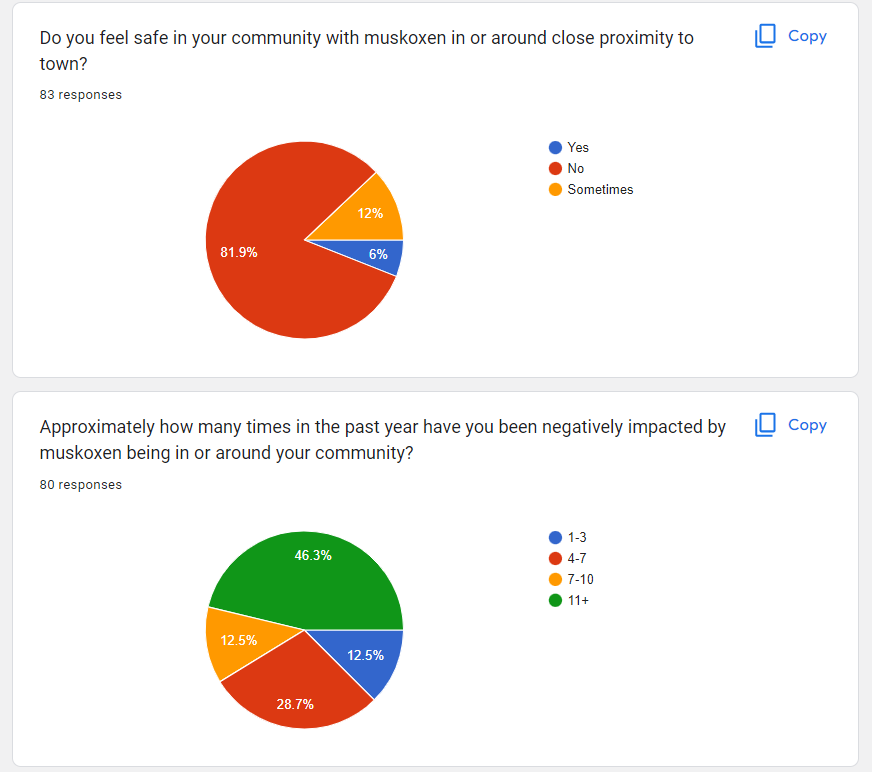
•A recent questionnaire shows that the people of the region overwhelmingly do not feel safe around muskoxen, and they are experiencing negative interactions with them repeatedly
REQUESTED SOLUTIONS TO CONSIDER:
•An emergency order to reduce the number of muskoxen in and around Nome city limits
•Allow culling of repeated nuisance animals and donate the meat to communities in need
•Better management of predator populations of bears and wolves, which have driven the animals into populated areas
•Provide EFFECTIVE resources for non-lethal ways to move herds
•Training local LEOs to be able to assist with moving herds away from populated areas
•Train and equip local volunteers on how to safely move muskox herds, to be done as a group for safety purposes
•Open up more hunting opportunities inGame Unit 22C, and open it up to bulls and cows
•Modernized methods of humane chipping, tagging, and tracking of muskoxen to obtain crucial data on their herd movements that will assist in any scientific studies needed to help with the population, as well as to curate a more accurate census. Scientific field testing to ensure the population is healthy and not carrying any latent diseases that could harm or change our ecosystem.
•In the 1970s, the Kellogg Foundation financed an operation in Unalakleet, Alaska by sending approximately 30 muskoxen to start a farm. Over the tenure of the farm’s existence, the handlers were able to tend the muskoxen in a successful enclosure to maintain the herd. There were very few reports of the musk ox breaking through their barriers. There are no documented incidents to where any damage or injuries took place outside of the musk ox enclosures to humans, animals, or property. The demise of the farm occurred in the 1980s when the cost of feeding the animals became too high, as all the feed and supplies were shipped via bypass mail.
The remaining herd was successfully relocated to Palmer, Alaska, where they have been able to successfully maintain a large number of muskoxen. The muskoxen in their care receive stress-free handling and monitored ethical husbandry. They are able to focus on qiviut production and educating the public. There is a very large tourism draw to this farm, and they function as a noteworthy 501C non-profit.
We (the residents of Nome and the Bering Straits) would like to have the opportunity to possibly revisit the musk ox farm concept as a productive means to harvest qiviut, keep the herds contained within ethical enclosure systems, help promote tourism, increase safety, and utilize the animals for their resources in a similar model in addition to forming barriers to keep other muskoxen out of residential areas.

1,418
The Issue
STATEMENT:
Muskoxen are a prehistoric arctic land mammal that disappeared in Alaska by the early 1900s. Since the reintroduction of this species in the 1930s (specifically in the Bering Strait Region in the 1970s), their existence has morphed from a novelty into a nuisance to now - dangerous and sometimes lethal.
We, the residents of rural Alaska, request that Governor Dunleavy, the Alaska Department of Fish and Game, and any other stakeholders in wildlife management in Alaska hold accountability and honor their duty in managing the game and wildlife of the Bering Strait region and beyond. Change is desperately needed for the citizens of this region to feel empowered in defending themselves and their animals without fear of prosecution. We request training for local state/government agencies so we may reasonably co-exist as we have done and continue to do with other wildlife.
In the last half-century, the muskox population has exploded and spread throughout the region without a proper nor effective contingency strategy to control it. Stemming from an ineffective hunting and conservation strategy, muskoxen have become an invasive species. This has allowed these animals to flourish in a way that has become dangerous and lethal to animals and, now, humans.
As rural Alaskans, we pride ourselves on being able to be caretakers of the wildlife population and co-exist with them, but this has gone beyond that. In recent years, muskoxen have increasingly caused destruction and dog deaths. They have destroyed graveyards, decimating the locations of our loved ones' final resting places. They have eaten food that people grew for their personal food security. Families cannot safely subsist on the tundra or let their children play outside without the looming threat to their lives and personal safety. Muskoxen hang around and spend time on runways, endangering planes and people, which airplanes are our primary source of transportation and moving freight.
Recently, Nome lost a valuable community member and public servant. CSO Curtis Worland (Alaska State Troopers) was fatally gored by a muskox on December 13th. Over the past decade, this had become a growing fear of the citizens in the region, and now our worst nightmare has become a reality. Our dear friend Kamey Kapp Worland is now a young widow due to the gross mismanagement of an animal introduced without any contingency plan to keep the public safe.
News of Curtis’ death has spread across the globe. Hundreds of articles were written and shared in dozens of prominent major news outlets, including People Magazine, NYPost, Washington Examiner, Daily Mail, Newsweek, USA Today as well as ABC, CBS, NBS, and yahoo News online. We are tired of unanswered calls for aid in managing these animals. We are tired of losing our pets, our property, our food, and now our friends to these animals.
FACTS:
•Muskox had died out in Alaska by the early 1900s
•Not reintroduced to Alaska until the 1930s, and then not reintroduced to the Nome/Bering Strait region until the 1970s
•Muskoxen have hurt or killed dozens of dogs in recent years
•They have now escalated to attacking and killing people
•They are a danger to passenger and cargo airplanes because of their proximity to the runway in which previous efforts to keep them away have been unsuccessful
•They trample and destroy the gravesites of our loved ones, causing financial hardships and emotional trauma
•They were not in the region when Nome was established as a permanent gold-mining settlement and had not been in the region as an established food or subsistence resource at any point during the colonization of Alaska
•Unlike moose and bears, they have no respect or fear of populated areas and instead seek them out to get away from predators such as wolves and bears and to seek easy food sources (i.e., people's gardens and grass growing near homes)
•People are afraid to defend their life and property with deadly weapons because of fear of prosecution from the state
•We cannot coexist with them as we can with other wildlife, such as bears, moose, caribou, and reindeer, as they have no fear or respect for populated areas
•Fish and Game and other authorities have been repeatedly notified of the issues, and nothing has been done
•The state legislature supports Alaskans’ “right to mush,” and while not statutory, they support mushing and its significance to Alaskan people and cultures. Muskoxen are a barrier to this Alaskan right
•A recent questionnaire shows that the people of the region overwhelmingly do not feel safe around muskoxen, and they are experiencing negative interactions with them repeatedly
REQUESTED SOLUTIONS TO CONSIDER:
•An emergency order to reduce the number of muskoxen in and around Nome city limits
•Allow culling of repeated nuisance animals and donate the meat to communities in need
•Better management of predator populations of bears and wolves, which have driven the animals into populated areas
•Provide EFFECTIVE resources for non-lethal ways to move herds
•Training local LEOs to be able to assist with moving herds away from populated areas
•Train and equip local volunteers on how to safely move muskox herds, to be done as a group for safety purposes
•Open up more hunting opportunities inGame Unit 22C, and open it up to bulls and cows
•Modernized methods of humane chipping, tagging, and tracking of muskoxen to obtain crucial data on their herd movements that will assist in any scientific studies needed to help with the population, as well as to curate a more accurate census. Scientific field testing to ensure the population is healthy and not carrying any latent diseases that could harm or change our ecosystem.
•In the 1970s, the Kellogg Foundation financed an operation in Unalakleet, Alaska by sending approximately 30 muskoxen to start a farm. Over the tenure of the farm’s existence, the handlers were able to tend the muskoxen in a successful enclosure to maintain the herd. There were very few reports of the musk ox breaking through their barriers. There are no documented incidents to where any damage or injuries took place outside of the musk ox enclosures to humans, animals, or property. The demise of the farm occurred in the 1980s when the cost of feeding the animals became too high, as all the feed and supplies were shipped via bypass mail.
The remaining herd was successfully relocated to Palmer, Alaska, where they have been able to successfully maintain a large number of muskoxen. The muskoxen in their care receive stress-free handling and monitored ethical husbandry. They are able to focus on qiviut production and educating the public. There is a very large tourism draw to this farm, and they function as a noteworthy 501C non-profit.
We (the residents of Nome and the Bering Straits) would like to have the opportunity to possibly revisit the musk ox farm concept as a productive means to harvest qiviut, keep the herds contained within ethical enclosure systems, help promote tourism, increase safety, and utilize the animals for their resources in a similar model in addition to forming barriers to keep other muskoxen out of residential areas.
The Decision Makers

Petition Updates
Share this petition
Petition created on December 19, 2022