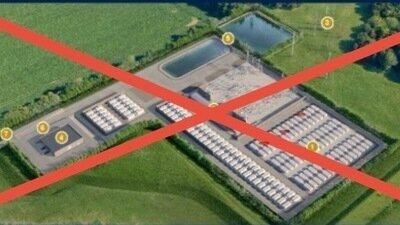

STOP The 344 LITHIUM Battery Storage System by NEOEN (Brookfield) in Saugeen Shores - ONLY
The Issue
STOP The 344 LITHIUM Battery Storage System by NEOEN (Brookfield) in Saugeen Shores - ONLY 4KM south of Port Elgin’s town limits
- Fire Risk and Emergency Response: Large-scale lithium-ion BESS installations carry the inherent risk of "thermal runaway," a chain-reaction fire that can reach temperatures exceeding 1,000°C. These fires are notoriously difficult to extinguish and often reignite. Lithium-ion battery fires require specialized suppression tactics, immense volumes of water, and advanced hazardous material training. There is a severe concern regarding the capacity of local emergency services
to manage a specialized lithium-battery incident: our local volunteer firefighters are neither equipped nor adequately
trained to handle a massive industrial chemical fire. Standard firefighting methods are ineffective for BESS fires and our local fire departments are not equipped to handle the specialized hazardous materials response required for a catastrophe of this scale. A thermal runaway event at this facility could easily burn out of control, threatening
adjacent properties and straining our emergency services beyond their capacity.
Contamination Risks to Groundwater & Aquifers: The site preparation involves massive grading that threatens to
permanently alter the hydrology of the aquifer feeding surrounding properties. Furthermore, in the event of a fire, the
"firewater" used for suppression—which becomes heavily contaminated with toxic chemicals, heavy metals, and electrolytes—could breach containment, infiltrating our shallow wells and poisoning our primary source of drinking water.
Species at Risk and Local Wildlife: The proposed site cuts directly into habitats utilized by regional wildlife and Species at Risk. The physical footprint, paired with industrial noise and light pollution, will fragment critical migratory corridors and push vulnerable avian and terrestrial species out of their established habitats. The continuous low-frequency noise generated by cooling systems and inverters will create persistent industrial noise pollution.
Light Pollution: Continuous 24/7 security lighting will disrupt the natural behaviors of nocturnal wildlife and severely impact migratory birds that rely on dark skies for navigation.
Noise and Pollution: Industrial cooling systems and continuous inverter hum create persistent low-frequency noise. This acoustic pollution induces chronic stress in livestock, disrupting feeding, breeding, and overall health.
Bees and Pollinators: The electromagnetic fields (EMFs) and potential chemical emissions from a facility of this scale
can disorient pollinators, threatening crop yields and regional biodiversity.
Infringement on Future Development Rights and Setback Encroachment: We formally object to any project footprint
or associated safety hazard zone that would restrict what adjacent landowners can do with their own property. The
approval of this BESS facility must not impose any new municipal setbacks, noise contours, or safety-related building
restrictions that overlap onto neighboring parcels. We must retain the unrestricted right to build future residences,
agricultural structures, or outbuildings at any desired location within our own property lines. The developer must be
required to contain all hazard, fire, and noise buffers strictly within their own leased boundaries, ensuring our future
property development rights are not impeded, sterilized, or dictated by their industrial operation.
Violation of Agricultural Policy Mandates: The Bruce County Official Plan establishes "Agriculture" as a core guiding principle, with a clear directive to protect and conserve prime agricultural land for future generations. The proposed BESS
facility—an industrial installation requiring the permanent leveling and sterilization of twenty acres—directly contradicts
this primary mandate. Converting viable farmland into a permanent industrial footprint is a failure to uphold the County's own stated commitment to preserving our finite agricultural assets.
Minimal Job Opportunities for the Community: most monitoring of the system will be completed remotely and by existent staff of NEOEN, thus not creating job opportunities for the community.
Lack of Comprehensive Lifecycle Analysis The full lifecycle of these battery plants remains deeply concerning. There
is a glaring lack of transparency regarding the long-term decommissioning plans, safe disposal of degraded cells, and soil remediation protocols once the facility reaches its end-of-life. AI Data Centers: Brookfield Renewable Partners (the
owners of NEOEN since 2024) - a division of Brookfield Investments - agrees to provide Microsoft with 10500 megawatts of renewable power. What isn't in the brief is what is found on Brookfield's head office web page - in that Brookfield Investments owns 150 data centers. Please investigate Brookfield’s AI Data Centers online for more information.
The Myth of a "Temporary" Project: the community is aware that this project is proposed under a twenty-year lease
agreement. We want to be clear: a twenty-year industrial lease is not a "temporary" use of land. It represents a generation
of lost agricultural productivity and a permanent alteration of the rural landscape. Given the extensive concrete
foundations, site leveling, and soil compaction required, this land will effectively be removed from the agricultural pool for the foreseeable future, if not permanently.
Risks of Industrial Path Dependency and "Use-Creep": We are adamantly opposed to this project, in part, because it
creates a "turn-key" industrial site that inevitably invites further, more intensive industrial development. Once twenty acres
of prime farmland is leveled, graded, and serviced with the massive high-voltage grid connections required for a BESS,
the site becomes an ideal, ready-made location for subsequent industrial uses—most notably data centers. Energy
analysts are currently identifying BESS sites as the primary target for "co-location" with AI-driven data centers,
as these sites effectively solve the two biggest hurdles for data center developers: securing land and obtaining highcapacity grid interconnections. By approving this BESS facility, the County is not just approving a battery array; it is
creating the infrastructure foundation for a permanent industrial hub. We do not want this BESS project, nor do we want
the industrial trajectory it sets for our community.
Canada’s Prime Minister, the Honorable Mark Carney, stated that food security is a matter of national sovereignty in his
National Food Security Strategy. It is senseless that NEOEN’s BESS system is going to destroy prime agricultural lands
when there are other options available such as: abandoned gravel pits that pepper our community.
WHAT YOU CAN DO NOW:
Write to the following with your concerns:
• MP Alex Ruff
SON
• Saugeen Shores Council: attention Luke Charbonneau and Diane Huber
• IESO
• Lisa Thompson
Others to consider:
• Great Lakes Guardian Council
• Grain Farmers of Ontario
• Ontario Association of Agricultural
Societies (OAAS)
• Christian Farmers’ Federation of
Ontario (CFFO)
• Great Lakes Protection Act Alliance
• County of Bruce: attention Jenn Burnett (Bruce County Planning)
• OFA
*** all signatures will go on the public record
441
The Issue
STOP The 344 LITHIUM Battery Storage System by NEOEN (Brookfield) in Saugeen Shores - ONLY 4KM south of Port Elgin’s town limits
- Fire Risk and Emergency Response: Large-scale lithium-ion BESS installations carry the inherent risk of "thermal runaway," a chain-reaction fire that can reach temperatures exceeding 1,000°C. These fires are notoriously difficult to extinguish and often reignite. Lithium-ion battery fires require specialized suppression tactics, immense volumes of water, and advanced hazardous material training. There is a severe concern regarding the capacity of local emergency services
to manage a specialized lithium-battery incident: our local volunteer firefighters are neither equipped nor adequately
trained to handle a massive industrial chemical fire. Standard firefighting methods are ineffective for BESS fires and our local fire departments are not equipped to handle the specialized hazardous materials response required for a catastrophe of this scale. A thermal runaway event at this facility could easily burn out of control, threatening
adjacent properties and straining our emergency services beyond their capacity.
Contamination Risks to Groundwater & Aquifers: The site preparation involves massive grading that threatens to
permanently alter the hydrology of the aquifer feeding surrounding properties. Furthermore, in the event of a fire, the
"firewater" used for suppression—which becomes heavily contaminated with toxic chemicals, heavy metals, and electrolytes—could breach containment, infiltrating our shallow wells and poisoning our primary source of drinking water.
Species at Risk and Local Wildlife: The proposed site cuts directly into habitats utilized by regional wildlife and Species at Risk. The physical footprint, paired with industrial noise and light pollution, will fragment critical migratory corridors and push vulnerable avian and terrestrial species out of their established habitats. The continuous low-frequency noise generated by cooling systems and inverters will create persistent industrial noise pollution.
Light Pollution: Continuous 24/7 security lighting will disrupt the natural behaviors of nocturnal wildlife and severely impact migratory birds that rely on dark skies for navigation.
Noise and Pollution: Industrial cooling systems and continuous inverter hum create persistent low-frequency noise. This acoustic pollution induces chronic stress in livestock, disrupting feeding, breeding, and overall health.
Bees and Pollinators: The electromagnetic fields (EMFs) and potential chemical emissions from a facility of this scale
can disorient pollinators, threatening crop yields and regional biodiversity.
Infringement on Future Development Rights and Setback Encroachment: We formally object to any project footprint
or associated safety hazard zone that would restrict what adjacent landowners can do with their own property. The
approval of this BESS facility must not impose any new municipal setbacks, noise contours, or safety-related building
restrictions that overlap onto neighboring parcels. We must retain the unrestricted right to build future residences,
agricultural structures, or outbuildings at any desired location within our own property lines. The developer must be
required to contain all hazard, fire, and noise buffers strictly within their own leased boundaries, ensuring our future
property development rights are not impeded, sterilized, or dictated by their industrial operation.
Violation of Agricultural Policy Mandates: The Bruce County Official Plan establishes "Agriculture" as a core guiding principle, with a clear directive to protect and conserve prime agricultural land for future generations. The proposed BESS
facility—an industrial installation requiring the permanent leveling and sterilization of twenty acres—directly contradicts
this primary mandate. Converting viable farmland into a permanent industrial footprint is a failure to uphold the County's own stated commitment to preserving our finite agricultural assets.
Minimal Job Opportunities for the Community: most monitoring of the system will be completed remotely and by existent staff of NEOEN, thus not creating job opportunities for the community.
Lack of Comprehensive Lifecycle Analysis The full lifecycle of these battery plants remains deeply concerning. There
is a glaring lack of transparency regarding the long-term decommissioning plans, safe disposal of degraded cells, and soil remediation protocols once the facility reaches its end-of-life. AI Data Centers: Brookfield Renewable Partners (the
owners of NEOEN since 2024) - a division of Brookfield Investments - agrees to provide Microsoft with 10500 megawatts of renewable power. What isn't in the brief is what is found on Brookfield's head office web page - in that Brookfield Investments owns 150 data centers. Please investigate Brookfield’s AI Data Centers online for more information.
The Myth of a "Temporary" Project: the community is aware that this project is proposed under a twenty-year lease
agreement. We want to be clear: a twenty-year industrial lease is not a "temporary" use of land. It represents a generation
of lost agricultural productivity and a permanent alteration of the rural landscape. Given the extensive concrete
foundations, site leveling, and soil compaction required, this land will effectively be removed from the agricultural pool for the foreseeable future, if not permanently.
Risks of Industrial Path Dependency and "Use-Creep": We are adamantly opposed to this project, in part, because it
creates a "turn-key" industrial site that inevitably invites further, more intensive industrial development. Once twenty acres
of prime farmland is leveled, graded, and serviced with the massive high-voltage grid connections required for a BESS,
the site becomes an ideal, ready-made location for subsequent industrial uses—most notably data centers. Energy
analysts are currently identifying BESS sites as the primary target for "co-location" with AI-driven data centers,
as these sites effectively solve the two biggest hurdles for data center developers: securing land and obtaining highcapacity grid interconnections. By approving this BESS facility, the County is not just approving a battery array; it is
creating the infrastructure foundation for a permanent industrial hub. We do not want this BESS project, nor do we want
the industrial trajectory it sets for our community.
Canada’s Prime Minister, the Honorable Mark Carney, stated that food security is a matter of national sovereignty in his
National Food Security Strategy. It is senseless that NEOEN’s BESS system is going to destroy prime agricultural lands
when there are other options available such as: abandoned gravel pits that pepper our community.
WHAT YOU CAN DO NOW:
Write to the following with your concerns:
• MP Alex Ruff
SON
• Saugeen Shores Council: attention Luke Charbonneau and Diane Huber
• IESO
• Lisa Thompson
Others to consider:
• Great Lakes Guardian Council
• Grain Farmers of Ontario
• Ontario Association of Agricultural
Societies (OAAS)
• Christian Farmers’ Federation of
Ontario (CFFO)
• Great Lakes Protection Act Alliance
• County of Bruce: attention Jenn Burnett (Bruce County Planning)
• OFA
*** all signatures will go on the public record
Supporter Voices
Petition Updates
Share this petition
Petition created on October 19, 2026