Stop Social Media Platforms And Content Creators Profiting From Animal Abuse
Stop Social Media Platforms And Content Creators Profiting From Animal Abuse
The Issue
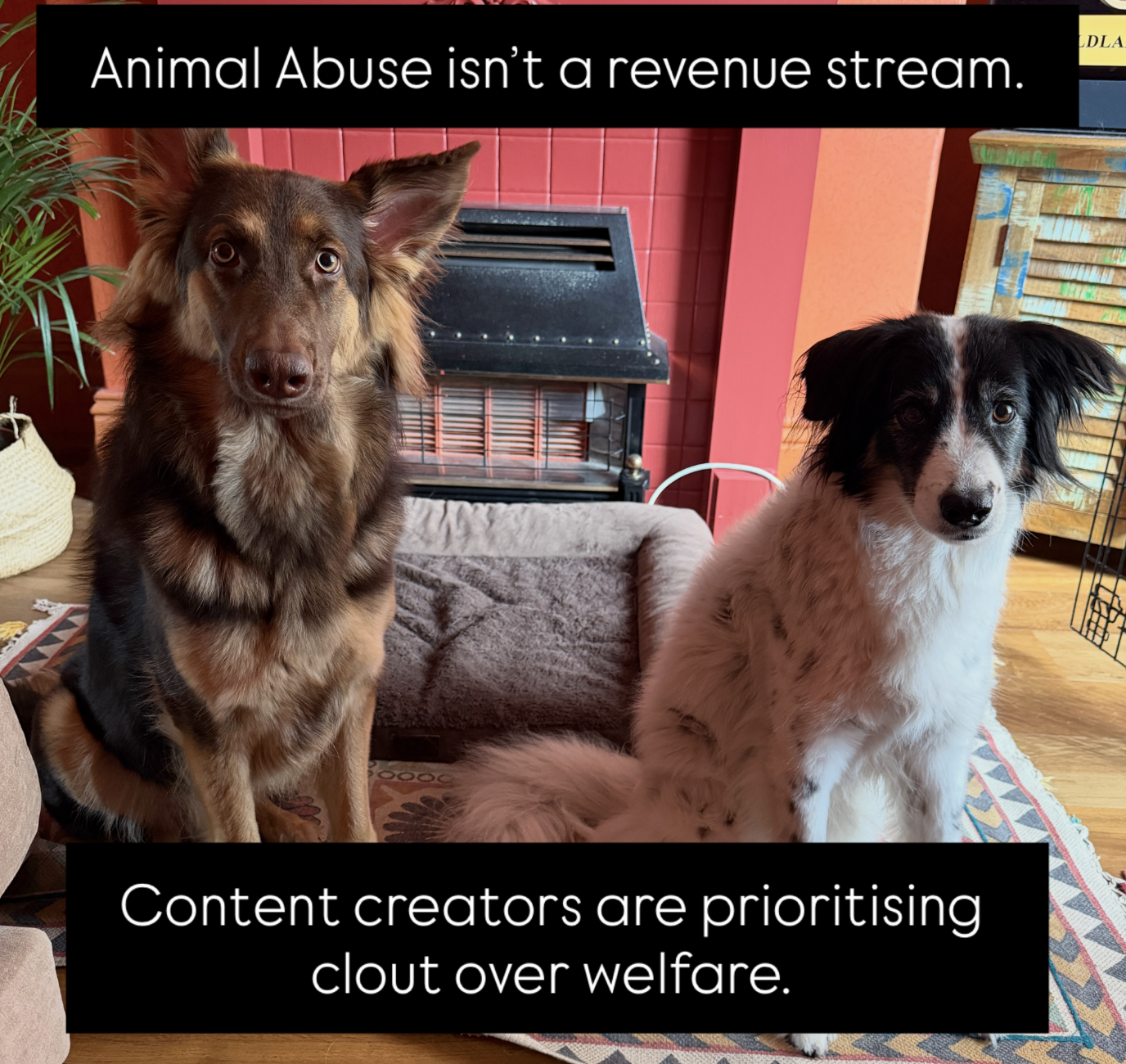
Animals should never have to suffer for someone's views, followers or income.
We are calling on TikTok and other social media platforms to take animal abuse seriously. When credible reports of animal cruelty, neglect or deliberate mistreatment are made, platforms should not simply treat them as ordinary content-moderation disputes.
They should investigate them properly.
And while a serious allegation is being investigated, the creator should not be able to continue financially benefiting from the content that is at the centre of those concerns.
OUR DEMAND IS SIMPLE:
If credible evidence of animal abuse is reported, the platform should have the power to temporarily pause monetisation while the case is investigated.
This should include, where applicable:
• LIVE gifts and donations
• Creator rewards
• Advertising revenue
• Subscriptions
• Affiliate income
• TikTok Shop or other commercial income
• Any other platform-based monetisation connected to the reported content
This would NOT mean automatically declaring someone guilty. It would be a temporary safeguarding measure, just as platforms already use temporary restrictions in other areas while disputes and potential violations are assessed.
If the allegation is found to be unfounded, monetisation can be restored.
If the content is found to violate animal welfare or platform rules, appropriate enforcement can follow.
What should NOT happen is someone continuing to make money from potentially abusive content while that content is being investigated.
WHY IS THIS NECESSARY?
Social media has created an entirely new form of animal entertainment.
Millions of people share their pets online every day, and the overwhelming majority of this content is completely harmless.
We are not asking for animals to be banned from social media.
We are not asking people to stop sharing their pets.
We are not asking platforms to remove every piece of controversial animal content.
We are asking for something much more reasonable:
When there is credible evidence that an animal is being deliberately harmed, neglected, frightened, mistreated or exploited for content, the platform must have a serious process for dealing with it. At present, viewers can report apparent abuse only to receive automated decisions saying that content does not violate community guidelines.
That is not good enough.
A general content moderator may understand hate speech, harassment or copyright infringement. But animal welfare can be much more complicated. What looks like "entertainment" to one person may be deliberate distress, dangerous handling, neglect or cruelty to an animal that has no ability to remove itself from the situation.
Platforms need people and systems capable of recognising that difference.
ANIMAL WELFARE NEEDS ITS OWN REPORTING PATHWAY
We want social media companies to introduce a dedicated Animal Welfare/Animal Abuse reporting category.
Reports should be assessed by moderators with appropriate training and clear guidance on issues such as:
• Deliberate physical harm
• Neglect
• Dangerous or inappropriate handling
• Deliberately causing animals fear or distress
• Withholding food, water or appropriate care
• Forcing animals into dangerous situations for content
• Exploiting sick, injured or vulnerable animals for engagement
• Encouraging animals to fight or behave aggressively
• Repeatedly placing animals at risk to generate views
• Using an animal's suffering or distress as entertainment
Not every allegation will be straightforward. That's precisely why these reports need proper investigation rather than automatic dismissal.
DON'T LET ABUSE BECOME PROFITABLE CONTENT
There is an uncomfortable reality at the centre of this issue. On social media, shocking content generates attention. Attention generates views. Views generate followers. Followers can generate gifts, donations, subscriptions, advertising revenue and other forms of income. That creates a dangerous incentive.
If someone discovers that mistreating an animal attracts millions of views, and that those views can be converted into money, the platform can unintentionally create a financial reward for behaviour that should instead be stopped. An animal's suffering should never become a monetisation strategy. Platforms should not financially incentivise creators to push animal welfare boundaries further and further in pursuit of engagement.
A RECENT EXAMPLE THAT HIGHLIGHTS THE PROBLEM
The situation surrounding a TikTok creator has brought this issue into sharp focus.
There has been extensive publicly available social media footage documenting concerns about the treatment of dogs associated with the creator. Following welfare concerns, the animals were reportedly removed following intervention involving the RSPCA and police. The purpose of highlighting this example is NOT to ask TikTok or members of the public to determine someone's criminal guilt.
It demonstrates a much broader problem:
If serious animal welfare concerns are being investigated in the real world, should the associated social media account still be able to financially benefit from the attention generated by that content?
We believe the answer should be NO. At least temporarily, while credible allegations are investigated. This petition is not asking TikTok to determine someone's criminal guilt. It is asking TikTok to recognise that there is a difference between:
"We don't know whether this person has committed an offence."
and:
"There is credible evidence of potential animal abuse, so we should temporarily prevent anyone from profiting from the disputed content while it is investigated."
That distinction matters.
THIS IS ABOUT PREVENTION, NOT PUNISHMENT
The most important part of this proposal is that a monetisation pause would not have to be permanent. Imagine a system like this:
1) A user reports suspected animal abuse.
They provide the relevant videos, livestreams, dates and information.
2) The report is assessed
A properly trained animal welfare moderation team determines whether the report contains credible evidence requiring further investigation.
3) Monetisation is temporarily paused.
If the allegation meets an appropriate threshold, monetisation connected to the relevant content/account is temporarily suspended.
4) The case is investigated.
The platform assesses the content and, where appropriate, works with relevant animal welfare organisations or law enforcement.
5) A decision is made.
If there is no violation, restrictions can be lifted. If there is a violation, appropriate enforcement can be applied. If there is evidence of serious criminal animal cruelty, the appropriate authorities can be contacted or provided with preserved evidence where legally appropriate.
This protects animals without turning every accusation into an automatic ban.
SOCIAL MEDIA COMPANIES ALREADY KNOW HOW TO RESTRICT MONETISATION
This isn't an impossible technical or commercial demand.
Platforms already have systems for restricting creator features, earnings and commercial activity when content or accounts breach their policies.
We are asking platforms to apply the same principle to credible animal welfare concerns.
If a platform can temporarily restrict someone's ability to earn money because of a suspected policy violation involving commercial content, it can create a mechanism for temporarily protecting animals from financial exploitation too.
THE UK ALREADY RECOGNISES THE SERIOUSNESS OF ANIMAL CRUELTY ONLINE
This isn't simply an issue raised by a handful of concerned viewers. The RSPCA's research found that 43% of 16–17-year-olds surveyed had witnessed animal cruelty online, and the organisation has specifically called on social media companies to take greater responsibility for removing content featuring animal abuse. The organisation has also highlighted the importance of social media platforms responding swiftly to harmful animal abuse content. The problem is therefore not whether animal cruelty exists online. It does. The question is whether platforms are doing enough to stop people from being rewarded for producing it.
WE ARE NOT ASKING FOR A BAN ON ANIMALS IN ENTERTAINMENT
This petition is deliberately NOT calling for animals to be removed from social media.
Animals can appear in:
• Pet videos
• Educational content
• Rescue stories
• Training demonstrations
• Wildlife documentaries
• Family content
• Livestreams
• Entertainment
The issue is welfare.
An animal appearing happily in someone's video is not the problem.
An animal being deliberately distressed, endangered, neglected or abused because the resulting footage attracts attention and money is.
There must be a line.
ANIMALS CANNOT SPEAK FOR THEMSELVES
A human creator can decide not to participate in a livestream.
A human viewer can close the app.
A human employee can leave a workplace.
An animal being filmed cannot make those choices.
It cannot tell millions of viewers:
"Please stop."
It cannot report its owner to TikTok.
It cannot appeal a moderation decision.
It cannot understand why its fear, pain or distress is being broadcast to thousands of people.
The responsibility therefore falls on us.
And that includes the platforms making money from the attention.
WHAT WE WANT TIKTOK AND OTHER PLATFORMS TO DO
We are calling for the following minimum safeguards:
1) DEDICATED ANIMAL ABUSE REPORTING
Create a clear reporting category specifically for suspected animal abuse and welfare violations.
2) TRAINED MODERATION
Ensure serious reports are assessed by appropriately trained moderators rather than being dismissed through generic automated moderation.
3) TEMPORARY MONETISATION SUSPENSION
Where credible evidence indicates potential animal abuse, temporarily suspend monetisation connected to the relevant content/account while the matter is investigated.
4) EVIDENCE PRESERVATION
Where serious allegations are made, preserve relevant content and evidence so that it can be properly assessed and, where legally appropriate, shared with relevant authorities.
5) ESCALATION
Create clear procedures for escalating serious cases to appropriate animal welfare organisations and/or law enforcement.
6) ALGORITHMIC RESPONSIBILITY
Ensure recommendation and monetisation systems do not actively reward increasingly shocking or harmful animal content simply because it generates high engagement.
7) TRANSPARENCY
Give users meaningful information about how animal welfare reports are assessed and what action has been taken.
THIS SHOULD BE THE MINIMUM STANDARD
We don't expect social media companies to become animal welfare enforcement agencies. We don't expect moderators to replace police officers, vets or organisations such as the RSPCA. We simply expect platforms to recognise their responsibility when their own systems are helping turn potentially abusive animal content into entertainment and income.
If a creator is innocent, a temporary investigation can establish that.
If a report is malicious, appropriate safeguards can prevent abuse of the reporting system.
But if credible evidence exists, the platform should not continue handing financial rewards to the person whose content is under serious animal welfare investigation.
SIGN THIS PETITION
If you believe animals deserve protection from exploitation online, please sign this petition.
If you believe someone should not be able to turn an animal's suffering into gifts, views, followers and income, please sign.
If you believe social media companies have a responsibility to protect vulnerable animals appearing on their platforms, please sign.
And if you believe that temporary monetisation suspension during a credible investigation is a reasonable minimum safeguard, please share this petition.
ANIMALS ARE NOT CONTENT.
ANIMAL SUFFERING IS NOT ENTERTAINMENT.
AND CRUELTY SHOULD NEVER BE PROFITABLE.

1,587
The Issue
Animals should never have to suffer for someone's views, followers or income.
We are calling on TikTok and other social media platforms to take animal abuse seriously. When credible reports of animal cruelty, neglect or deliberate mistreatment are made, platforms should not simply treat them as ordinary content-moderation disputes.
They should investigate them properly.
And while a serious allegation is being investigated, the creator should not be able to continue financially benefiting from the content that is at the centre of those concerns.
OUR DEMAND IS SIMPLE:
If credible evidence of animal abuse is reported, the platform should have the power to temporarily pause monetisation while the case is investigated.
This should include, where applicable:
• LIVE gifts and donations
• Creator rewards
• Advertising revenue
• Subscriptions
• Affiliate income
• TikTok Shop or other commercial income
• Any other platform-based monetisation connected to the reported content
This would NOT mean automatically declaring someone guilty. It would be a temporary safeguarding measure, just as platforms already use temporary restrictions in other areas while disputes and potential violations are assessed.
If the allegation is found to be unfounded, monetisation can be restored.
If the content is found to violate animal welfare or platform rules, appropriate enforcement can follow.
What should NOT happen is someone continuing to make money from potentially abusive content while that content is being investigated.
WHY IS THIS NECESSARY?
Social media has created an entirely new form of animal entertainment.
Millions of people share their pets online every day, and the overwhelming majority of this content is completely harmless.
We are not asking for animals to be banned from social media.
We are not asking people to stop sharing their pets.
We are not asking platforms to remove every piece of controversial animal content.
We are asking for something much more reasonable:
When there is credible evidence that an animal is being deliberately harmed, neglected, frightened, mistreated or exploited for content, the platform must have a serious process for dealing with it. At present, viewers can report apparent abuse only to receive automated decisions saying that content does not violate community guidelines.
That is not good enough.
A general content moderator may understand hate speech, harassment or copyright infringement. But animal welfare can be much more complicated. What looks like "entertainment" to one person may be deliberate distress, dangerous handling, neglect or cruelty to an animal that has no ability to remove itself from the situation.
Platforms need people and systems capable of recognising that difference.
ANIMAL WELFARE NEEDS ITS OWN REPORTING PATHWAY
We want social media companies to introduce a dedicated Animal Welfare/Animal Abuse reporting category.
Reports should be assessed by moderators with appropriate training and clear guidance on issues such as:
• Deliberate physical harm
• Neglect
• Dangerous or inappropriate handling
• Deliberately causing animals fear or distress
• Withholding food, water or appropriate care
• Forcing animals into dangerous situations for content
• Exploiting sick, injured or vulnerable animals for engagement
• Encouraging animals to fight or behave aggressively
• Repeatedly placing animals at risk to generate views
• Using an animal's suffering or distress as entertainment
Not every allegation will be straightforward. That's precisely why these reports need proper investigation rather than automatic dismissal.
DON'T LET ABUSE BECOME PROFITABLE CONTENT
There is an uncomfortable reality at the centre of this issue. On social media, shocking content generates attention. Attention generates views. Views generate followers. Followers can generate gifts, donations, subscriptions, advertising revenue and other forms of income. That creates a dangerous incentive.
If someone discovers that mistreating an animal attracts millions of views, and that those views can be converted into money, the platform can unintentionally create a financial reward for behaviour that should instead be stopped. An animal's suffering should never become a monetisation strategy. Platforms should not financially incentivise creators to push animal welfare boundaries further and further in pursuit of engagement.
A RECENT EXAMPLE THAT HIGHLIGHTS THE PROBLEM
The situation surrounding a TikTok creator has brought this issue into sharp focus.
There has been extensive publicly available social media footage documenting concerns about the treatment of dogs associated with the creator. Following welfare concerns, the animals were reportedly removed following intervention involving the RSPCA and police. The purpose of highlighting this example is NOT to ask TikTok or members of the public to determine someone's criminal guilt.
It demonstrates a much broader problem:
If serious animal welfare concerns are being investigated in the real world, should the associated social media account still be able to financially benefit from the attention generated by that content?
We believe the answer should be NO. At least temporarily, while credible allegations are investigated. This petition is not asking TikTok to determine someone's criminal guilt. It is asking TikTok to recognise that there is a difference between:
"We don't know whether this person has committed an offence."
and:
"There is credible evidence of potential animal abuse, so we should temporarily prevent anyone from profiting from the disputed content while it is investigated."
That distinction matters.
THIS IS ABOUT PREVENTION, NOT PUNISHMENT
The most important part of this proposal is that a monetisation pause would not have to be permanent. Imagine a system like this:
1) A user reports suspected animal abuse.
They provide the relevant videos, livestreams, dates and information.
2) The report is assessed
A properly trained animal welfare moderation team determines whether the report contains credible evidence requiring further investigation.
3) Monetisation is temporarily paused.
If the allegation meets an appropriate threshold, monetisation connected to the relevant content/account is temporarily suspended.
4) The case is investigated.
The platform assesses the content and, where appropriate, works with relevant animal welfare organisations or law enforcement.
5) A decision is made.
If there is no violation, restrictions can be lifted. If there is a violation, appropriate enforcement can be applied. If there is evidence of serious criminal animal cruelty, the appropriate authorities can be contacted or provided with preserved evidence where legally appropriate.
This protects animals without turning every accusation into an automatic ban.
SOCIAL MEDIA COMPANIES ALREADY KNOW HOW TO RESTRICT MONETISATION
This isn't an impossible technical or commercial demand.
Platforms already have systems for restricting creator features, earnings and commercial activity when content or accounts breach their policies.
We are asking platforms to apply the same principle to credible animal welfare concerns.
If a platform can temporarily restrict someone's ability to earn money because of a suspected policy violation involving commercial content, it can create a mechanism for temporarily protecting animals from financial exploitation too.
THE UK ALREADY RECOGNISES THE SERIOUSNESS OF ANIMAL CRUELTY ONLINE
This isn't simply an issue raised by a handful of concerned viewers. The RSPCA's research found that 43% of 16–17-year-olds surveyed had witnessed animal cruelty online, and the organisation has specifically called on social media companies to take greater responsibility for removing content featuring animal abuse. The organisation has also highlighted the importance of social media platforms responding swiftly to harmful animal abuse content. The problem is therefore not whether animal cruelty exists online. It does. The question is whether platforms are doing enough to stop people from being rewarded for producing it.
WE ARE NOT ASKING FOR A BAN ON ANIMALS IN ENTERTAINMENT
This petition is deliberately NOT calling for animals to be removed from social media.
Animals can appear in:
• Pet videos
• Educational content
• Rescue stories
• Training demonstrations
• Wildlife documentaries
• Family content
• Livestreams
• Entertainment
The issue is welfare.
An animal appearing happily in someone's video is not the problem.
An animal being deliberately distressed, endangered, neglected or abused because the resulting footage attracts attention and money is.
There must be a line.
ANIMALS CANNOT SPEAK FOR THEMSELVES
A human creator can decide not to participate in a livestream.
A human viewer can close the app.
A human employee can leave a workplace.
An animal being filmed cannot make those choices.
It cannot tell millions of viewers:
"Please stop."
It cannot report its owner to TikTok.
It cannot appeal a moderation decision.
It cannot understand why its fear, pain or distress is being broadcast to thousands of people.
The responsibility therefore falls on us.
And that includes the platforms making money from the attention.
WHAT WE WANT TIKTOK AND OTHER PLATFORMS TO DO
We are calling for the following minimum safeguards:
1) DEDICATED ANIMAL ABUSE REPORTING
Create a clear reporting category specifically for suspected animal abuse and welfare violations.
2) TRAINED MODERATION
Ensure serious reports are assessed by appropriately trained moderators rather than being dismissed through generic automated moderation.
3) TEMPORARY MONETISATION SUSPENSION
Where credible evidence indicates potential animal abuse, temporarily suspend monetisation connected to the relevant content/account while the matter is investigated.
4) EVIDENCE PRESERVATION
Where serious allegations are made, preserve relevant content and evidence so that it can be properly assessed and, where legally appropriate, shared with relevant authorities.
5) ESCALATION
Create clear procedures for escalating serious cases to appropriate animal welfare organisations and/or law enforcement.
6) ALGORITHMIC RESPONSIBILITY
Ensure recommendation and monetisation systems do not actively reward increasingly shocking or harmful animal content simply because it generates high engagement.
7) TRANSPARENCY
Give users meaningful information about how animal welfare reports are assessed and what action has been taken.
THIS SHOULD BE THE MINIMUM STANDARD
We don't expect social media companies to become animal welfare enforcement agencies. We don't expect moderators to replace police officers, vets or organisations such as the RSPCA. We simply expect platforms to recognise their responsibility when their own systems are helping turn potentially abusive animal content into entertainment and income.
If a creator is innocent, a temporary investigation can establish that.
If a report is malicious, appropriate safeguards can prevent abuse of the reporting system.
But if credible evidence exists, the platform should not continue handing financial rewards to the person whose content is under serious animal welfare investigation.
SIGN THIS PETITION
If you believe animals deserve protection from exploitation online, please sign this petition.
If you believe someone should not be able to turn an animal's suffering into gifts, views, followers and income, please sign.
If you believe social media companies have a responsibility to protect vulnerable animals appearing on their platforms, please sign.
And if you believe that temporary monetisation suspension during a credible investigation is a reasonable minimum safeguard, please share this petition.
ANIMALS ARE NOT CONTENT.
ANIMAL SUFFERING IS NOT ENTERTAINMENT.
AND CRUELTY SHOULD NEVER BE PROFITABLE.
The Decision Makers

Supporter Voices
Petition Updates
Share this petition
Petition created on 28 August 2026