
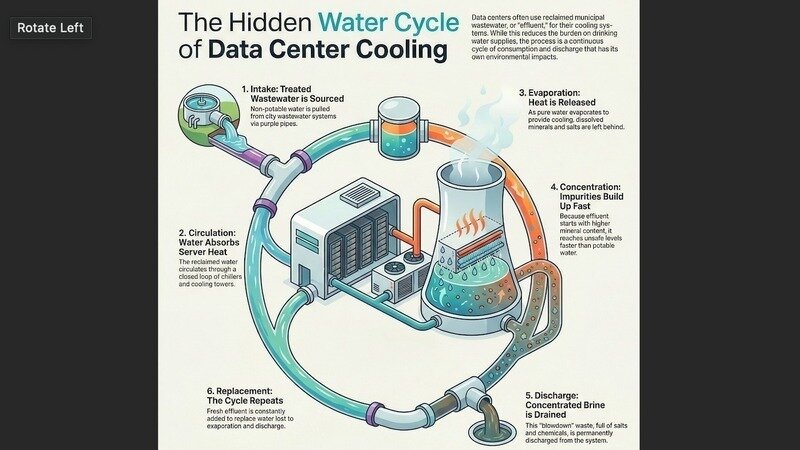
Let’s Clear Up a Big Misunderstanding About Data Centers & Water
A lot of people hear “closed-loop cooling” and assume it means no water use. That’s not how most data centers actually work.
Here’s the simple, honest breakdown
A “closed-loop” system does NOT mean water-free.
It means the same water is reused inside the system — but heat still has to be released somewhere, and that usually happens through evaporation.
What really happens in a closed-loop system (even using effluent):
• Water (often reclaimed/effluent) is pulled from the utility
• It circulates through chillers and cooling towers to absorb server heat
• Heat is removed by evaporation in cooling towers
• Minerals and salts concentrate
• Blowdown/brine is discharged to protect equipment
• New water is constantly added to replace what evaporated and discharged
Even with reclaimed water, water is consumed every day, 24/7.
Important distinction
Using effluent is better than using drinking water — but it is not free, unlimited, or impact-free.
Effluent supplies are tied to population size, wastewater output, and treatment capacity.
The only systems that avoid evaporation almost entirely:
• Fully air-cooled facilities (very energy-intensive, difficult in South Texas heat)
• Full immersion cooling (rare, expensive, not common at large scale)
If a project truly used one of these, it would usually be clearly advertised — because it’s a major selling point.
Why this matters for the Rio Grande Valley
For the data centers proposed in Cameron County and nearby areas, the cooling system has not been clearly disclosed.
But there’s a critical clue:
Harlingen Waterworks has been referenced as supplying up to 5 million gallons per day.
That level of demand strongly suggests:
• Evaporative cooling towers, or
• Hybrid wet/dry systems, or
• Infrastructure sized for future large-scale expansion
All of those use water daily, even if labeled “closed loop.”
Context matters
The RGV already faces:
• Low reservoir levels
• Ongoing drought risk
• Heavy reliance on the Rio Grande
• Aging water infrastructure
A 24/7 facility using millions of gallons per day adds permanent demand to an already stressed system.
It’s a basic, reasonable ask:
What cooling system will be used, how much water will it consume today and at full build-out, and how does that fit into the Valley’s long-term water reality?
Transparency matters — especially when resources are limited.