
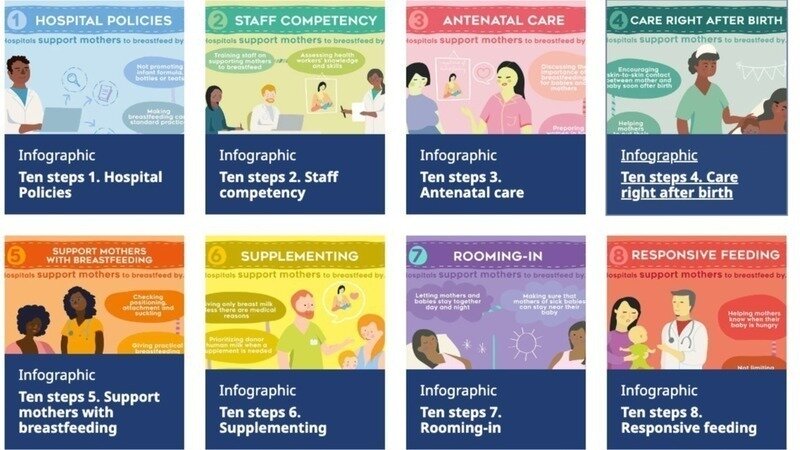
It is quite some time that we have been able to communicate with you-all the supporters who have kindly helped the petition grow. We are now beginning to update you and introduce a new angle to the ongoing work that helps to reduce and minimise the use of infant formula to the newborn. We aim that there shall be no unnecessary use of commercial infant formula. In this work we would need your continued support. This update is about the standard of care created by the global health agencies.
Ten steps to successful breastfeeding
WHO and UNICEF launched the Baby-friendly Hospital Initiative (BFHI) in 1991 to help motivate facilities providing maternity and newborn services worldwide to implement the Ten Steps to Successful Breastfeeding. The Ten Steps summarize a package of policies and procedures that facilities providing maternity and newborn services should implement to support breastfeeding.
We have branded the work in India as "Breastfeeding Friendly Hospitals" to be more specific and a focus on early breastfeeding during hospital stay. In coming days we will update you on how it works and what you can do. We will try and explain each of the Step and the tools we have created to implement these steps.
According to WHO "There is substantial evidence that implementing the Ten Steps significantly improves breastfeeding rates. A systematic review of 58 studies on maternity and newborn care published in 2016 demonstrated clearly that adherence to the Ten Steps impacts early initiation of breastfeeding immediately after birth, exclusive breastfeeding and total duration of breastfeeding".
It has two parts: A and B
A. Critical management procedures:
1a. Comply fully with the International Code of Marketing of Breast-milk Substitutes and relevant World Health Assembly resolutions.
1b. Have a written infant feeding policy that is routinely communicated to staff and parents.
1c. Establish ongoing monitoring and data-management systems.
2. Ensure that staff have sufficient knowledge, competence and skills to support breastfeeding.
B. Key clinical practices:
3. Discuss the importance and management of breastfeeding with pregnant women and their families.
4. Facilitate immediate and uninterrupted skin-to-skin contact and support mothers to initiate breastfeeding as soon as possible after birth.
5. Support mothers to initiate and maintain breastfeeding and manage common difficulties.
6. Do not provide breastfed newborns any food or fluids other than breast milk, unless medically indicated.
7. Enable mothers and their infants to remain together and to practise rooming-in 24 hours a day.
8. Support mothers to recognize and respond to their infants’ cues for feeding.
9. Counsel mothers on the use and risks of feeding bottles, teats and pacifiers.
10. Coordinate discharge so that parents and their infants have timely access to ongoing support and care.