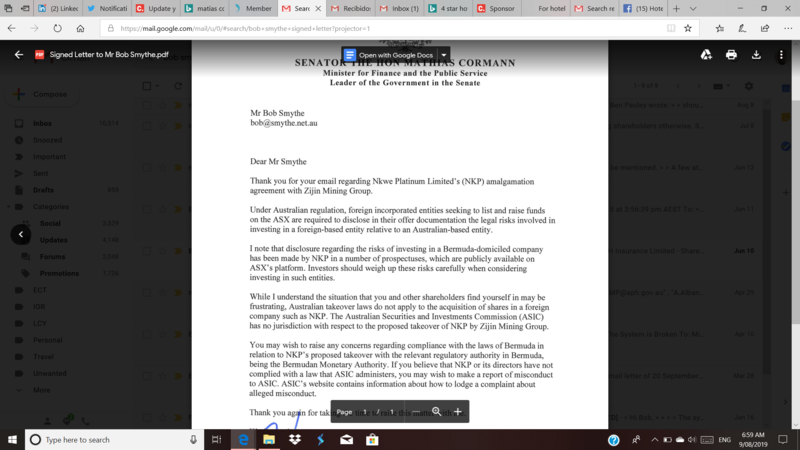
Email from NKP shareholder to Mathias Cormann

Federal Finance Minister, Hon Mathias Cormann .
With respect, your intervention is required in the current takeover of NKP (listed on the ASX) by the Chinese company Zijin in a manner that will seriously financially disadvantage the Australian minority shareholders. The need to escalate this matter to your jurisdiction is necessary because the ASX and ASIC do not have the desire to intervene on behalf of the those shareholders.
For the purpose of this email, the functions of your office, ASIC and ASX will be referred to as ‘The System’. which is broken. The cause and effect of the problem is briefly addressed below.
Background
I am aged 74 years and began acquiring Nkwe Platinum Limited (NKP) shares in my SMSF in 2006/07. NKP was selected after considerable research and consultation with friends and brokers NKP was listed on the Australian Stock Exchange. The attraction of NKP was the location of the assets, its stage in the development life cycle which meant that when I retired it would be delivering a dividend similar to other platinum producers in RSA and be the back bone of my portfolio investments. Over the years I acquired 1,537,440 shares at a total base cost of circa $650k. If the shares were sold today I would recoup about $135k. Regrettably, my risk assessment which was done before buying NKP did not take into consideration the likelihood of corruption, mis management, the GFC (which slowed down the development cycle), business conflicts, the non compliance with ASX rules, and the inability or a lack of willingness by the ‘regulators’ (ASX and ASIC) to ensure that NKP operated efficiently, honestly and fairly. In recent years, the Chinese company Zijin has acquired though dubious/questionable transactions a majority holding in NKP (evidence is available to support those statements) and is now planning to use Bermudian Law to force a takeover of the minority shareholders who collectively hold some 27% of more of NKP. While company takeovers are common practice the expectation of shareholders is that they will receive a fair price for their shares. Zijin has offered 10c/share which is not only unfair but unreasonable. They recently recruited two supposedly independent directors (Australian), with no input from shareholders, who are now being used to state that the Zijin offer of 10c/share is fair and reasonable.
Cause
The Royal Commission into Misconduct in the Banking, Superannuation and Financial Services Industry that was established on 14 December 2017 should have included the Australian Stock Exchange. Many companies and, in particular, those involved in takeovers use what I call ‘legal theft’ - the use of tactics that are deemed to be legitimate to acquire an asset to which they are either not entitled or have not been justified. The use of bonuses is a classic tactic as has been demonstrated by the Banks during the Royal Commission. ASX companies frequently issue millions/billions of shares at a fraction of a cent to dilute the percentage holdings of existing shareholders. Post the takeover, consolidations occurs. The use of robotic trading and short selling are other tactics used to ‘rob’ shareholders. In the case of Zijin, they plan to use Bermudian Law and not abide by their ASX/Corporations Act obligations. I also understand that Zijin, using Australian lawyers, have threatened to sue the ASX if they intervene on behalf of the minority shareholders which may explain their reluctance to get involved and offer as a justification this statement: "We exercise our discretion to select matters for further action to ensure that we direct our finite resources appropriately.”
It is my understanding that under the ASIC Act, ASIC has the role and powers to enforce and regulate company and financial services laws to protect Australian consumers, investors and creditors. It also has powers to protect consumers against misleading or deceptive and unconscionable conduct affecting all financial products and services, including credit. Yet, despite numerous requests from many shareholders, ASIC and the ASX see the actions of Zijin as being outside their jurisdiction. Does that mean that all companies listed on the ASX but incorporated and domiciled in Bermuda or any other tax haven are not subject or required to comply with the Corporations Act or be subject to any of the Australian regulatory rules that protect Australian shareholders/investors. If that is case, then that loop hole surely encourages companies to follow the example of Nkwe. It is apparent that ASIC does not regulate ASX which is the view promoted by the Government. The latest Memorandum of Understanding (MOU) recognises that ASIC and ASX have complementary roles and sets out the expectations in relation to the supervisory activities that each party is required to undertake to meet their statutory obligations. The document was clearly written by lawyers sitting down together to ensure minimum respective accountability. The MOU covers the working relationship and only in terms of "guiding principles, so it does not define any enforceable rights, any legally binding obligations or agreement".
The financial system has five regulatory bodies whose responsibilities overlap but seemingly, individually and collectively, they do have the powers to protect consumers against misleading or deceptive and unconscionable conduct affecting all financial products and services, including credit. Yet when asked to exercise those powers the Australian shareholder is told that nothing can be down because the Chinese company is allowed to use Bermudan Law yet remains listed and operate on the ASX. The current financial services regulator system is not meeting its obligations by not providing support to the Australian NKP shareholders, hence the view that the System is broken.
Effect
Should Zijin be allowed to by-pass the Australian Regulators including the ASX and the Corporations Act, then some 460 shareholders will lose many millions of dollars with the likely impact that some will be required to seek pension payment from the Federal Government. Investors will continue to lose: faith in the integrity, efficiency and honesty of the ASX operations; the regulatory role of the ASIC; and, in the Government's ability to provide the laws that look after the rights of Australian investors when confronted by unethical Chinese companies.
Summary
There are many claims made in this email. Should further evidence be required there is a NKP Minority Shareholder Action Group that is acting as a united group to collectively combat the unacceptable takeover strategies now being used by Zijin and, prima facie, the evidence covers ethics violations, business conflicts, potential criminal acts, and flagrant lying. The inaction by the ASX and ASIC to assist and help reduce the significant financial losses being incurred by the minority NKP shareholders is unacceptable and needs to be redressed by your office.
Recommendations
The recommendations are:
1. You advise ASIC/ASX that the Government’s expectations are that the legitimate concerns of the NKP minority shareholders must be addressed and supported by any required resources and that the outcomes of the NKP/Zijin issues are resolved fairly through mutually acceptable compensation; and
2. Consideration be given to stream lining the Regulatory and Financial Systems so that intentions, expectations, overlapping responsibilities etc etc are replaced by sound policies, objectives and meaningful ‘rules and metrics’ and that any changes are given to system stakeholders (investors and consumers) to ensure that the new system does promote confidence, respect and
fairness to all system users.
Thank you for your time and consideration to this email,