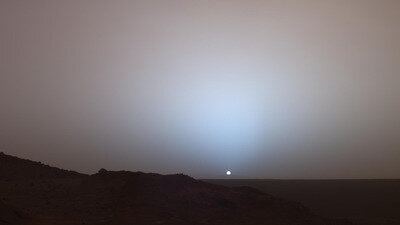

Start Mars Year 1 with The Martian Chronicles, not a dust storm
The Issue
Every calendar begins with a story. The Martian calendar should too.
The current Mars Year epoch, 11 April 1955, was chosen for a practical reason: to place the 1956 global dust storm within MY 1. It marks no event of lasting significance for how humanity imagines Mars. The Martian Chronicles (1950) is one of the works that shaped that imagination, inspiring generations of readers, engineers, and scientists.
For many of us, Mars first became a place through Bradbury's pages, with its cities, its loneliness, and a future worth traveling toward. The missions that now map its surface were built, in part, by people who grew up on stories like these. Rovers and orbiters are the work of engineering, but the wish to send them came from somewhere, and for a great many people it came from a book.
How the convention works today
Mars Year numbering counts Martian years of about 687 Earth days, each beginning when Mars reaches the northern spring equinox (Ls = 0°). The system was proposed in a 2000 paper and spread because researchers and data teams adopted it. No treaty, agency, or standards body governs it. That is what makes this petition possible: a convention based on agreement can be improved by agreement.
Who we are asking
We are asking the community that uses the convention: planetary scientists, mission and data teams, the developers of Mars models and tools, and the forums and journals where Mars science is discussed. We ask you to consider moving the epoch to 1950, or at least to open a discussion about how the epoch should be chosen.
What we propose
- Mars Year 1 begins at the northern summer solstice (Ls = 90°) of 1950, on 6 March 1950 (approximately 04:50 UTC);
- Mars Year 1 would last about 687 Earth days, until 22 January 1952. The publication of The Martian Chronicles (4 May 1950) falls inside Mars Year 1, just as the 1956 dust storm falls inside Mars Year 1 in the current convention.
Why now
The convention is only about 25 years old and rests on agreement, not on any physical law. Before crewed missions make the calendar part of daily life, changing it will never be cheaper. Every new dataset, paper, and mission that uses the current numbering makes a later change harder.
A planet's calendar can honor both its science and the imagination that led us there. Other human calendars begin with events that people found meaningful, and a Mars Year 1 that contains the book that taught the world to dream of Mars would say something true about how we got here.
Sign if you think Mars deserves a calendar with a story at its beginning.

13
The Issue
Every calendar begins with a story. The Martian calendar should too.
The current Mars Year epoch, 11 April 1955, was chosen for a practical reason: to place the 1956 global dust storm within MY 1. It marks no event of lasting significance for how humanity imagines Mars. The Martian Chronicles (1950) is one of the works that shaped that imagination, inspiring generations of readers, engineers, and scientists.
For many of us, Mars first became a place through Bradbury's pages, with its cities, its loneliness, and a future worth traveling toward. The missions that now map its surface were built, in part, by people who grew up on stories like these. Rovers and orbiters are the work of engineering, but the wish to send them came from somewhere, and for a great many people it came from a book.
How the convention works today
Mars Year numbering counts Martian years of about 687 Earth days, each beginning when Mars reaches the northern spring equinox (Ls = 0°). The system was proposed in a 2000 paper and spread because researchers and data teams adopted it. No treaty, agency, or standards body governs it. That is what makes this petition possible: a convention based on agreement can be improved by agreement.
Who we are asking
We are asking the community that uses the convention: planetary scientists, mission and data teams, the developers of Mars models and tools, and the forums and journals where Mars science is discussed. We ask you to consider moving the epoch to 1950, or at least to open a discussion about how the epoch should be chosen.
What we propose
- Mars Year 1 begins at the northern summer solstice (Ls = 90°) of 1950, on 6 March 1950 (approximately 04:50 UTC);
- Mars Year 1 would last about 687 Earth days, until 22 January 1952. The publication of The Martian Chronicles (4 May 1950) falls inside Mars Year 1, just as the 1956 dust storm falls inside Mars Year 1 in the current convention.
Why now
The convention is only about 25 years old and rests on agreement, not on any physical law. Before crewed missions make the calendar part of daily life, changing it will never be cheaper. Every new dataset, paper, and mission that uses the current numbering makes a later change harder.
A planet's calendar can honor both its science and the imagination that led us there. Other human calendars begin with events that people found meaningful, and a Mars Year 1 that contains the book that taught the world to dream of Mars would say something true about how we got here.
Sign if you think Mars deserves a calendar with a story at its beginning.
The Decision Makers

Petition Updates
Share this petition
Petition created on October 6, 2026