
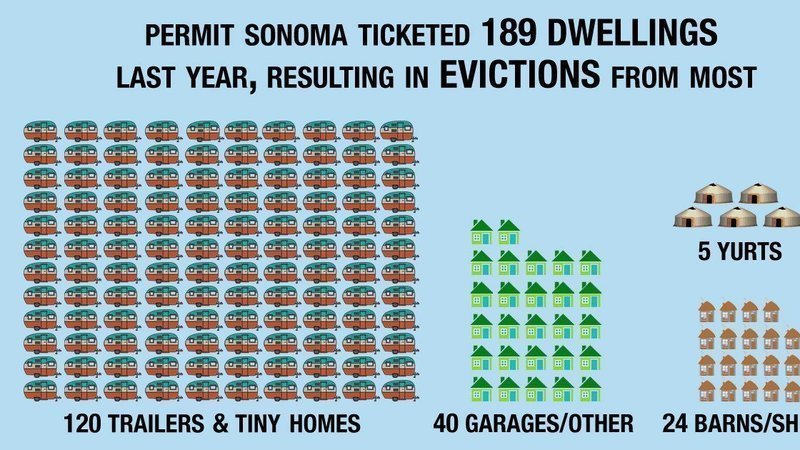
We may finally be on the verge of a breakthrough in curbing Permit Sonoma’s senseless evictions of 200 people living safely in trailers, tiny homes, and other simple and affordable housing every year
Next Tuesday, April 5 at about 11 am, our Board of Supervisors will discuss solutions to a dysfunctional code enforcement policy that forces twice as many people into homelessness as Sonoma County spends $20 million per year acquiring housing for.
In response to the petition that you signed (thank you!) and an outpouring of grassroots support from citizens and housing rights organizations Staff has, for the first time ever, provided supervisors with these meaningful options to stop county code enforcement from evicting low income people, many of them seniors, from the only homes they can afford.
Included in these options is an emergency ordinance similar to one that allows fire victims to legally live in trailers and RV’s. If approved, this would allow people living in alternative housing to stay in their homes as long as there is a housing crisis in the county.
In order for this urgency ordinance to be passed by a majority of the board, a major expression of support for our neighbors living in alternative housing will be needed during the Board meeting on April 5th.
An email to your supervisor is helpful (see below), but even more helpful would be joining others to speak for one minute over zoom during public testimony of Agenda item #49, which will take place between 11 am and 2 pm on Tuesday, April 5.
Click here to follow and join the Board of Supervisors Zoom meeting on April 5. We have provided a few proposed talking points below. If you would like us to email you on Tuesday when public comment begins, please email us at campaigns@progressivesource.com
If you can’t make a public comment but would like to help, please call your supervisor at (707)565-2241 and urge her or him to vote for a far reaching urgency ordinance that will protect thousands of our unpermitted neighbors.
Or email all the County Supervisors and tell them where you live and a few sentences on how you feel about this and why. You can email them all at once and let us know you have done so by pasting these addresses into an email:
Susan.Gorin@sonoma-county.org, Arielle.Kubu-Jones@sonoma-county.org, David.Rabbitt@sonoma-county.org, Andrea.Krout@sonoma-county.org, Chris.Coursey@sonoma-county.org, sean.hamlin@sonoma-county.org, district4@sonoma-county.org, jchamber@sonoma-county.org, district5@sonoma-county.org, Leo.Chyi@sonoma-county.org, campaigns@progressivesource.com (this cc would allow us to have a record of the number of supportive emails).
Talking points:
- I object that my government uses my tax dollars and legal authority to enforce a dysfunctional, inhumane code enforcement system that pushes 200 safely housed low income renters, many of them seniors, to become homeless for their own “health and safety.” Homeless living is NOT safe living!
- Please pass an urgency ordinance today to protect people living safely and happily in RV’s and tiny homes.
- This ordinance can be modeled on the temporary housing ordinances that allow fire victims, caregivers, and farmworkers to live in travel trailers and RV’s on private property.
- Extend Appendices O and X of the California Residential and Building Codes to private property so that people can live in alternative housing during this ongoing housing and homelessness crisis.
- If supervisors choose to allow Permit Sonoma’s eviction war on the poor to continue, you are likely to waste millions of our tax dollars fighting a federal housing rights lawsuit defending a shameful policy that I do not support. During this housing emergency, why would you choose to do this instead of protecting low income renters?
Please implement and model a positive solution, not the powerless perpetuation of a dysfunctional, inhumane system that doesn't reflect our values. After passing an urgency ordinance to protect people today, the county needs to begin the challenging work of making sure that these same homes are legalized on a permanent, non-emergency basis.