The Campaign Continues!

Hi everyone!
The campaign continues! We are now at 3958 signatures – so so close to 4000! Do please share this if you haven’t already. This represents nearly 20% of Alton’s population! A wonderful achievement.
Grateful thanks to the Alton Herald for their unstinting support in publishing our campaign articles. Here’s the link to the latest one from 2 December. https://tinyurl.com/CPFarticle2Dec It’s also copied and pasted below for those who’d like to read it.
News.....News.....News.....News....
East Hampshire District Council will be delaying the Local Plan Public Consultation (Reg 19) until Autumn 2022. This is not something they would enter into lightly. Does this extension to the timetable and the fact that “additional evidence and research will be required for more site options” give us hope?
EHDC tell us that clarification of an updated timetable will be forthcoming in early 2022.
They also need the extra time for something that our umbrella organisation, The Alton Society is a strong supporter of: to include in the Local Plan their demand that developers build zero-carbon homes – which if approved by the Inspector in 2023, will “empower the council to demand that all new developments are energy efficient, zero-carbon homes that are clean and cost-effective”.
Also “A six-week public consultation on the environmental improvements to the current Local Plan will begin before the end of the year”.
See the Alton Society’s article in support here https://tinyurl.com/Article27Nov or here in the Alton Herald https://tinyurl.com/AHarticle27Nov
Meanwhile we must continue to exert pressure on East Hampshire District Council and will continue to do so until Chawton Park Farm is taken out of their Spatial Strategy and the Local Plan.
Thank you as ever for all your support and interest in our campaign.
saynotochawtonparkfarm@gmail.com
Here is the article from 2 Dec but without the photos.
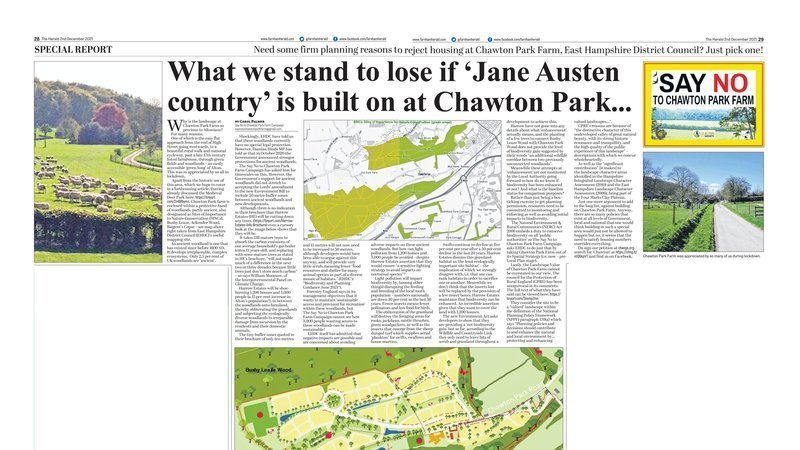
What we Stand to Lose if ‘Jane Austen Country’ is built on at Chawton Park
Why is the landscape at Chawton Park Farm so precious to Altonians? For many reasons. One of which is the easy flat approach from the end of High Street going westwards, to a beautiful rural walk and national cycleway, past a late 17th century listed farmhouse, through green fields and woodlands – an easily accessible ‘green lung’ of Alton. This was so appreciated by us all in lockdown.
Apart from the historic use of this area, which we hope to cover in a forthcoming article, (having already discussed the Medieval Deer Park here https://tinyurl.com/2n49fbym , Chawton Park farm is enclosed within a protective band of woodlands, partly ancient, also designated as Sites of Importance to Nature Conservation (SINCs), Bushy Leaze, Ackender Wood, Baigent’s Copse – see map below taken from East Hampshire District Council (EHDC)’s useful mapping site http://maps.easthants.gov.uk/easthampshire.aspx
East Hampshire District Council © 2021
An ancient woodland is one that has existed since before 1600 AD. It develops irreplaceable, complex ecosystems. Only 2.5% of UK woodlands are ‘ancient’. Shockingly EHDC have told us that these woodlands currently have no special legal protection. However, Damian Hinds MP has told us that in October 2020 the Government announced stronger protections for Ancient Woodlands. The Say No to Chawton Park Farm Campaign has asked him for timescales on this. However, the Government’s support for Ancient Woodlands did not stretch to accepting the Lords’ amendment to the new Environment Bill to include 50m buffer zones between Ancient Woodlands and new developments.
Although there is no indication in their brochure that Harrow Estates (HE) will be cutting down any trees, (https://tinyurl.com/Harrow-Estates-Info-Brochure even a cursory look at the image below shows that they will be. It takes 138 mature trees to absorb the carbon emissions of one average household’s gas boiler, and replacing with semi-mature trees (c15 years old) as stated in HE’s brochure
“will not make much of a difference in the next two or three decades because little trees just don’t store much carbon” quote from William Moomaw, of the Intergovernmental Panel on Climate Change.
Harrow Estates will be shoehorning 1200 houses and 3000 people (a 15% increase in Alton’s population!), in between the woodlands onto farmland (see graphic below), thereby obliterating the grasslands and subjecting the ecologically diverse woodlands to irreparable damage from incursion by the residents and their domestic animals. The tiny buffer zones quoted in their brochure of only 10m and 15m will not now need to be increased to 50m (see above), although developers would have been able to argue against this anyway, and will provide very little scrub, meaning fewer “food resources and shelter for many animal species as part of a diverse mosaic of habitats.” (Quote from EHDC’s “Biodiversity and Planning Guidance June 2021”.)
Harrow Estates ©2018 (note: author has merged images on pages 6 & 7 of brochure for clarity)
Forestry England says in its management objectives that it wants to maintain ‘sustainable access and provision for recreation’ within these woodlands, but The Say No to Chawton Park Farm Campaign cannot see how 3000 people wanting access to these woodlands can be made sustainable!
EHDC itself has admitted that negative impacts are possible and are concerned about avoiding adverse impacts on these Ancient Woodlands. But how can light pollution from 1200 homes and 3000 people be avoided - despite Harrow Estates assertion that they would ensure ‘a sensitive lighting strategy to avoid impacts on nocturnal species’? Light pollution will impact biodiversity by, (amongst other things) disrupting the feeding and breeding of the local moth population - numbers nationally are down 30% in the last 50 years. Fewer insects means fewer pollinators and less food for birds.
The obliteration of the grassland will destroy the foraging areas for Rooks , Jackdaws, Mistle Thrushes, Green Woodpeckers, as well as the insects that emerge from the sheep dunged turf which supplies aerial ‘plankton’ for swifts, swallows and house martins. Swifts continue to decline at 5% per year after a 50% decline in the last 20. Harrow Estates dismiss this grassland habitat as ‘the least ecologically important site habitat’ – the implication of which we strongly disagree with, i.e. that one can rank habitats in order to sacrifice one or another. Meanwhile we don’t think that the insects lost will be replaced by the provision of a few insect boxes.
Harrow Estates maintains that biodiversity can be enhanced. An incredible assertion given that they want to cover the land with 1200 houses. The new Environment Act asks Developers to show that they are providing a ‘net biodiversity gain’ but so far, according to the Wildlife and Countryside Link they only need to leave bits of scrub and grassland throughout a development to achieve this. Harrow have not gone into any details about what ‘enhancement’ actually means, and the planting of a few trees to connect Bushy Leaze Wood with Chawton Park Wood (see image above) does not to us provide the level of biodiversity gain suggested by their words “an additional wildlife corridor between two previously unconnected woodlands”. Meanwhile these attempts at ‘enhancement’ are not monitored by the Local Authority going forward so how do we know if biodiversity has been enhanced or not? And what is the baseline status for comparison purposes? Rather than just being a box-ticking exercise to get planning permission, resources need to be committed to monitoring and enforcing as well as avoiding initial impacts to biodiversity.
The Natural Environment & Rural Communities (NERC) Act 2006 embeds a duty to conserve biodiversity on all ‘public authorities’ so The Say No to Chawton Park Farm Campaign asks EHDC to do just that by taking Chawton Park Farm out of its Spatial Strategy (i.e. now - pre Local Plan stage).
Lastly, the Landscape Value of Chawton Park Farm cannot be overstated in our view. The Council for the Protection of Rural England (CPRE) has been unequivocal in its comments. The full text of what they have said can be viewed here: https://tinyurl.com/2exmp7mn They consider the Site to be a "valued" landscape within the definition of the National Planning Policy Framework (NPPF) paragraph 170(a) which says ‘Planning policies and decisions should contribute to and enhance the natural and local environment by…protecting and enhancing valued landscapes…’. CPRE’s reasons are because of “the distinctive character of this undeveloped valley of great natural beauty, with its strong historic resonance and tranquillity, and the high quality of the public experience of this landscape” – descriptions with which we concur wholeheartedly. As well as the “significant contribution [it makes] to the landscape character areas identified in the Hampshire Integrated Landscape Character Assessment (2010) and the East Hampshire Landscape Character Assessment (2006), being part of the Four Marks Clay Plateau.
Just one more argument to add to the long list, against building on Chawton Park Farm
Anyway there are so many policies that exist at all levels of Government, local and national that one would think building in such a special area would just not be allowed to happen but no, it seems that the need to satisfy housing numbers overrides everything.
saynotochawtonparkfarm@gmail.com