She Should Still Be Here: Pass TATU’s Law in St. Louis
The Issue
Mayor of St. Louis, St. Louis City Council, City Departments, Local Policy Leaders, and Community Stakeholders
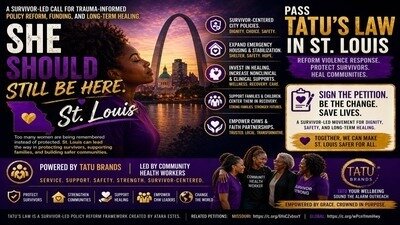
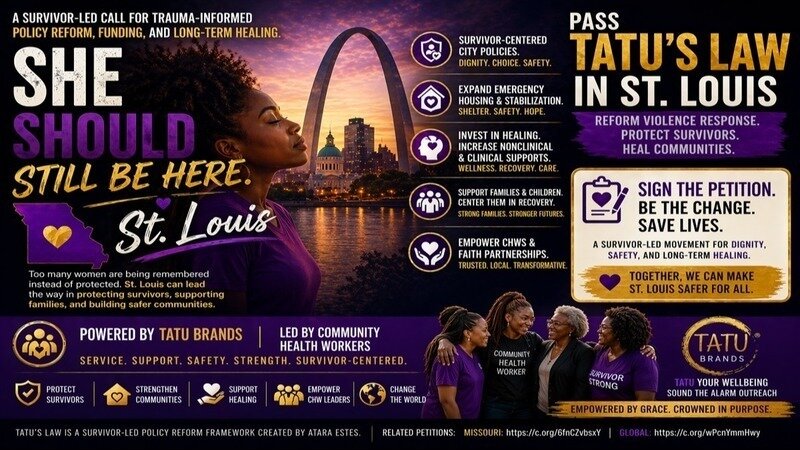
She should still be here.
In our communities and across our nation, women are losing their lives to preventable acts of violence connected to domestic abuse and access to firearms.
This is not random. This is preventable.
We honor the lives of women who were leaders, mothers, healers, and pillars in their communities:
Nancy Metayer Bowen
Cerina Fairfax
Barbara Deer
Tammy McCollum
Their lives reflect a painful truth:
Too many women are being remembered instead of protected.
Why This Matters in St. Louis
Violence response systems in St. Louis continue to fail survivors of domestic, dating, gender-based, and gun violence—not because help does not exist, but because policies, funding priorities, and coordination remain fragmented, reactive, and harmful.
Survivors are often forced to navigate:
- Unsafe or retraumatizing systems
- Limited shelter access and long waitlists
- Crisis-driven responses without long-term support
- Barriers to safety when violence escalates
Children and families supporting survivors are frequently left without the emotional, financial, and community-based resources needed for recovery.
As a survivor of domestic violence and gun violence, I understand this reality personally.
I am here because I survived. Many women do not get that chance.
The Urgent Reality We Cannot Ignore
When systems are not coordinated and trauma-informed, survivors are left vulnerable.
When intervention is delayed, violence escalates.
When support is fragmented, healing is disrupted.
These gaps cost lives.
This Is Why TATU’s Law Is Necessary in St. Louis
St. Louis does not need more disconnected systems.
It needs alignment, coordination, and survivor-centered reform.
This petition calls for local policy reform that centers dignity, safety, and long-term healing—while strengthening the organizations, shelters, and community partnerships already doing the work.
What Is TATU’s Law
TATU’s Law is a survivor-led, trauma-informed policy reform framework created by Atara Estes, a survivor of domestic violence and gun violence and a community health and advocacy leader in St. Louis.
TATU’s Law does not create new systems or duplicate services.
It calls for:
- Reforming existing policies
- Aligning funding priorities
- Strengthening partnerships across systems
So survivors are protected, supported, and not retraumatized by the very systems meant to help them.
This is not a service program.
It is a policy and funding reform model rooted in lived experience.
Why the Semicolon Matters
In grammar, a semicolon is used when an author could have ended a sentence—but chose not to.
TATU’s Law carries that same meaning.
This framework was born from a life that could have ended—but did not.
For survivors of violence, the semicolon represents something sacred:
We are not finished.
Survivorship is not a period.
It is a continuation.
Why St. Louis Needs TATU’s Law
- St. Louis continues to experience high rates of gun violence and intimate partner violence
- Survivors face limited shelter capacity and fragmented support systems
- Children and families are often excluded from recovery planning
- Faith communities and grassroots organizations are underutilized
- Funding prioritizes emergency response over long-term healing
Local solutions must be survivor-informed, coordinated, and trauma-aware.
Core Pillars of TATU’s Law (St. Louis)
1. Survivor-Centered City Policies
Adopt trauma-informed local policies that prioritize survivor dignity, choice, and safety.
2. Emergency Housing and Stabilization
Expand emergency housing through shelters, hotel placement programs, and community partnerships.
3. Community-Based Emotional and Behavioral Health Support
Increase funding for nonclinical, culturally responsive healing and wellness services.
4. Family and Child-Centered Recovery
Ensure city resources support children and families impacted by violence—not just crisis response.
5. Community Health Workers and Faith Partnerships
Strengthen CHW-led, survivor-led, and faith-based collaborations as trusted systems of care.
Urgent Local Actions That Must Be Taken
To better protect survivors in St. Louis, we call for:
Immediate Safety and Support
- Expanded access to emergency housing and shelter alternatives
- Faster, coordinated response for high-risk cases
- Survivor-centered safety planning
System Coordination
- Stronger collaboration between city agencies, shelters, CHWs, and community organizations
- Integrated response systems that reduce retraumatization
Sustainable Investment
- Increased funding for survivor support, stabilization, and recovery services
- Investment in prevention and long-term healing—not just crisis intervention
What We Are Asking the City of St. Louis to Do
We call on city leaders, policymakers, and partner institutions to:
- Reform violence response policies using trauma-informed, survivor-led standards
- Increase funding for survivor support, housing stabilization, and family recovery
- Strengthen coordination among shelters, nonprofits, faith communities, and CHWs
- Center survivor voices in policy and funding decisions
Why Action Cannot Wait
Too many women are being remembered instead of protected.
Too many survivors are navigating systems that fail them.
Too many families are left to recover without support.
St. Louis has the opportunity to lead by choosing reform over fragmentation and healing over harm.
Call to Action
If you believe St. Louis can do better for survivors and families impacted by violence—
Add your name to this petition.
Your signature supports:
- Stronger local protections for survivors
- Better coordination of care and response
- Increased investment in healing and recovery
- A safer, stronger St. Louis community
Closing Declaration
We honor their lives.
We continue their legacy.
But we will not stop at remembrance.
We demand change.
Because the next woman deserves to live.
Petition Creator
Atara Estes
Survivor Advocate | Community Health Worker Strategist
Founder, TATU Your Wellbeing
📧 tatuyourwellbeing@gmail.com
🌐 https://www.ataraestes.com
Take Action at Every Level
Missouri residents: Support statewide reform → TATU’s Law (Missouri)
https://c.org/6fnCZvbsxY
Global advocates: Call for worldwide reform → TATU’s Law (Global)
https://c.org/wPcnYmmHwy

28
The Issue
Mayor of St. Louis, St. Louis City Council, City Departments, Local Policy Leaders, and Community Stakeholders
She should still be here.
In our communities and across our nation, women are losing their lives to preventable acts of violence connected to domestic abuse and access to firearms.
This is not random. This is preventable.
We honor the lives of women who were leaders, mothers, healers, and pillars in their communities:
Nancy Metayer Bowen
Cerina Fairfax
Barbara Deer
Tammy McCollum
Their lives reflect a painful truth:
Too many women are being remembered instead of protected.
Why This Matters in St. Louis
Violence response systems in St. Louis continue to fail survivors of domestic, dating, gender-based, and gun violence—not because help does not exist, but because policies, funding priorities, and coordination remain fragmented, reactive, and harmful.
Survivors are often forced to navigate:
- Unsafe or retraumatizing systems
- Limited shelter access and long waitlists
- Crisis-driven responses without long-term support
- Barriers to safety when violence escalates
Children and families supporting survivors are frequently left without the emotional, financial, and community-based resources needed for recovery.
As a survivor of domestic violence and gun violence, I understand this reality personally.
I am here because I survived. Many women do not get that chance.
The Urgent Reality We Cannot Ignore
When systems are not coordinated and trauma-informed, survivors are left vulnerable.
When intervention is delayed, violence escalates.
When support is fragmented, healing is disrupted.
These gaps cost lives.
This Is Why TATU’s Law Is Necessary in St. Louis
St. Louis does not need more disconnected systems.
It needs alignment, coordination, and survivor-centered reform.
This petition calls for local policy reform that centers dignity, safety, and long-term healing—while strengthening the organizations, shelters, and community partnerships already doing the work.
What Is TATU’s Law
TATU’s Law is a survivor-led, trauma-informed policy reform framework created by Atara Estes, a survivor of domestic violence and gun violence and a community health and advocacy leader in St. Louis.
TATU’s Law does not create new systems or duplicate services.
It calls for:
- Reforming existing policies
- Aligning funding priorities
- Strengthening partnerships across systems
So survivors are protected, supported, and not retraumatized by the very systems meant to help them.
This is not a service program.
It is a policy and funding reform model rooted in lived experience.
Why the Semicolon Matters
In grammar, a semicolon is used when an author could have ended a sentence—but chose not to.
TATU’s Law carries that same meaning.
This framework was born from a life that could have ended—but did not.
For survivors of violence, the semicolon represents something sacred:
We are not finished.
Survivorship is not a period.
It is a continuation.
Why St. Louis Needs TATU’s Law
- St. Louis continues to experience high rates of gun violence and intimate partner violence
- Survivors face limited shelter capacity and fragmented support systems
- Children and families are often excluded from recovery planning
- Faith communities and grassroots organizations are underutilized
- Funding prioritizes emergency response over long-term healing
Local solutions must be survivor-informed, coordinated, and trauma-aware.
Core Pillars of TATU’s Law (St. Louis)
1. Survivor-Centered City Policies
Adopt trauma-informed local policies that prioritize survivor dignity, choice, and safety.
2. Emergency Housing and Stabilization
Expand emergency housing through shelters, hotel placement programs, and community partnerships.
3. Community-Based Emotional and Behavioral Health Support
Increase funding for nonclinical, culturally responsive healing and wellness services.
4. Family and Child-Centered Recovery
Ensure city resources support children and families impacted by violence—not just crisis response.
5. Community Health Workers and Faith Partnerships
Strengthen CHW-led, survivor-led, and faith-based collaborations as trusted systems of care.
Urgent Local Actions That Must Be Taken
To better protect survivors in St. Louis, we call for:
Immediate Safety and Support
- Expanded access to emergency housing and shelter alternatives
- Faster, coordinated response for high-risk cases
- Survivor-centered safety planning
System Coordination
- Stronger collaboration between city agencies, shelters, CHWs, and community organizations
- Integrated response systems that reduce retraumatization
Sustainable Investment
- Increased funding for survivor support, stabilization, and recovery services
- Investment in prevention and long-term healing—not just crisis intervention
What We Are Asking the City of St. Louis to Do
We call on city leaders, policymakers, and partner institutions to:
- Reform violence response policies using trauma-informed, survivor-led standards
- Increase funding for survivor support, housing stabilization, and family recovery
- Strengthen coordination among shelters, nonprofits, faith communities, and CHWs
- Center survivor voices in policy and funding decisions
Why Action Cannot Wait
Too many women are being remembered instead of protected.
Too many survivors are navigating systems that fail them.
Too many families are left to recover without support.
St. Louis has the opportunity to lead by choosing reform over fragmentation and healing over harm.
Call to Action
If you believe St. Louis can do better for survivors and families impacted by violence—
Add your name to this petition.
Your signature supports:
- Stronger local protections for survivors
- Better coordination of care and response
- Increased investment in healing and recovery
- A safer, stronger St. Louis community
Closing Declaration
We honor their lives.
We continue their legacy.
But we will not stop at remembrance.
We demand change.
Because the next woman deserves to live.
Petition Creator
Atara Estes
Survivor Advocate | Community Health Worker Strategist
Founder, TATU Your Wellbeing
📧 tatuyourwellbeing@gmail.com
🌐 https://www.ataraestes.com
Take Action at Every Level
Missouri residents: Support statewide reform → TATU’s Law (Missouri)
https://c.org/6fnCZvbsxY
Global advocates: Call for worldwide reform → TATU’s Law (Global)
https://c.org/wPcnYmmHwy
The Decision Makers


Petition Updates
Share this petition
Petition created on August 6, 2025