Supporting early disclosure of child sexual abuse and access to all needed services through one door

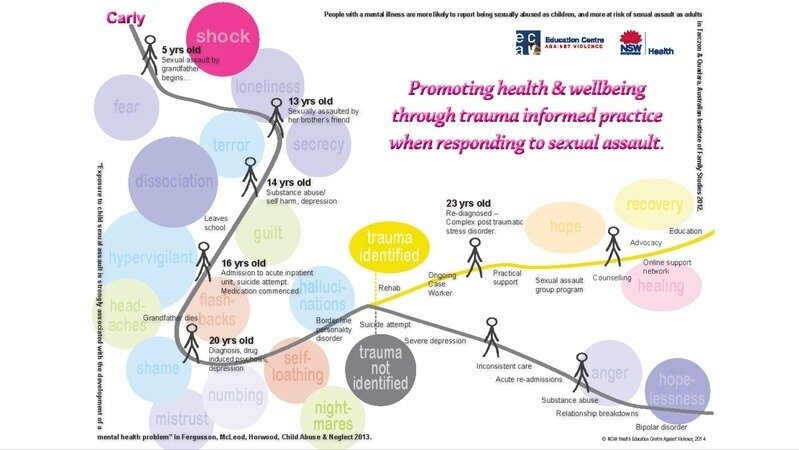
The NSW Health Education Centre Against Violence (ECAV) Carly Poster explores the journey of Carly, a survivor of child sexual assault who enters the mental health system and the difference in trajectory depending on whether her abuse is identified or unidentified.
One trajectory where substance abuse, self-harm and depression from the age of 14, leaving school early and a non-fatal suicide attempt at 16 years old, results in the diagnosis of drug induced psychosis and depression at 20 years old, and an additional diagnosis of borderline personality disorder. Carly's trajectory then includes a second non-fatal suicide attempt, followed by severe depression, ongoing substance abuse, relationship breakdowns and bipolar disorder.
The other trajectory depicts Carly's complex trauma as a result of her child sexual abuse being identified at her second non-fatal suicidal attempt, leading to a re-diagnosis of complex post traumatic stress disorder. Carly is then supported by an ongoing case worker who connects her to receiving the practical support and other supports she requires.
Which for Carly is participating in a peer group program and receiving counselling. Leading to Carly's involvement in advocacy, online support networks and education, which for Carly, are those things important to her healing and long-term recovery.
This is a powerful depiction of 'no wrong door', where any service a victim/survivor of child sexual abuse accesses, includes an intake/assessment process that can identify the underlying trauma.
Resulting in individuals and families, not only receiving services that respond to the physical, mental, emotional and social signs and symptoms and outcomes of child sexual, which can include fractured relationships, homelessness, unemployment, incarceration, disabilities and early mortality. They are connected earlier to services and supports in response to what happened to victims/survivors as a child. And families, friends and communities are also supported in the impacts this had on them.
Symptomatic treatment which attempts only to resolve symptoms, without diagnosing 'what happened/is happening', which can be trauma, are inadequate. They are not sufficient to change the lifelong trajectory of individuals living with complex post traumatic stress, because they only address the effects, not the cause.
For example, making it difficult for individuals living with substance abuse to recover from this mental illness at a level that reduces the possibility of relapses, when the substance abuse maybe self-medication for the untreated complex trauma they are living with.
Carly's trajectory that results in diagnosis of trauma is a depiction of the 'no wrong door' model, something the Victorian government has been advocating for since 2008, but yet to invest in making a reality.
Which would be the integration of health, community, education, legal, justice, unemployment, housing and social services etc., meaning any of their doors is a 'right door' for disclosure of the child sexual abuse. That leads to early diagnosis and referrals to services and supports that can result in the start of their healing journey. Which we know is lifelong.
The NSW government has been piloting limited versions of 'no wrong door' in two regions of Sydney, as part of their response to the following recommendation.
"The 2017 Royal Commission into Institutional Responses to Child Sexual Abuse Report, Recommendation 9.1:
"The Australian Government and state and territory governments should fund dedicated community support services for victims and survivors in each jurisdiction, to provide an integrated model of advocacy and support and counselling to children and adults who experienced childhood sexual abuse in institutional contexts. Funding and related agreements should require and enable these services to:
- trauma-informed and have an understanding of institutional child sexual abuse
- be collaborative, available, accessible, acceptable and high quality
- use case management and brokerage to coordinate and meet service needs
- support and supervise peer-led support models.”
To-date the Victorian Government has not accepted this recommendation in full, nor has it sought to follow in the NSW government's footsteps of piloting what integrated services could look like and how they could work.
Which is what our petition has been asking the Victorian government to do, for nearly two years.
To pilot frameworks of accessible and integrated service systems that result in earlier disclosures of child sexual abuse, and individuals, families and communities receiving services and supports for complex trauma and its symptoms and outcomes of complex trauma, in the Ballarat and the Bayside communities of Melbourne.
The Australian Government has responded to a major part of Royal Commission Recommendation 9.9, through the establishment of the National Centre for Action on Child Sexual Abuse, to "lead to the establishment of better service models and interventions" and "inform government policy" at a federal, state and territory level.
Especially through their release on 6 September 2023 of Minimum Practice Standards Specialist and Community Support Services Responding to Child Sexual Abuse.
We participated in the stakeholder engagement on which these national standards are based, and whilst the minimum standards include the importance of integrated services and referrals, there is no mention of how these should be funded and case managed. Something that service providers highlighted as important, if they are to have the education and resources to meet these minimum standards.
We have also provided the Board of Inquiry into historical child sexual abuse in Beaumaris Primary School and certain other government schools, at private and other sessions, with all the existing recommendations of various Royal and other Commissions, reports and research, on the compelling 'why".
Why creating opportunities for early disclosure of historic child sexual abuse, that results in wrapping services around the very individual and speficic needs of victim/survivors of child sexual abuse, their families and communities, make sense.
Child sexual abuse is a social issue, which all governments are responsible for not only it's prevention, but addressing the impacts on too many members of Australian society.
----------------------------------------------------------------------
Thank you for all our ongoing supporters, and the more than 3,000 supporters who have signed and promoted our petition, over the past nine days.
We are stronger together.