
Ask Narendra V, IFS - DFO, N.Wayanad to stop destroying the catchment areas of Cauvery !
The Issue
Wayanad and River Cauvery
Wayanad is home to 3 major rivers from the Western Ghats (Panamaram river, Manantavady river, Thirunelli river) flowing from the shola grasslands which eventually joins Kabani in Karnataka. Kabani is one of the main tributaries of Cauvery. The east-flowing Kabini and its tributaries water almost the entire area of Wayanad district. Total catchment area is 1934.50 sq. km. The river Kabini has a basin length of 56 km in Wayanad. 95% of the land area of Wayanad drains into river Kabini. Kabini drains roughly 93 TMC of water into river Cauvery.
Shola Grasslands maintain Water Cycles
The Sholas are a mosaic of mountain evergreen forests and grasslands. They are found only in high altitude (>1500 m ASL) regions within the tropics, and are limited to the southern part of the Western Ghats. They are also vitally important in keeping the water cycles alive. They retain most of the rain they get over the monsoons and release it slowly through the year via a network of streams and rivers. The microclimate and the soil properties within the Shola have been found very conducive for retention of precious water. Shola grasslands are the water sinks of the Western Ghats.
Destruction of Shola Grasslands of Brahmagiri and Muneeshwaran Mudi
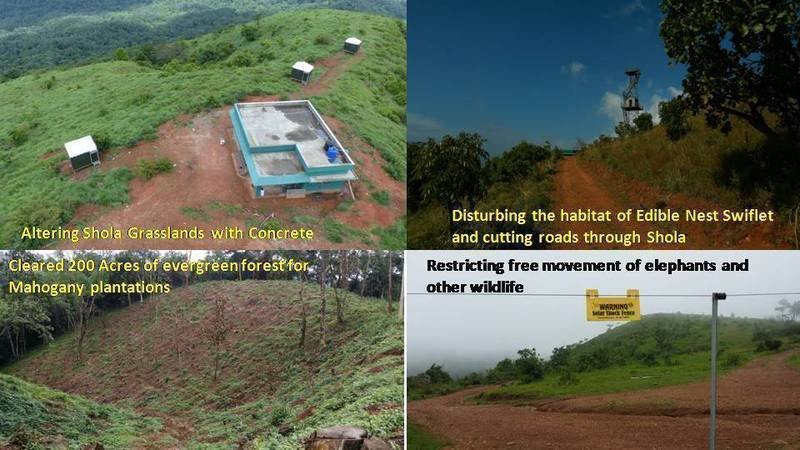
The Kerala Forest Department is establishing tourist resorts in the shola grasslands of Brahmagiri and Muneeshwaran Mudi in the North Wayanad Forest Division in Wayanad district. They have already constructed one concrete building and five cottages each, surrounded by wire fence in the above places. They have also constructed motorable roads to these hills using earth movers. This is a flagrant violation:
(a) The guideline MOEF and CC for eco-tourism that no new constructions should be made inside reserve forests.
(b) The existing working plan of Kerala Forest Department
Impact to Rare bird species
The tourist resort in Brahmagiri is near a large breeding colony of the rare and endemic Indian Edible-nest Swiftlet (*Aerodramus unicolor*). This is one of the two bird species nesting inside dark caves. They are amongst a very few species of birds using echo-location to ‘see’ in the dark. The Indian Edible-nest Swiftlet is on the brink of extinction. There are only a very few nesting colonies of this bird in the Western Ghats, and they, including the one in Brahmagiri, is being plundered regularly by nest hunters. In addition to that, tourists trekking to Brahmagiri hill collect nests as trophies from the cave. Influx of a large number of tourists attracted by the new facilities including the road will doom the nesting colony, and ultimately the fate of the Indian Edible-nest Swiftlet
Impact to Wildlife, triggering man animal conflict
Brahmagiri is an important corridor connecting the Wayanad Wildlife Sanctuary in Kerala and Nagarhole National Park in Karnataka to Aaralam Wildlife Sanctuary in Kerala and Brahmagiri Wildlife Sanctuary on Karnataka. It is a critical elephant corridor which is already under pressure due to the influx of tourists into Thirunelli temple during peak season. Tourist activities to Brahmigir peak would mean additional pressure on the landscape on Elephant herds that are using these hill slopes as grazing land thus trigger conflicts with the local farmer population in the region.
Ecologically Destructive tourism
1. Permanent structures in concrete along with the pre fabricated tents that are made of permanent material would leave remnants of material waste on the landscape over time.
2.The solar fence and the numerous wires that criss cross the camping site would potentially impact the free movement of elephants and other wildlife in the area
3.There is already pressure of tourism in Wayanad where heavy loads of plastic waste by tourists need to be managed on a regular basis. These hills that feed water into the nearby streams will see its’ natural death with the plastic waste by tourists staying in these cottages
4.Additionally, human faecal matter which is typically loaded with anti biotics would contaminate the grass lands and the microbe colonies in the pristine landscape.
5.New road that has been built has destroyed large area of shola grasslands exposing the delicate soil in the region and destroying nesting sites of the Indian Edible-nest Swiftlet
Violation of Section 2 of Forest Conservation Act, 1980
The Kerala High Court has ruled that tourism is not a forestry operation, and hence the Forest Department should have obtained prior permission for the construction of buildings on the shola grasslands and roads through the forests .Toursm needs prior permission of the Central Government. DFO cannot make decisions based on his whims and fancies to destroy forest land that belong to the citizens of India.
Destroying 200 Acres of natural forests in Periya
North Wayanad Division has already denuded 200 acres of natural evergreen forests in Periya peak and steep slopes are planted with exotic Mahogany. A mono culture plantation of Mahogany would destroy the narural regeneration capacity of the evergreen landscape which needs protection. Kerala has one of the last remaining patches of tropical wet ever green forests and it is important that these tracts are left intact in order to sequester carbon dioxide and ensure the much needed moisture retention in soil that supplies water to the streams and rivers perennially.
Our Prayer
(1) The buildings and fencing built at the top of Brahmagiri and Muneeshwaran Mudi be removed; the roads constructed to these sensitive areas be removed; and no tourists be allowed to go to these ecologically fragile lands. These are tracts that need to be left pristine to ensure protection of ecology of the landscape and for future water security. If any such activity is permitted in the area, additional private players would potentially occupy the non forest area of the landscape thus destroying the hills.
(2) The Mahogany saplings planted in Periya be uprooted and no weeding be done there in future so that the natural regeneration occurs. Strict fire protection measures be provided to these and other ‘failed’ plantations to assist regeneration of natural vegetation.
Thanking You, Wayanad Prakruthi Samrakshana Samithi
Kabini and Wayanad Catchment related news links
Related news links
http://www.deccanchronicle.com/nation/in-other-news/080816/now-keralas-turn-to-root-out-forests.html
http://www.mathrubhumi.com/tv/ReadMore1/27520/wayanad4/M#.V45X9IjDe2A.facebook

Petition Closed
The Issue
Wayanad and River Cauvery
Wayanad is home to 3 major rivers from the Western Ghats (Panamaram river, Manantavady river, Thirunelli river) flowing from the shola grasslands which eventually joins Kabani in Karnataka. Kabani is one of the main tributaries of Cauvery. The east-flowing Kabini and its tributaries water almost the entire area of Wayanad district. Total catchment area is 1934.50 sq. km. The river Kabini has a basin length of 56 km in Wayanad. 95% of the land area of Wayanad drains into river Kabini. Kabini drains roughly 93 TMC of water into river Cauvery.
Shola Grasslands maintain Water Cycles
The Sholas are a mosaic of mountain evergreen forests and grasslands. They are found only in high altitude (>1500 m ASL) regions within the tropics, and are limited to the southern part of the Western Ghats. They are also vitally important in keeping the water cycles alive. They retain most of the rain they get over the monsoons and release it slowly through the year via a network of streams and rivers. The microclimate and the soil properties within the Shola have been found very conducive for retention of precious water. Shola grasslands are the water sinks of the Western Ghats.
Destruction of Shola Grasslands of Brahmagiri and Muneeshwaran Mudi
The Kerala Forest Department is establishing tourist resorts in the shola grasslands of Brahmagiri and Muneeshwaran Mudi in the North Wayanad Forest Division in Wayanad district. They have already constructed one concrete building and five cottages each, surrounded by wire fence in the above places. They have also constructed motorable roads to these hills using earth movers. This is a flagrant violation:
(a) The guideline MOEF and CC for eco-tourism that no new constructions should be made inside reserve forests.
(b) The existing working plan of Kerala Forest Department
Impact to Rare bird species
The tourist resort in Brahmagiri is near a large breeding colony of the rare and endemic Indian Edible-nest Swiftlet (*Aerodramus unicolor*). This is one of the two bird species nesting inside dark caves. They are amongst a very few species of birds using echo-location to ‘see’ in the dark. The Indian Edible-nest Swiftlet is on the brink of extinction. There are only a very few nesting colonies of this bird in the Western Ghats, and they, including the one in Brahmagiri, is being plundered regularly by nest hunters. In addition to that, tourists trekking to Brahmagiri hill collect nests as trophies from the cave. Influx of a large number of tourists attracted by the new facilities including the road will doom the nesting colony, and ultimately the fate of the Indian Edible-nest Swiftlet
Impact to Wildlife, triggering man animal conflict
Brahmagiri is an important corridor connecting the Wayanad Wildlife Sanctuary in Kerala and Nagarhole National Park in Karnataka to Aaralam Wildlife Sanctuary in Kerala and Brahmagiri Wildlife Sanctuary on Karnataka. It is a critical elephant corridor which is already under pressure due to the influx of tourists into Thirunelli temple during peak season. Tourist activities to Brahmigir peak would mean additional pressure on the landscape on Elephant herds that are using these hill slopes as grazing land thus trigger conflicts with the local farmer population in the region.
Ecologically Destructive tourism
1. Permanent structures in concrete along with the pre fabricated tents that are made of permanent material would leave remnants of material waste on the landscape over time.
2.The solar fence and the numerous wires that criss cross the camping site would potentially impact the free movement of elephants and other wildlife in the area
3.There is already pressure of tourism in Wayanad where heavy loads of plastic waste by tourists need to be managed on a regular basis. These hills that feed water into the nearby streams will see its’ natural death with the plastic waste by tourists staying in these cottages
4.Additionally, human faecal matter which is typically loaded with anti biotics would contaminate the grass lands and the microbe colonies in the pristine landscape.
5.New road that has been built has destroyed large area of shola grasslands exposing the delicate soil in the region and destroying nesting sites of the Indian Edible-nest Swiftlet
Violation of Section 2 of Forest Conservation Act, 1980
The Kerala High Court has ruled that tourism is not a forestry operation, and hence the Forest Department should have obtained prior permission for the construction of buildings on the shola grasslands and roads through the forests .Toursm needs prior permission of the Central Government. DFO cannot make decisions based on his whims and fancies to destroy forest land that belong to the citizens of India.
Destroying 200 Acres of natural forests in Periya
North Wayanad Division has already denuded 200 acres of natural evergreen forests in Periya peak and steep slopes are planted with exotic Mahogany. A mono culture plantation of Mahogany would destroy the narural regeneration capacity of the evergreen landscape which needs protection. Kerala has one of the last remaining patches of tropical wet ever green forests and it is important that these tracts are left intact in order to sequester carbon dioxide and ensure the much needed moisture retention in soil that supplies water to the streams and rivers perennially.
Our Prayer
(1) The buildings and fencing built at the top of Brahmagiri and Muneeshwaran Mudi be removed; the roads constructed to these sensitive areas be removed; and no tourists be allowed to go to these ecologically fragile lands. These are tracts that need to be left pristine to ensure protection of ecology of the landscape and for future water security. If any such activity is permitted in the area, additional private players would potentially occupy the non forest area of the landscape thus destroying the hills.
(2) The Mahogany saplings planted in Periya be uprooted and no weeding be done there in future so that the natural regeneration occurs. Strict fire protection measures be provided to these and other ‘failed’ plantations to assist regeneration of natural vegetation.
Thanking You, Wayanad Prakruthi Samrakshana Samithi
Kabini and Wayanad Catchment related news links
Related news links
http://www.deccanchronicle.com/nation/in-other-news/080816/now-keralas-turn-to-root-out-forests.html
http://www.mathrubhumi.com/tv/ReadMore1/27520/wayanad4/M#.V45X9IjDe2A.facebook
The Decision Makers
Petition Updates
Share this petition
Petition created on 20 September 2016