The Council of Canadians Concerns Regarding Northern Pulp's Waste Proposal

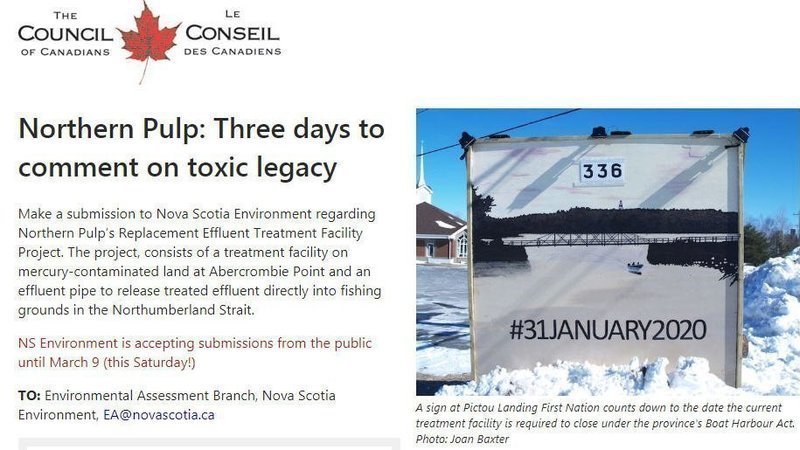
Please consider making a submission to the Nova Scotia Environment regarding Northern Pulp’s Replacement Effluent Treatment Facility Project via clicking on the link below. ( We only have 2 days remaining to submit our feedback.) The project consists of a treatment facility on mercury-contaminated land at Abercrombie Point and an effluent pipe to release treated effluent directly into fishing grounds in the Northumberland Strait.
https://secure.canadians.org/page/39589/action/1
Below is the Council Of Canadians letter to the NS Environment Minister
07 March 2019
RE: Northern Pulp’s Replacement Effluent Treatment Facility Project
Dear Minister Miller,
I write to you on behalf of the Council of Canadians, a grassroots social justice organization with more than 100,000 supporters across Canada concerned with protecting our water and environment for future generations. We are working to eliminate the social harm and
inequality that climate change perpetuates, and the historical injustices that Indigenous people and people of colour have experienced in the present day.
The Council of Canadians calls on the Nova Scotia government to reject the proposed Northern Pulp Replacement Effluent Treatment Facility Project based on the following:
Concern: Lack of evidence provided by proponent on risk
Northern Pulp’s submission does not prove a lack of significant risk, and is missing critical data on many issues. One example of this is mercury, which is recognized by Health Canada to have significant risks to human health. Northern Pulp hardly mentions their site on Abercrombie Point is contaminated with mercury and disrupting this contamination on a site surrounded by water requires extreme caution and a full examination (reference Joan Baxter’s article in the Halifax Examiner: Northern Pulp’s Environmental Documents: missing mercury, a pulp mill that
never was, and oodles of contradictions, March 5, 2019). The company’s claims that damage will be minimal, there will be no significant residual damage in any situation (whether by normal operation or accident), and whatever damage done can be mitigated, are not quantified. There is insufficient evidence to know exactly how broad that damage will be, hence the company’s claims are not credible and should not be accepted.
Fishing is a major part of this community and the economic backbone of not just Nova Scotia but the other two provinces who would be impacted by the proposal – Prince Edward Island and New Brunswick. The tourism industries in the Maritime provinces are also vital, part of this being dependent on outdoor recreation, which is also highly valued by the people who live here. The reality is that once ecosystems are damaged, they are not easily healed; just as damaging one part of the system inevitably impacts the whole. As such, we do not accept that
monetary compensation is appropriate mitigation for damaging an ecosystem and a sustainable industry.
Per Nova Scotia’s Environment Act (Purpose of the Act, 2.b.ii.), “the precautionary principle will be used in decision-making so that where there are threats of serious or irreversible damage, the lack of full scientific certainty shall not be used as a reason for postponing measures to prevent environmental degradation.”
Concern: Lack of Indigenous consent According to the United Nations Declaration on the Rights of Indigenous Peoples, Indigenous peoples have a right to free, prior and informed consent.
We expect that the Nova Scotia Environment will go above and beyond the base expectations to ensure the appropriate level of consultation occurs moving forward, specifically around issues of consent. It is clear that Pictou Landing First Nation (PLFN), both the elected leadership and the community, are opposed to this proposal and want the government to keep its promise of
closing the current effluent treatment facility. They want Boat Harbour closed on schedule, and they do not want the risks to the fisheries that piping effluent into the Northumberland Strait represents. Years ago, the concerns of PLFN about how effluent would affect their community were
ignored. All of their concerns proved to be accurate. We believe their concerns are accurate today too.
Concern: Lack of community consultation, inadequate time for meaningful community response
The community was not consulted on the actual project submitted by Northern Pulp for environmental assessment. Any public consultation was on a somewhat similar ETF proposal discharging into a completely different location. In addition, a 30-day period for public consultation on 2000 pages of previously undisclosed information does not fulfill requirements for meaningful public review and input.
Concern: Climate change
Oceans are already stressed by climate change. Scientists warn that theGulf of St. Lawrence is warming more rapidly than almost anywhere on Earth. Adding additional stressors to a system that is already stressed is not wise. The Northumberland Strait is an area that requires additional protection, not additional degradation. This past October, The United Nations’ Intergovernmental Panel on Climate Change released its
dire warning that we have just over 11 years to curb GHG emissions before the Earth’s climate tips past a point of no return. Industry creep is such that the government is willing to risk other billion-dollar industries as well as the global climate for this fundamentally undemocratic and
unsustainable industry. What we do need is a just transition to a sustainable economy, and specifically for the hundreds of workers employed by Northern Pulp. We also need to knit all the climate solutions we know into a more compelling and tangible vision to protect our oceans and our planet.
Conclusion
This project is simply not worth the risk. The precautionary principle means it is incumbent on the Nova Scotia government to err on the side of caution. A bigger picture reflection on this, such as Joan Baxter’s “The Mill” (in chapter 16: The Politics of Pulp, for example) or Dr. Ingrid Waldron’s “There’s Something In the Water: Environmental Racism in Indigenous and Black Communities,” points to a failure by successive provincial governments to protect the people of Pictou Landing First Nation and the broader community, and environment in and around Boat Harbour and the Northumberland Strait. Although you have a task at hand with specific considerations, please keep these bigger issues in mind. The Council of Canadians calls on you to reject the proposed Northern Pulp Replacement Effluent Treatment Facility Project. If you don’t feel you can do this with the evidence before you, please call for a full Environmental Assessment report on this proposal. Either way, we
support the closure of the effluent treatment facility in Boat Harbour on schedule.
Sincerely,
Angela Giles
Atlantic regional organizer | The Council of Canadians
Organizing on unceded and unsurrendered ancestral territory of the Mi’kmaq Nation