Rebuttal of WSDOT "Clarification" sent to many petition signers

Thanks to everyone for signing and sharing.
The 520 Portage Bay Bridge Community Working Group sent the following letter to WSDOT in response to WSDOT's "clarification" letter of December 21, 2022 that was sent to many petition signers.
Our group believes The 520 bridge over Portage Bay could be built more quickly, more cheaply, and be much better for the environment if WSDOT allowed and encouraged using barges for construction and using prefabricated concrete beams. After previous conversations, WSDOT’s Omar Jepperson sent the letter "clarification" below and then distributed it widely. We believe that WSDOT is misconstruing and misrepresenting the factual information our group presented. We furthermore think that WSDOT’s behavior is reckless, in failing to avoid and minimize risks of damage to homes and slopes from vibration; congealed traffic near haul routes; health of residents in at least 200 “frontline” homes; danger to construction workers; and damage to the important Portage Bay ecosystem.
We suggest a 30-day study by an independent entity, estimating costs, impact, and risks.
The "plain text" is from WSDOT’s letter of December 21, 2022
The italicized text shows our group's responses.
From WSDOT: "Dear neighbors,
We understand the community’s desire for a seemingly simple and less impactful construction method. Unfortunately, the approach recommended by the petition’s authors – if feasible at all – is substantially more complex and costly than the authors convey. We’ve provided below some context and clarification."
This paragraph by WSDOT is a statement of opinion with no supportive facts. WSDOT may be characterizing their proposal as having lower impact and lower cost than will actually occur.
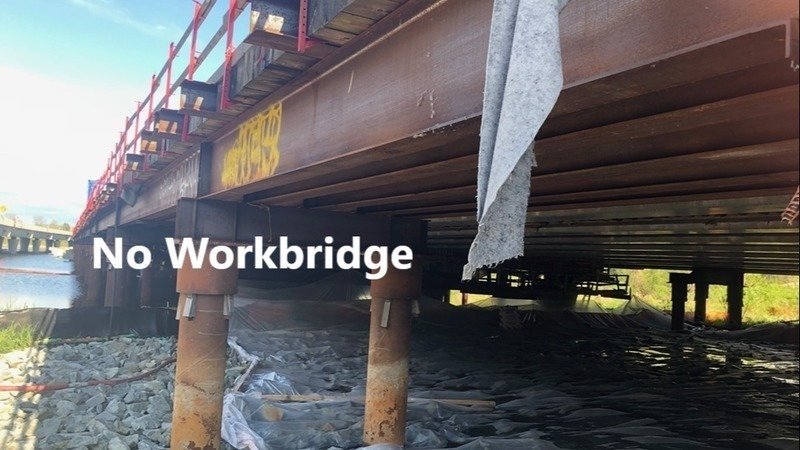
"Stated cost savings: The petition argues for using barges exclusively to haul materials and operate cranes and heavy equipment rather than using temporary work bridges (also referred to as work trestles), which our contractors have employed for other SR 520 projects in Union Bay and Montlake. The authors claim that the barge-only approach would save over $200 million. Their assumptions overstate the cost of work trestles. Based on real-world experience from the Montlake and West Approach Bridge North Projects, we estimate the trestles needed for the Portage Bay Bridge and Roanoke Lid Project will cost approximately $30 million. This includes the materials, installation, and removal of the work trestles."
This paragraph questions our group’s opinion of possible cost savings. We are suggesting that savings of $130m may result from elimination of the work bridges.
This estimate is based on a work bridge cost of approximately $325 per square foot. The WSDOT estimate of $30m for work bridge construction works out to about $80 per square foot. This cost seems unreasonably low, more at the level of a residential deck than heavy work bridge.
The 30-day research study we suggest would enable WSDOT to produce a stamped engineer’s opinion of probable cost documenting the $30m work bridge unit cost line by line and item by item.
The remaining savings of $70m projected by our working group come from cost advantages associated with the use of barges including:
A. An increased ability to construct larger parts off site
B. Cost savings from an equal length span design
"The selected design-build contractor for this project will use a cost-benefit analysis to determine the most innovative, time-efficient, and cost-effective approach. Ultimately, the contractor will likely use a balance of barge and trestle-supported construction. While the project’s Request for Proposals (RFP) does not preclude barges,"
The request for qualifications does preclude contractors from fully including the use of barges. Line 31 of page 5 of the RFQ states that construction alternatives will be considered provided they are consistent with “environmental documents and permits”. WSDOT has not applied for a corps permit amendment that would allow the full use of barges. WSDOT cannot obtain bids for barge based construction using the current RFQ because they have not obtained permits to allow barge based construction.
The decision by WSDOT to not allow barge based construction was made long before WSDOT developed the depth and contamination information they now have, that is typically used to determine the feasibility of this approach.
Now that depth and contamination information is available to accurately evaluate the feasibility of barge based construction, it is prudent to reconsider the decision to use work bridges. Our working group has projected that barge based construction may have substantial cost savings, benefits to the natural environment and dramatically reduced impacts to the human environment. The decision making, environmental and engineering process WSDOT has followed has prevented them from objectively comparing the costs and benefits of work bridges vs barge based construction.
"building a new Portage Bay bridge entirely via marine construction would require dredging shallow parts of Portage Bay, removing portions of marinas currently in the bay, and mitigating other impacts. Our Program’s final environmental impact statement (FEIS) incorporated design and construction methods that were the most cost effective and environmentally friendly. Dredging did not meet those standards."
This statement from WSDOT is inaccurate in implying that barge based construction received full consideration at the time of FEIS preparation. The FEIS was produced long before WSDOT had detailed depth and contamination information so the WSDOT decision to not allow barge based construction was based on incomplete information. WSDOT has not revisited that decision in light of newer, more complete information.
WSDOT is correct that some removal of sediment, deposited from the bridge and roadways since construction of the viaduct, will be needed.
"Moreover, the cost estimates cited in the petition overlook the increased costs a marine-only approach would cause by delaying the project."
The marine-only approach need not delay the project. The north span can be constructed while permitting for the south span is underway. In addition, eliminating the need to construct the work bridge prior to construction of any span will speed the project up.
"Not only is extensive dredging harmful to the environment,"
This is a statement of opinion, without any reference to scientific fact or to the specific environment in south portage bay. WSDOT is already proposing extensive “dredging”. The areas to construct the bridge piers will be excavated, and the existing span will be made into rubble, dropped into the sediments and then dug up.
South Portage Bay is suffering from rapid silt deposition from bridge drains and roadway runoff. Human- caused silt deposition decreases depth, raises water temperature and decreases habitat for fish. Sediment removal will arguably produce dramatic positive benefits for the fish, wildlife and botanical resources in South Portage Bay.
"but it would require new or updated local, state, and federal permits, including from the city of Seattle, the Washington Department of Fish and Wildlife, the Washington Department of Ecology,"
Amended permits may be required, but there is no insurmountable hurdle that our working group has found other than inertia and unwillingness to review an outdated decision that was based on incomplete information.
"the U.S. Army Corps of Engineers and the U.S. Coast Guard. Because we already have permits for construction activities that minimize harm to the environment,"
The statement that the permits obtained minimize harm to the environment is extremely misleading. WSDOT has obtained the permits they applied for. There is no evidence presented that these permits produce construction that minimizes harm to the human and natural environment.
"a dredging permit would be difficult to justify to permitting agencies. The permitting process alone could delay the project by a year or more, with no certainty the permits would be issued. This would add millions of dollars to the project cost."
If dredging is considered in absence of benefits produced it can be difficult to justify in cases where it is proposed solely for private benefit such as private marinas. In the case of public benefit projects such as ports and navigation, dredging is often approved. In the case of south portage bay, dredging will improve the natural environment and improve public recreation, and dramatically reduce impacts to the human environment. The regulations for agencies such as the Corps of Engineers and city of Seattle do allow dredging where benefits to society outweigh harm to the natural environment. Based on experience with dredging permits, our working group believes that south portage bay is a case where dredging is likely to be approved by the agencies involved.
"Schedule: The project’s duration has less to do with construction techniques and more to do with the construction and environmental commitments WSDOT has made after years of collaboration and consultation with the community and other agencies. Those commitments will remain largely the same no matter how the bridge is built. We have committed to keeping the existing bridge open to traffic during construction. This means the contractor must build one bridge at a time, regardless of the construction method. Similarly, all construction will be limited by in-water work restrictions due to the annual “fish window” – the four-month season when fish migrate through Portage Bay and disruptive in-water work is prohibited."
This paragraph does not address whether barge construction is faster or not. If work bridges are eliminated, this will save a season or two in the construction schedule.
"Environmental impacts: Dredging requires moving large amounts"
“Large amounts” is a value judgement. Our working group is asking that WSDOT estimate the actual quantities involved and the cost of dealing with these materials. This requires more in-depth investigation.
"of sediment from the bottom of the bay. This would be harmful to the 24 documented species living in or around Portage Bay."
There is no evidence presented to support the claim that dredging would be harmful. Our working group is asking that WSDOT identify the species they believe are living or using the area that would be affected by dredging. The use of the term “documented” is misleading. Are these threatened or endangered species? Are any of these “documented” species of concern in any way?
"Despite environmental mitigation, any construction project of this size – whether constructed by barge or work trestle – will have inevitable carbon impacts. Water-based marine construction also releases carbon emissions because barges must be brought into the bay via diesel-powered tugboats. More barge traffic could also increase impacts to tribal fishing."
Our working group agrees that air quality impacts may not be a critical decision- making factor. The main benefit of marine construction is that the inevitable pollution is further from residential neighborhoods and streets.
"Vibration: Fears of potential damage from construction vibrations are understandable, and WSDOT will take every precaution to prevent and minimize damage. That is one key reason we conducted two test pile installations in August and September 2022 to gather data on local vibration effects and set vibration limits for the contract. At no point during those tests did vibration levels surpass the thresholds established to protect nearby buildings from damage.
We have written those vibration limits into our RFP, and the contractor will be held to them."
This paragraph is misleading. WSDOT is proposing to meet an arbitrary industry standard, not protect homes. The test piles damaged at least one home and caused serious discomfort in several others. Our working group estimates that WSDOT is planning on spending over ten million dollars in direct noise and vibration mitigation costs and direct mitigation payments (see attachment 1). These costs are largely avoidable with marine based construction. The vibration levels proposed by WSDOT are higher than those produced by the test piles. WSDOT is budgeting significant amounts of money to pay for the significant damage to homes they expect to occur from work bridge construction.
"Construction access: A recent update to the petition claims most material leaving and entering the work bridges will be on “narrow neighborhood streets” in the Portage Bay neighborhood. However, the contractor will be able to access the Portage Bay work zones from five different locations. Only one of the five locations requires use of city streets in the Portage Bay neighborhood. You can find the additional locations on page 7 of this Q&A."
This paragraph does not address the concern that use of work bridges causes a substantial number of heavy construction vehicles to use narrow neighborhood streets that are unsuited for this type of traffic.
"Conclusion
The upcoming RFP for the Portage Bay project neither requires work bridges nor precludes barges."
As noted above, the RFQ does preclude the use of construction barges.
"We expect contractors to compare the costs and benefits of alternative construction techniques."
Contractors cannot compare the costs and benefits of alternative construction techniques because WSDOT has not obtained permits to allow barge use.
"Because this is a design-build project – meaning the contactor both completes the final design and constructs the project – the contractor ultimately will decide the project’s means, methods, and approach within the constraints of the contract."
Contractors cannot compare alternative means, methods, and approach because WSDOT has not obtained permits to allow barge use.
"We are committed to keeping the community’s well-being at the forefront of this project. Our process to select the design-builder provides incentives for contractors who propose and commit to approaches that minimize impacts on the community. The RFP also includes incentives for the contractor to go above and beyond contract requirements to reduce neighborhood impacts. On the Montlake Project, for example, our contractor, Graham, developed an approach that reduced the number of piles needed for work trestles by almost 30%. Graham also proposed an innovative approach to remove the existing bridge: Instead of breaking down the existing structure on site, crews constructed a gantry system, with large blue cranes, that allowed them to sawcut and remove pieces of the bridge and then break down the material off site.
We hope this message sheds light on why and how we’ve arrived at our decisions and path forward. We’ve also included additional information about this topic in a neighborhood Q&A we shared last month (see pages 4-7 for more details about barges and marine construction). If you have additional questions, please don’t hesitate to reach out to us at sr520bridge@WSDOT.wa.gov."
We repeat our request that contractors be allowed and encouraged to provide bids using marine construction and prefabricated concrete beams. This implies that WSDOT will promptly apply for the permits that would permit such construction.
Contractors can best estimate the final costs and assess the best methods, but only if they are enabled by WSDOT.
"Sincerely,
Omar Jepperson, PE, DBIA SR 520 & AWV Program
Program Administrator (he, him, his)
999 3rd Avenue, Suite 2300, Seattle, WA 98104 WSDOT mail stop: NB-82-99
SR 520 Bridge Replacement & HOV Program Alaskan Way Viaduct Replacement Program"
January 20, 2023
SR 520 WORKING GROUP. Attachment 1 to Response to WSDOT letter
DIRECT AND INDIRECT VIBRATION MITIGATION COSTS
Direct vibration mitigation costs - costs from work bridge impacts that are paid directly by taxpayers from WSDOT budget and other state budgets
Indirect vibration mitigation costs – costs from work bridge impacts borne by residents of the neighborhood, and by other nearby neighborhoods, some are a result of tax revenue declines affecting city, county and state collections.
We estimate the most obvious direct and indirect costs associated with work bridge impacts as roughly $16m irrespective of any construction costs.
1. Direct Costs $12,000,000
1) Vibration
a) pre-construction home inspections – 400X$5,000 = $2,000,000 b) minor - damage - 200X$15,000 = $3,000,000
c) major damage – 10 x $200,000 = $2,000,000
2) Pre-construction payments PBCA 24x$15,000 = $300,000
3) Sound Mitigation
a) Residential unit sound mitigation 200x$3,500=$700,000
b) Easement Acquisition for work bridge
c) PBCA marina occupation and rent reduction = $750,000
d) Frolund property = $1,000,000
4) Increased neighborhood road use
a) Road repair due to damage = $750,000
b) Utility repair sewer water $750,000
c) Traffic control and detours during construction = $500,000
5) Total direct cost of work bridge related impacts and mitigation = $11,750,000
6) Indirect Costs shifted to owners $4,000,000
a) Health impacts* – one death noise and vibration stress - $1,500,000
b) Homeowner borne claims costs - 200x$2,500 = $500,000
c) 10% rent reduction 150 apartments 200/mo x12x6 = $2,000,000
d) Total in direct cost = $4,000,000
Other costs include increased travel time, reduced use and enjoyment of parks and homes nearby. Tax revenue reduction from decreased home prices REET collections over six years could be as much as a half million dollars. Property tax reductions resulting from lower values during construction.
*Current values suggest a $10,000 million plus figure.