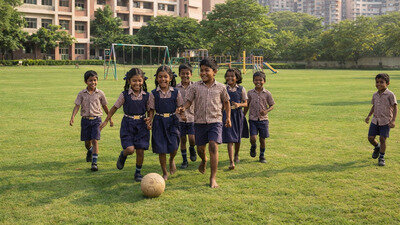

Save Our Children's Sight: Mandate 120 Mins Daily Outdoor Play In Indian Schools
The Issue
To: Ministry of Education, State Education Boards, and School Managements across India
Dear Parents and Fellow citizens
As an ophthalmologist, I am witnessing a quiet but significant public-health concern in daily clinical practice.
Children are developing distance vision problems at an unprecedented rate.
If current trends continue, nearly every second child in urban India may require glasses by 2050.
This Is Not Merely a Refractive Issue
When a child’s eye grows excessively long—a condition known as myopia (near-sightedness)—the internal tissues of the eye undergo permanent stretching.
This structural change substantially increases the lifetime risk of retinal detachment, glaucoma, severe visual impairment, and blindness.
Once established, these changes cannot be reversed.
Evidence-Based Prevention Exists — and It Is Accessible
The most effective preventive measure for childhood myopia does not rely solely on medication or optical devices.
Robust scientific evidence shows that regular exposure to natural daylight plays a critical protective role.
Outdoor light stimulates the release of dopamine in the retina, a natural signal that slows excessive eye growth and supports healthy visual development.
Why Outdoor Exposure Is Clinically Important
- Typical indoor lighting (homes and classrooms): approximately 500 lux
- Outdoor daylight, even under shade: 10,000–50,000 lux
This difference in light intensity is biologically meaningful and directly relevant to eye growth regulation.
The 120-Minute Threshold
International research consistently demonstrates that a minimum of 120 minutes (2 hours) of outdoor time per day significantly reduces both the onset and progression of childhood myopia.
School-based programs in countries such as Taiwan have shown measurable success in reducing population-level myopia rates by adopting this standard.
Why Medical Treatment Alone Is Insufficient
Therapies such as low-dose atropine eye drops and specialized myopia-control lenses are valuable and evidence-based.
However, these interventions are designed to complement environmental measures, not replace them.
Without adequate outdoor exposure, their effectiveness is substantially reduced.
Outdoor daylight remains the foundational preventive factor.
Policy Momentum Exists — and Can Be Strengthened
The mandate introduced in January 2026 by the Andhra Pradesh Government for 60 minutes of daily physical activity in schools is a positive and commendable step.
From a visual-health perspective, however, evidence indicates that 60 minutes represents a minimum, while 120 minutes is the protective standard.
Our Request: A Preventive Vision Policy for Children
In light of current evidence, we respectfully urge education authorities to:
1. Mandate a minimum of 120 minutes of outdoor time daily in schools
This may be achieved through recess, physical education, and structured outdoor learning.
2. Encourage outdoor classrooms where feasible
Non-laboratory subjects such as languages and social sciences can be conducted under natural daylight.
3. Recognize childhood vision as a public-health priority
Visual health is fundamental to learning, productivity, and long-term quality of life.
How the Public Can Support This Effort
Parents and caregivers play a vital role in shaping education policy.
By supporting this petition, signatories affirm that children’s long-term health must be protected alongside academic outcomes.
Ensuring adequate outdoor time today safeguards vision for a lifetime.

2
The Issue
To: Ministry of Education, State Education Boards, and School Managements across India
Dear Parents and Fellow citizens
As an ophthalmologist, I am witnessing a quiet but significant public-health concern in daily clinical practice.
Children are developing distance vision problems at an unprecedented rate.
If current trends continue, nearly every second child in urban India may require glasses by 2050.
This Is Not Merely a Refractive Issue
When a child’s eye grows excessively long—a condition known as myopia (near-sightedness)—the internal tissues of the eye undergo permanent stretching.
This structural change substantially increases the lifetime risk of retinal detachment, glaucoma, severe visual impairment, and blindness.
Once established, these changes cannot be reversed.
Evidence-Based Prevention Exists — and It Is Accessible
The most effective preventive measure for childhood myopia does not rely solely on medication or optical devices.
Robust scientific evidence shows that regular exposure to natural daylight plays a critical protective role.
Outdoor light stimulates the release of dopamine in the retina, a natural signal that slows excessive eye growth and supports healthy visual development.
Why Outdoor Exposure Is Clinically Important
- Typical indoor lighting (homes and classrooms): approximately 500 lux
- Outdoor daylight, even under shade: 10,000–50,000 lux
This difference in light intensity is biologically meaningful and directly relevant to eye growth regulation.
The 120-Minute Threshold
International research consistently demonstrates that a minimum of 120 minutes (2 hours) of outdoor time per day significantly reduces both the onset and progression of childhood myopia.
School-based programs in countries such as Taiwan have shown measurable success in reducing population-level myopia rates by adopting this standard.
Why Medical Treatment Alone Is Insufficient
Therapies such as low-dose atropine eye drops and specialized myopia-control lenses are valuable and evidence-based.
However, these interventions are designed to complement environmental measures, not replace them.
Without adequate outdoor exposure, their effectiveness is substantially reduced.
Outdoor daylight remains the foundational preventive factor.
Policy Momentum Exists — and Can Be Strengthened
The mandate introduced in January 2026 by the Andhra Pradesh Government for 60 minutes of daily physical activity in schools is a positive and commendable step.
From a visual-health perspective, however, evidence indicates that 60 minutes represents a minimum, while 120 minutes is the protective standard.
Our Request: A Preventive Vision Policy for Children
In light of current evidence, we respectfully urge education authorities to:
1. Mandate a minimum of 120 minutes of outdoor time daily in schools
This may be achieved through recess, physical education, and structured outdoor learning.
2. Encourage outdoor classrooms where feasible
Non-laboratory subjects such as languages and social sciences can be conducted under natural daylight.
3. Recognize childhood vision as a public-health priority
Visual health is fundamental to learning, productivity, and long-term quality of life.
How the Public Can Support This Effort
Parents and caregivers play a vital role in shaping education policy.
By supporting this petition, signatories affirm that children’s long-term health must be protected alongside academic outcomes.
Ensuring adequate outdoor time today safeguards vision for a lifetime.
Petition Updates
Share this petition
Petition created on 22 January 2026