Maju means progress. Towards what, exactly?

Forty-five thousand of you have now signed.
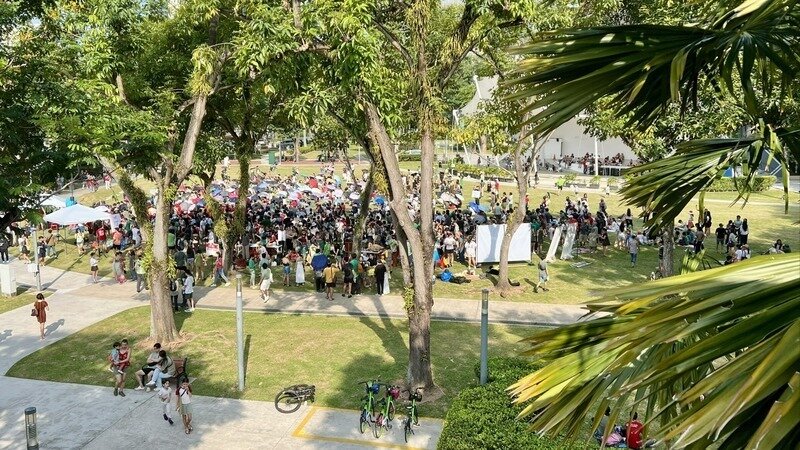
More than a thousand people stood in the afternoon heat at the Maju For The People rally, organised by SG Climate Rally. CNA estimated the crowd at over 1,000 from aerial photographs and the organisers put it above 2,000. We will let the two numbers sit side by side rather than choose the flattering one.
Either figure means the same thing. This is no longer a Sunset Way conversation, and it has not been for some time. People came for Maju and Gillman, and also for Tengah, Tagore, Sembawang and East Coast Park. Families brought children. Strangers wrote more than 250 postcards to Members of Parliament, which the organisers are sending on. Members from several parties came to listen. The credit for the day belongs to SG Climate Rally and to everyone who gave up a Sunday for a forest most of them have never walked in.
Ethan Wee, fourteen, told Mothership he came because he loves nature — and then mentioned, almost in passing, that he's never actually been to Maju Forest. He's only seen the videos. It looked fun. He'd like it to stay.
A boy showed up to defend a place he hasn't been to yet, in the hope that he still might.
My last update laid out what we're asking the agencies for, and none of it has changed, so I won't repeat the list. I want to use this one differently. Six weeks in, I've stopped being able to think about Maju as only a forest question, and I'd like to try and explain why.
One sentence I keep turning over
Standing outside the forest on 14 August, Minister of State Alvin Tan said that keeping more greenery means fewer homes for fellow Singaporeans.
We wrote on Friday about why we've never asked for fewer homes, so I won't go over that again. What I keep turning over is the shape of the sentence rather than its fairness — because that shape sits behind a lot of decisions here, not just this one.
It assumes a fixed amount of need, land as the only thing that can move, and every hectare kept as a family turned away. Follow it and a forest stops being a place. It becomes a housing unit that hasn't been built yet, and the only question left is when.
I don't think that's wrong exactly. I think it's unexamined. And once you start examining it, the questions don't stay inside twenty-three hectares.
The number behind the number
Start with what we're told. The need is real, households are forming faster, they're getting smaller, and demand near the centre is high.
Now put that next to something else. In February, Deputy Prime Minister Gan Kim Yong told Parliament our resident fertility rate had fallen to 0.87, an all-time low. About 27,500 resident births in 2025, the fewest ever recorded. Without new measures, he said, the citizen population starts shrinking in the early 2040s — and among the measures he pointed to was careful management of the non-resident workforce.
Both things are true at once, and I think people miss why that matters. Household numbers can climb while a population falls, because households keep getting smaller. And a population can climb while births fall, because we decide it should.
Which means the demand curve running under these two sites isn't weather. It's a decision. A considered one, made by people doing a genuinely hard job but a decision.
So the question I'd put to the agencies is simple. If the case for clearing fifteen hectares of fifty-year-old forest rests on projections, why can't we see them?
That's not a rhetorical question. Mr Dennis Tan asked it on 4 August, in almost those words: what long-term population and household formation figures are driving these sites, and will they be published so the public can judge whether clearing is necessary now? Mr Yin Zhoucai asked how HDB's forecasts have compared with actual take-up over ten years. Neither got a number back.
We're being asked to accept a subtraction without being shown what we're subtracting from.
Forests or flats?
Then there's the version of the argument that turns up in comment sections: keep your forest and your children will never afford a flat.
Before deciding whether that's true, notice what it does. It puts a young couple and a pangolin on opposite ends of a see-saw and asks which one you love more.
But that trade-off doesn't arise on anything we've asked for. We haven't asked for fewer flats. We haven't asked for less land to be released. We've asked for different land — brownfield sites and ageing estates before untouched forest. Same homes, same timeline, different postcode. And if those alternatives were assessed and found wanting, then show us the assessment. Why is that a difficult thing to publish?
There's a harder question underneath, and I genuinely don't have an answer to it. What if the flat problem and the forest problem come from the same place? Both are what happens when something only becomes visible to us after it's been turned into something tradeable. A flat becomes an asset. A forest becomes a site. The number goes up in both cases, and something else quietly goes.
Near the MRT
The Cross Island Line will bring a station to Maju, and that proximity is part of the case for building here. Fair enough — homes should sit near transport.
But the same station also sits beside an estate that's been standing since the early 1980s. "Near the MRT" argues at least as well for renewing what's already there as for clearing what isn't. So why is it only ever used one way?
Mr Andre Low asked the version of this that looks forward: when future MRT lines are drawn, will ecologically sensitive sites be taken into account, so we don't keep arriving at the same conclusion by the same route? He didn't really get an answer. It's a question worth keeping alive long after this month.
There's a related bargain here I'd like to say plainly, because it's part of the same ledger. Owning a car is out of reach for a great many households now — Category A premiums closed above$128,000 this month, and commercial vehicle COEs sit above $90,000. That isn't an accident. Vehicle growth has been deliberately held near zero for years. The state chose to price cars out, and what it offered in exchange was the shared realm: the train, the bus, the park connector, the space you don't have to own in order to use.
I think that's a fair bargain, honestly. Not everyone priced out of a car wanted status. The parent ferrying children to school and an elderly mother to the clinic in the same morning. The tradesman whose tools don't fit through a fare gate — they took the deal on the understanding that the public alternative would be worth it.
So here's the question that follows. If the public realm is the compensation we're offered for everything else we give up — the space, the quiet, the shade — how much longer can it also be the thing we spend?
What happens when the answer is "major negative"?
Two questions from the 4 August sitting are still hanging, and they're the technical form of everything above.
Mr Kenneth Foo asked what actually happens when an assessment comes back as major negative, as this one did for biodiversity even after mitigation. He got a definition rather than a decision rule. So is there a rating at which a site is simply left alone? Or is every finding, however severe, just an input to a mitigation plan?
Ms Nadia Samdin asked what minimum viable habitat size we're optimising for, and how retained forest would be monitored afterwards for habitat quality, stormwater and cooling. No thresholds, no metrics. So how would anyone know, in ten years, whether the strip we kept is still working?
Meanwhile we're planting a million trees, and NParks expects to hit that by end-2027, three years early. That's genuinely admirable and we should say so more often than we do. But a million saplings and one fifty-year-old canopy aren't the same currency, and I suspect most people know that even before they read it on paper.
Here's the version no assessment covers. In 2045, on a Sunday afternoon, where does a family in Clementi go outside?
The forest we sent to Venice
This is the part I find hardest to write.
In 2024, Singapore sent Robert Zhao Renhui to the Venice Biennale. His exhibition, Seeing Forest, came out of roughly five years spent watching the secondary forest in and around the former Gillman Barracks — exactly the sort of unplanned, self-seeded scrub that planning documents file under disturbed land. It was commissioned by the National Arts Council, opened by our own Minister for Culture, and seen by more than 320,000 people.
Two years later, that forest is on the list.
I don't think anyone intended that. I think it's what happens when a country becomes very good at one kind of decision and never has to build the muscle for the other. Which raises a question I'd honestly like someone to answer: when was the last time we decided not to build on something, and why?
Because we've taken down the old National Library, the old National Stadium, Rochor Centre, kampungs, whole neighbourhoods of people's childhoods. Always for a reason, usually a good one, and nearly always with the same phrase attached that "We cannot avoid difficult trade-offs".
But a culture is precisely the set of things a people decided they couldn't afford to lose. That's all a culture has ever been. If the answer every time is that the land is worth more built, what will we have to say about ourselves in a hundred years, apart from a list of what we replaced?
And that loops back to the birth rate, oddly enough. We ask every year why young Singaporeans aren't having children, and we list the costs, the careers, the flats, the uncertainty. I wonder whether somewhere on that list is something nobody has worked out how to measure — whether a person feels they're inheriting a home or camping on a construction site. Whether the place they grew up in still exists. Whether anything here stays put long enough to be handed to someone.
What we're asking, in one line
Everything we're asking the agencies for is in Friday's update and it still stands. The one line worth repeating: how much more greenery, and measured against what?
Write to your MP again — a paragraph is plenty. Email HDB and MND with the same question. Send this to one person who has walked the old railway line. The plans are expected to be settled over the coming month, and the agencies have said they'll publish their response to the feedback first. Between now and then is all the room there is.
For Ethan
A fourteen-year-old came to Hong Lim Park on Sunday to speak up for a forest he's never set foot in.
Whatever gets decided this month, I'd like it decided in a way we could explain to him. Not the trade-off — he understands that better than the argument gives him credit for — but the working behind it. He's old enough to be shown the numbers. He'll be living with them longer than anyone making them.
And if something is left standing, I hope someone takes him. He's only ever seen the videos.
For the forest
The Save Maju Forest petition
IG: @savemajuforest